

Full article
Published 30/08/2026
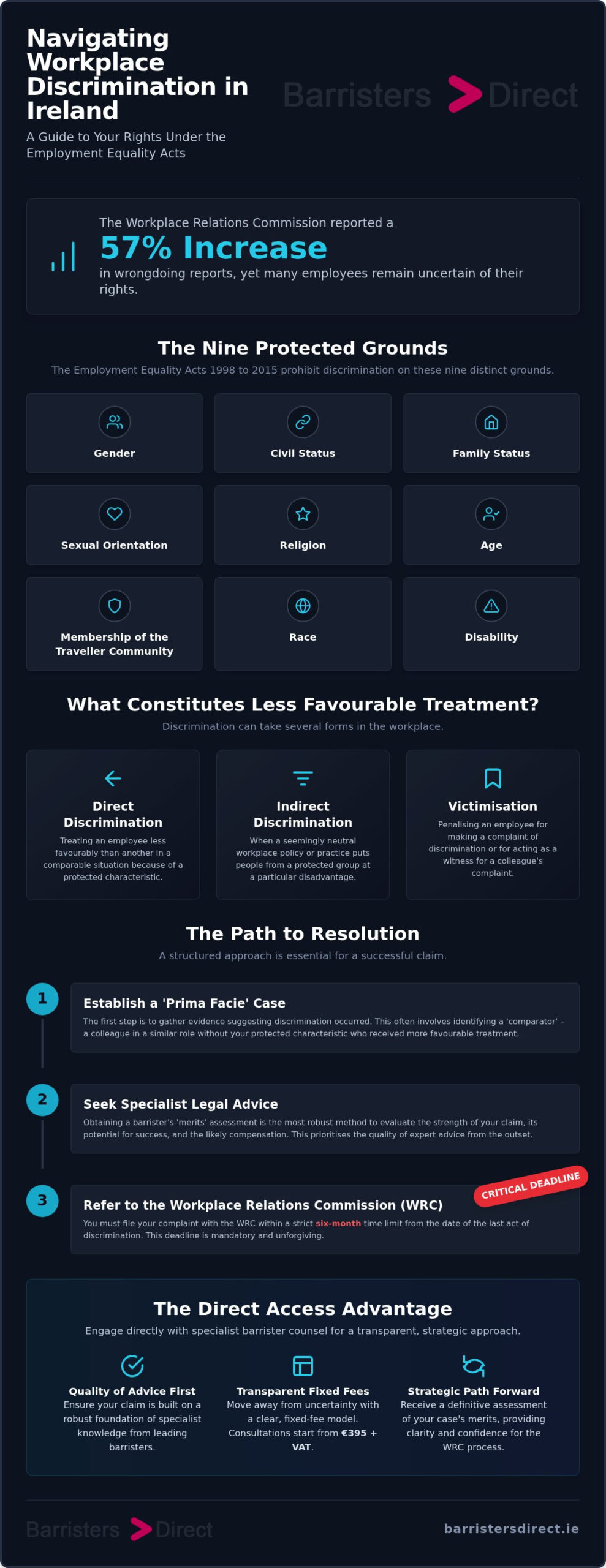
The Workplace Relations Commission reported a 57 per cent rise in wrongdoing reports in its 2025 Annual Report, yet many employees remain hesitant to act because the legal landscape feels unnecessarily opaque. If you are struggling to determine whether your experience fits within the nine protected grounds, obtaining expert workplace discrimination advice Ireland is the essential first step toward clarity. It’s common to feel overwhelmed by the strict six-month deadline for filing a claim or to worry that high-level legal expertise is reserved only for the most complex corporate disputes.
This guide provides a comprehensive breakdown of Irish employment equality law. If you require a definitive assessment of your case’s merits, then consulting with specialist barrister counsel provides the most strategic path forward. You’ll learn how to manage the WRC process with confidence, moving away from uncertainty and toward a transparent, fixed-fee model. By prioritising the quality of expert legal advice, you can ensure your claim is built on a robust foundation of specialist knowledge from the outset.
Key Takeaways
- Understand the foundational protections of the Employment Equality Acts 1998 to 2015 and how they define less favourable treatment across nine protected grounds.
- Learn how to distinguish between general workplace conflict and legally actionable claims by obtaining specialist workplace discrimination advice Ireland to establish a ‘prima facie’ case.
- Discover why a specialist barrister’s ‘merits’ assessment is the most robust method for evaluating the strength and potential compensation of a claim before entering the WRC process.
- Master the procedural requirements of the Workplace Relations Commission, including the mandatory six-month timeline for referring disputes and the shift in the burden of proof.
- Explore how the Direct Access model facilitates immediate consultation with expert legal counsel through a transparent, fixed-fee path starting at €395 + VAT.
Table of Contents
- Understanding Workplace Discrimination and the Employment Equality Acts
- Identifying Discriminatory Behaviour in Professional Environments
- The Role of Specialist Legal Advice in Discrimination Claims
- The Procedure for Making an Equality Claim in Ireland
- Direct Access to Expert Counsel for Employment Disputes
Understanding Workplace Discrimination and the Employment Equality Acts
The Employment Equality Acts 1998 to 2015 serve as the definitive framework for equality in the Irish workplace. If an employer treats an individual less favourably than another person in a comparable situation, they may be in breach of these statutes. This legislation is comprehensive, governing everything from recruitment and equal pay to promotion and dismissal. Obtaining expert workplace discrimination advice Ireland is often the only way to distinguish between a general grievance and a statutory breach. It’s essential to understand that discrimination isn’t always overt. Direct discrimination occurs when someone is treated less favourably because of a specific characteristic; indirect discrimination happens when an employer applies a policy or practice that appears neutral but puts a specific group at a disadvantage.
The Nine Protected Grounds in Irish Law
Irish law identifies nine distinct grounds where discrimination is prohibited. These include Gender, Civil Status, and Family Status, which refers to parental or caring responsibilities. The legislation also protects against bias based on Sexual Orientation, Religion, and Age, provided the individual is at least 16 years old. Additionally, Disability, Race (which encompasses nationality and ethnic origin), and Membership of the Traveller community are strictly protected. If your situation involves any of these characteristics, seeking an Employment Law Consultation through a specialist barrister allows you to determine if a legal threshold has been met.
When Does Less Favourable Treatment Occur?
Less favourable treatment often manifests in subtle ways, but its legal impact is significant. Discriminatory dismissal is a prime example, occurring when the termination of a contract is linked to one of the nine grounds. This differs from standard unfair dismissal, as it focuses specifically on the breach of equality legislation rather than just procedural fairness. Disputes frequently arise regarding the terms and conditions of employment, such as being denied a bonus or flexible working whilst colleagues in similar roles receive them. Another critical protection is victimisation. This occurs if an employer treats an employee poorly because they raised a complaint or acted as a witness in an equality case. If you intend to refer a complaint to the Workplace Relations Commission (WRC), you must establish that the treatment was directly linked to a protected ground.
Identifying Discriminatory Behaviour in Professional Environments
Not every workplace dispute constitutes a legal claim. To move beyond mere conflict, you must establish a ‘prima facie’ case. This means providing enough evidence to suggest discrimination occurred before the burden of proof shifts to the employer. For those seeking workplace discrimination advice Ireland, the first task is identifying a ‘comparator’. This is an individual in a similar position who does not share your protected characteristic but has been treated more favourably.
Patterns often emerge during promotion cycles or when training opportunities are allocated. If a specific group is consistently excluded from high-value projects or denied access to professional development, it may indicate systemic bias. For a broader overview of statutory definitions, the Citizens Information guide to equality in the workplace offers a helpful starting point. Expert counsel can help you determine if these patterns are legally actionable and how they might be presented in a formal complaint.
Harassment and Sexual Harassment
Harassment is defined as unwanted conduct related to any of the nine protected grounds that has the purpose or effect of violating a person’s dignity. This includes creating an intimidating, hostile, or offensive environment. Employers are generally held liable for the behaviour of their employees amongst the workforce unless they can prove they took reasonably practicable steps to prevent the conduct.
Indirect Discrimination and Reasonable Accommodation
Indirect discrimination is often less obvious than direct bias. It occurs when a seemingly neutral policy or practice disproportionately affects a protected group without a valid, objective business justification. In cases involving disability, employers have a proactive duty to provide reasonable accommodation. If an employer fails to make these adjustments, it constitutes a specific breach of equality legislation. If you are unsure whether your employer’s actions meet the legal threshold for a claim, consulting with a specialist barrister can provide the high-level assessment needed to decide your next steps.
The Role of Specialist Legal Advice in Discrimination Claims
While the Workplace Relations Commission provides the necessary infrastructure to lodge a complaint, they are legally prohibited from advising you on whether your case is likely to succeed. This gap in the system is where high-level workplace discrimination advice Ireland becomes indispensable. Relying on a specialist barrister’s opinion allows you to assess the ‘merits’ of your claim before you commit to a formal process.
Case Triage and Strategic Assessment
A barrister’s primary value lies in their ability to identify strategic weaknesses in an employer’s defence long before a hearing begins. If you file a claim without a robust evidentiary foundation, you risk a dismissal that could have been avoided with better preparation. Expert counsel evaluates the strength of your comparators and the clarity of your ‘prima facie’ case, ensuring you don’t pursue a path that lacks a legal basis. There are significant advantages of instructing a barrister directly for this triage phase, as it provides a direct line to the person who would eventually argue the case.
The Value of Independent Counsel
Barristers operate as independent sole practitioners, which grants them a unique level of objectivity. When you seek a specialist view, you’re getting an unvarnished assessment of the facts. This is particularly vital in complex human rights breaches or high-stakes commercial disputes where emotions can often cloud judgment. Understanding the difference between solicitors and barristers is key to utilising the legal system effectively.
The Procedure for Making an Equality Claim in Ireland
The Workplace Relations Commission (WRC) serves as the primary body for resolving employment equality disputes. If you believe your rights have been infringed, then you must refer a complaint within six months of the final act of discrimination. This timeline is strict. Once a complaint is lodged, you may be offered mediation. If mediation is declined or fails, the case proceeds to a formal adjudication hearing.
Preparing the WRC Complaint Form
The initial complaint form is more than just a bureaucratic requirement; it is the foundation of your legal argument. You must draft the ‘statement of facts’ with extreme precision, ensuring that the discriminatory grounds are clearly identified and linked to specific events. An initial consultation with a specialist barrister allows you to organise your evidence logically before you submit the form. This ensures that the most impactful facts are highlighted from the very beginning.
The Adjudication Process
An adjudication hearing is an evidence-based legal proceeding. Unlike informal internal grievances, the Adjudication Officer makes a legally binding decision based on the balance of probabilities and statutory interpretations. You should expect a structured environment where witnesses are called and cross-examination occurs. This is where specialist advocacy becomes a decisive factor.
Direct Access to Expert Counsel for Employment Disputes
The Legal Services Regulation Act has fundamentally changed how individuals and businesses access the Irish Bar. Today, the direct access model allows you to engage with specialist barristers for expert advice without the immediate requirement for a solicitor’s retainer for an initial meeting. Barristers Direct facilitates this modern approach, providing a transparent bridge between those in need of high-level expertise and a nationwide network of over 100 barristers.
Fixed-Fee Consultations and Process
Transparency is a core component of the Barristers Direct model. If you require a professional consultation, then you can choose a fixed-fee structure that suits your specific situation. A barrister-only consultation is available for €395 + VAT, providing a direct line to specialist insights. For more contentious matters where a broader legal perspective is beneficial, a consultation with a solicitor present is available for €595 + VAT. These meetings are conducted via Zoom, Microsoft Teams, or telephone.
Post-Consultation Deliverables
The value of the consultation extends beyond the meeting itself. Every session includes the automatic generation of an audio recording and an AI-generated synopsis, which is provided to both the user and the barrister. There is no obligation for further engagement, allowing for a risk-free ‘path forward’ assessment of your discrimination claim.
Securing Your Professional Path Forward
Vindicating your rights under the Employment Equality Acts requires more than a sense of grievance; it demands a precise application of the law to the facts of your situation. You’ve seen that identifying the correct protected ground and adhering to the strict six-month WRC deadline are non-negotiable steps. By obtaining expert workplace discrimination advice Ireland early in the process, you can move from a position of uncertainty to one of strategic clarity.
Frequently Asked Questions
What are the 9 grounds of discrimination in Ireland?
The nine protected grounds under the Employment Equality Acts 1998 to 2015 include gender, civil status, family status, sexual orientation, and religion. Protection is also provided on the basis of age (for those 16 and over), disability, race (which encompasses nationality or ethnic origin), and membership of the Traveller community.
How long do I have to make a workplace discrimination claim?
You must refer a complaint to the Workplace Relations Commission within six months of the most recent occurrence of discrimination.
Can I get legal advice from a barrister without a solicitor?
Yes, the Legal Services Regulation Act allows members of the public and businesses to engage barristers directly for legal advice.
What is the difference between unfair dismissal and discriminatory dismissal?
Unfair dismissal generally focuses on whether an employer followed fair procedures, while discriminatory dismissal occurs when the termination is specifically linked to one of the nine protected grounds.
What does a fixed-fee legal consultation include?
A fixed-fee consultation includes a scheduled meeting with a specialist barrister, expert advice on the merits of your claim, and an audio recording and AI-generated synopsis of the meeting.
What is the role of the Workplace Relations Commission (WRC) in discrimination cases?
The Workplace Relations Commission (WRC) is the central body responsible for investigating and adjudicating employment equality disputes in Ireland.
Can an employer be held liable for harassment by another employee?
Employers can be held vicariously liable for harassment or sexual harassment carried out by one employee against another unless they can prove they took reasonably practicable steps to prevent the harassment.
Is there a specific fee for a direct access barrister consultation?
A meeting with a specialist barrister alone costs €395 + VAT. A consultation with both a barrister and a solicitor present is available for €595 + VAT.