
Full article
Published 12/11/2026
A judicial separation in Ireland allows spouses to formalise arrangements while remaining married. Unlike divorce, it does not end the marriage or allow either spouse to remarry.
Whether to make an agreement or apply to court depends on what the couple can resolve together and which issues need a formal decision. A written separation agreement can record agreed arrangements, but it does not dissolve the marriage.
This guide explains what a judicial separation order does, how an agreement works and how living apart relates to later divorce proceedings. These distinctions can help you identify which questions need tailored legal advice before deciding what to do next.
Key Takeaways
- Understand which financial and parenting arrangements a court may consider, and what “proper provision” means for spouses and dependent children.
- Learn how living apart under the same roof may be treated, and why the nature of the relationship matters.
- See how a written agreement can record arrangements and how agreed terms may be made enforceable through the courts.
- Find out why property is not automatically divided equally and which factors can shape financial arrangements.
- Explore how specialist legal advice can help you assess your options and plan your next steps.
Table of Contents
- What is a decree of judicial separation?
- What is the difference between being divorced and being legally separated?
- Judicial separation
- Separation agreements
- Marital separation and divorce proceedings
- Barristers Direct
What is a decree of judicial separation?
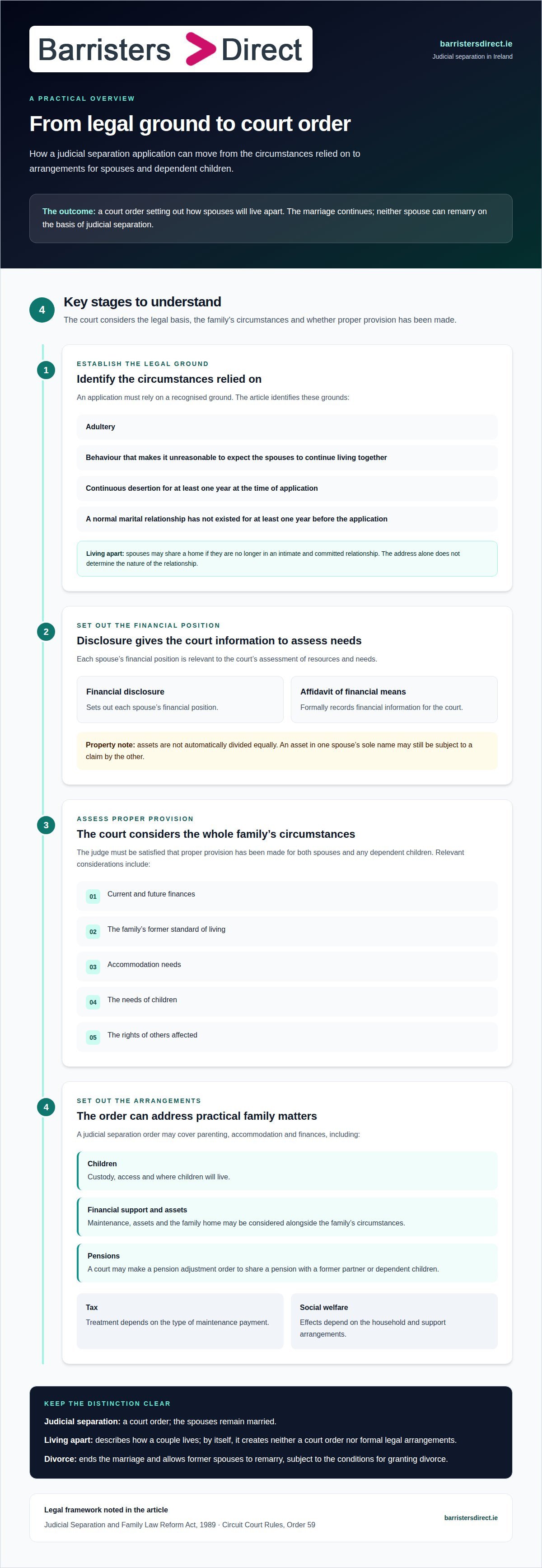
A decree of judicial separation is a court order setting out how spouses will live apart while remaining married. It can address parenting, accommodation and finances. The court must be satisfied that proper provision has been made for the couple and any dependent children.
Financial and Parenting Arrangements
The arrangements cover practical decisions about children, the family home and financial support. The order must address the needs of both spouses and any dependent children, not simply record that the relationship has ended.
For children, arrangements can cover custody, access and where they will live. Financial matters may include maintenance, assets and pensions. When assessing proper provision, an Irish judge considers current and future finances, the family’s former standard of living, accommodation needs, children’s needs and the rights of others affected.
The family home is considered alongside other assets. An asset held in one spouse’s sole name may still be subject to a claim by the other, so ownership on paper does not settle the issue. For example, accommodation needs may affect arrangements for the home even if it is registered to one spouse.
Disclosure, Pensions and Tax Effects
Financial disclosure sets out each spouse’s financial position, while an affidavit of financial means formally records financial information. The court needs these details to assess resources and needs before deciding whether proper provision has been made.
A court may also make a pension adjustment order to share a pension with a former partner or dependent children following judicial separation, divorce or dissolution.
Tax treatment depends on the type of maintenance payment. Social welfare effects depend on the household and support arrangements, so there is no single outcome for every family. These distinctions matter when assessing the practical effect of an agreement or court order.
In short, tax, pension and social welfare effects depend on the particular arrangement. Maintenance tax treatment varies by payment type, a court may order pension sharing, and social welfare consequences depend on the household’s circumstances.
What is the difference between being divorced and being legally separated?
Divorce ends a marriage; judicial separation does not. Legally separated spouses remain married, so neither a separation agreement nor a deed of separation allows them to remarry. Living apart describes how a couple lives and, by itself, creates neither a court order nor formal legal arrangements.
Living separately does not always require two homes. For judicial separation in Ireland, spouses can share a home if they are no longer in an intimate and committed relationship. A relationship is not considered non-intimate solely because it is no longer sexual. The nature of the relationship matters, not just the address on each spouse’s correspondence.
This distinction can affect future legal steps. A spouse may seek judicial separation if a normal marital relationship has not existed for at least one year before the application. Continuous living apart for at least one year immediately before applying is another route. A spouse may also seek it where the other has deserted them continuously for at least one year at the time of application, or has behaved in a way that makes continued cohabitation unreasonable.
A deed of separation has a specific consequence: a spouse who has signed one with the other spouse cannot then bring judicial separation proceedings. Understand what a document does before signing it. Neither a deed nor an agreement dissolves the marriage. A divorce decree does, and allows former spouses to remarry subject to the conditions for granting divorce.
Legal and family support can help spouses understand options and communicate about arrangements, particularly where children are affected. Mediation is voluntary for parties to a family-related dispute under the Mediation Act 2017. It offers a process for discussing disagreements, but it does not itself turn the parties’ decision into a divorce or court order.
Solicitor costs and access to legal aid are separate practical considerations. Costs depend on the advice and work required, so no single figure applies to every family. Legal aid has its own eligibility and application requirements; living apart alone does not establish whether someone qualifies. Before applying, identify the legal issue and the documents that explain your circumstances. This helps you assess the available route to representation.
Solicitors can advise on documents, court procedure and the implications of proposed arrangements. If you need advice specific to your family’s circumstances, consider seeking legal advice before deciding whether to sign an agreement or pursue court proceedings.
Judicial separation
In Ireland, judicial separation is a formal court process for married spouses who will live apart. A judge makes an order; an informal arrangement alone is not a judicial separation.
Grounds for Judicial Separation
Grounds are the legal reasons a spouse can rely on to seek an order, and they determine whether an application can proceed. In Ireland, adultery is a ground. So is behaviour that makes it unreasonable to expect the spouses to continue living together.
Other grounds include one spouse’s continuous desertion for at least one year at the time of application. A spouse may also apply if a normal marital relationship has not existed for at least one year before the application. These are distinct grounds, so clearly identify the circumstances relied on.
Applying for a Decree
An application asks the court to make a formal order setting out the terms on which the spouses will live apart. The process is similar to applying for divorce, but judicial separation does not dissolve the marriage.
The Judicial Separation and Family Law Reform Act, 1989 is identified for judicial separation applications, according to the Irish Statute Book. The Circuit Court Rules, specifically Order 59, set out the relevant rules and procedures.
Eligibility also depends on an Irish connection. Either the applicant or their spouse must be permanently living in Ireland, and the applicant must have lived in Ireland for at least one year before applying. These requirements concern where proceedings may be brought, not the grounds for seeking an order.
Living apart does not always mean living at separate addresses. For an application, spouses may share a home if they are no longer in an intimate and committed relationship. A relationship is not treated as non-intimate solely because it is no longer sexual. The court considers the nature of the relationship, not just the household address.
A judge deciding the application considers any agreement between the spouses and existing court orders. For example, an order about children is relevant. The judge assesses the case in light of those arrangements and the legal grounds relied on.
If granted, the decree is a court order setting out the terms on which the spouses live apart as a married couple. It formalises their legal arrangements but leaves them married. Neither spouse can remarry unless the marriage is later dissolved by divorce.
Separation agreements
In Ireland, spouses can use a written agreement to record arrangements for living apart. This provides a consensual route alongside judicial separation.
Agreeing Separation Arrangements
A separation agreement is a legally binding written contract setting out arrangements agreed by the spouses. Clear terms can reduce uncertainty about practical responsibilities after they begin living separately.
The agreement can cover the family home, children, finances, assets and pensions. For example, it may record where a child will live, how parents will share care and how household costs will be met. Married couples and civil partners who agree to live separately may enter into one.
Can spouses make a separation agreement without going to court in Ireland? Yes. Spouses can agree and sign a written contract without first obtaining a court order. If they want the agreed terms to be enforceable by the courts, they can ask for the agreement to be made a rule of court.
Good drafting makes each arrangement specific. For the family home, set out the practical arrangement rather than saying the couple will decide later. Terms about children can record agreed living and care arrangements. Financial provisions can specify maintenance obligations, while asset and pension provisions can address those matters directly.
Legal advice before signing can help each spouse understand the contract, its commitments and how its terms apply to their circumstances. Disagreements about the home, maintenance or parenting can have consequences beyond the immediate issue, so the agreement should cover the matters the couple has actually resolved.
Mediation and Consent Orders
Mediation is a voluntary process in which parties discuss disputed arrangements with a mediator. It gives a couple an opportunity to explore solutions before deciding whether unresolved issues need court involvement.
Under the Mediation Act 2017, parties to a family-related dispute may engage in mediation voluntarily. The process can help them work through specific disagreements, such as arrangements for children or financial terms. Mediation does not make participation compulsory, and it does not itself turn proposals into a court order.
If spouses reach agreement, they can record the terms in writing. To seek court enforceability, they can ask for the agreement to be made a rule of court. This distinguishes signing a contract from having agreed terms enforceable through the courts, which may matter if a spouse later fails to meet an obligation.
The Family Law (Maintenance of Spouses and Children) Act, 1976 provides for an agreement containing maintenance terms to be made a rule of court. This connects agreed maintenance with a court enforcement route. If discussions remain unresolved, mediation may help clarify which terms are acceptable and which still require a decision. Seeking advice on proposed legal terms can help spouses understand the effect of an agreement before signing.
Marital separation and divorce proceedings
Living apart and ending a marriage are different legal stages. In Ireland, divorce dissolves a marriage, while judicial separation leaves spouses married.
Divorce Eligibility and Living Apart
Divorce eligibility includes a requirement to have lived separate and apart for 2 out of the previous 3 years. This period matters because living apart alone does not dissolve a marriage or make either spouse free to remarry.
Time spent living separate and apart under the same roof counts towards the required period. The key question is not simply whether spouses share an address. A divorce decree also depends on meeting the conditions for granting divorce.
Divorce and Civil Partnerships
A divorce decree formally dissolves a marriage, while a dissolution decree formally ends a civil partnership. Each decree applies to a different legal relationship.
After divorce, former spouses may remarry, subject to the conditions for granting divorce. A dissolution decree ends a civil partnership, also subject to conditions. Neither outcome should be confused with a private agreement or simply living apart.
Financial arrangements are considered as part of the legal process, but there is no automatic presumption that marital property will be divided equally, such as on a 50/50 basis. The value and ownership of assets are not the only relevant questions. A family-law matter may also involve children, accommodation, maintenance and pensions, so proposed terms need to be understood as a whole.
For example, spouses may agree where children will live and how care will be arranged, while still needing clarity about the financial consequences. A court order and a private agreement have different legal forms. A divorce decree ends the marriage, but the terms made in the proceedings still matter to practical arrangements.
A divorce granted abroad raises a separate question: whether it is recognised for legal purposes in Ireland. Do not assume a foreign decree has the same effect here. Recognition can matter if either former spouse intends to remarry or needs to rely on the divorce in family-law matters. The particular decree and applicable recognition rules are relevant.
Before relying on an overseas divorce, have the decree and its legal effect assessed for your circumstances. This is especially relevant if a later marriage or a family-law decision depends on your marital status. Seek expert legal advice on your divorce proceedings to understand how the decree and related arrangements affect your next steps.
Barristers Direct
Barristers Direct connects individuals in Ireland with a specialist barrister for advice on their legal position. If you are weighing a court order against an agreement, or considering how either may relate to later divorce proceedings, a focused consultation can clarify the issues and possible next steps.
Barristers Direct matches you with a barrister whose expertise relates to your legal matter. The initial consultation is offered for a fixed fee, with no further fee charged for that meeting. It can help you identify the questions to resolve before deciding on family arrangements or court proceedings.
If you would like to discuss your circumstances, contact Barristers Direct.
Make your next decision with clarity
Decisions made during separation can shape family life and finances well beyond the immediate change in living arrangements. Before committing to a course of action, consider what you need to resolve, what matters most to your family and what legal advice will help you make an informed decision.
Specialist family law advice can help you assess your options and understand the implications of proposed arrangements. It can also help you prepare for a discussion or court process with a clearer view of the issues. The right next step depends on your circumstances and begins with a sound understanding of your legal position.
For advice tailored to your situation, contact Barristers Direct for advice. A considered decision today can help you move forward with greater confidence.
Frequently Asked Questions
Why would I bother getting legally separated if I cannot remarry?
A court order can formalise arrangements even though the marriage continues. This can provide clear terms for finances, children or the home instead of relying on informal discussions. It may also address inheritance rights: a legal separation can set out that a surviving spouse is not entitled to part of the deceased spouse’s estate. The value of formal arrangements depends on what the couple needs to resolve.
What is the difference between separation and divorce in Ireland?
Judicial separation leaves the marriage legally in place; divorce dissolves it. This affects whether either person can remarry and their legal status. A separation agreement is a contract, not a divorce decree. To end their marriage, spouses need a divorce decree and must meet the relevant conditions. A civil partnership ends by dissolution decree, not divorce.
What are the rules for dividing property and assets after separation in Ireland?
There is no automatic rule that marital assets are divided equally, such as on a 50/50 basis. A court considers proper provision for spouses and dependent children, including current and future finances, accommodation needs and the family’s pre-break-up standard of living. An asset in one spouse’s sole name may still be subject to a claim by the other. Ownership documents alone do not settle every claim.
How are child custody, access and maintenance decided after separation in Ireland?
Arrangements can cover custody, access and where children will live, as well as financial support. In court proceedings, proper provision for dependent children is central. The judge considers the children’s circumstances and the family’s financial position rather than treating one arrangement as suitable for every family. For example, a proposed living arrangement needs to be assessed alongside each parent’s accommodation and ability to meet the children’s needs.
What financial maintenance can a spouse claim after separation in Ireland?
Maintenance may be included in an agreement or considered by a court as part of proper provision. The financial picture includes each spouse’s current and future resources, accommodation needs and the family’s former standard of living. Tax treatment depends on the type of maintenance payment. A written agreement can record maintenance terms, which may be made a rule of court.
What happens to the family home when a couple separates in Ireland?
The home may be addressed through a written agreement or a court order, with accommodation needs considered alongside other financial circumstances. The Family Home Protection Act 1976 protects a married couple’s family home by preventing one spouse from acting in relation to it without the other spouse’s consent. A home registered in one spouse’s sole name may still be subject to a claim by the other spouse.
How long must spouses be separated before they can divorce in Ireland?
Spouses must have lived separate and apart for 2 out of the previous 3 years to be eligible for divorce in Ireland. Time living separate and apart under the same roof can count towards that period. Sharing an address therefore does not automatically prevent the time from counting. Eligibility also depends on the other conditions for granting a divorce being met.
Where can people in Ireland get legal aid or support when separating?
People can discuss their circumstances with a solicitor and ask about legal aid and the application route relevant to their case. Family-related disputes may also be discussed through voluntary mediation under the Mediation Act 2017. Mediation can help a couple explore agreed arrangements, but participation is voluntary. A solicitor can explain how legal advice, mediation and any court process relate to the issues that need resolving.
Disclaimer
_This article does not constitute legal advice. Barristers Direct does not provide legal advice. To obtain legal advice, you should contact a legal practitioner._