
Full article
Published 26/10/2026
The cause of a collision can affect who is responsible and what claim may follow. In Ireland, an injured person generally has two years to bring a road traffic accident claim. Injury claims may involve an assessment process before court proceedings, and the time involved can vary. Road traffic accident legal advice in Ireland can help you understand the process and preserve important details from the outset.
After a collision, it’s natural to focus on injuries, vehicle damage and what happens next. The steps you take, the evidence available and how responsibility is assessed can all affect how a claim progresses.
This article explains what can affect claim timelines, which losses may be claimed and what information or reports to gather after a crash. It also covers common causes of road traffic accidents, helping you understand how the circumstances may shape your next steps.
Key Takeaways
- Keep a clear record of the collision, including photographs, witness details and any dashcam footage.
- Write down the other driver’s identifying and insurance details, and notify your insurer promptly.
- Seek medical attention and retain records of treatment, time off work and accident-related expenses.
- How a collision happened can affect how responsibility is assessed, so preserve evidence that helps explain the circumstances.
- Specialist legal advice can help you understand your options and the steps involved in pursuing a claim.
Table of Contents
- How long does a road traffic accident claim take?
- Compensation for income loss, vehicle repairs and medical expenses
- Exchanging driver and insurance details
- Reporting an accident to An Garda Síochána
- Common causes of road traffic accidents
- Barristers Direct: Commercial Dispute Resolution
How long does a road traffic accident claim take?
There is no single timetable for every road traffic claim in Ireland. The process may involve gathering evidence, assessing injuries, establishing responsibility and, if necessary, court proceedings. Road traffic accident legal advice in Ireland can help you identify the relevant time limit and understand the steps involved.
An injured person generally has two years to bring a road traffic accident claim in Ireland. Treat that deadline as a limit, not a target: gathering medical evidence and preparing a claim takes time. If symptoms appear after the collision, note when they began and seek medical attention promptly. Early advice can help identify the relevant deadline and organise the information needed to progress your claim.
An assessment process may form part of the route before court proceedings. An assessment often takes around nine months, although the duration varies by case. That period is not the total claim timeline. The process may take longer if injuries need further assessment, responsibility is disputed or court proceedings are required.
Claims may involve different people and types of loss. An injured driver or passenger may pursue a personal injury claim, as may injured pedestrians, cyclists and bystanders. A road accident claim may also include damage to a vehicle or personal belongings. Keep injury evidence separate from records of repair or property costs, as each may require different documentation.
Hit-and-run collisions and accidents involving uninsured or unidentified vehicles need particular attention. If the other driver cannot be identified or is uninsured, contact the Motor Insurers’ Bureau of Ireland (MIBI) about a potential compensation claim. Preserve photographs, witness details, dashcam footage and any Garda report. Witness accounts or vehicle registration details may help establish what happened after a driver left the scene.
Solicitor fees and legal costs depend on the case and are given after a quote request; relevant factors include the work required, the evidence and whether liability is contested. Under section 149 of the Legal Services Regulation Act 2015, a legal practitioner in contentious business may not calculate fees or other charges as a percentage or proportion of an award or settlement, according to the Irish Statute Book.
For road traffic accident legal advice in Ireland, prepare a dated record of key events, medical appointments and claim correspondence. It gives an adviser a clear chronology to consider alongside the evidence and applicable deadlines.
Compensation for income loss, vehicle repairs and medical expenses
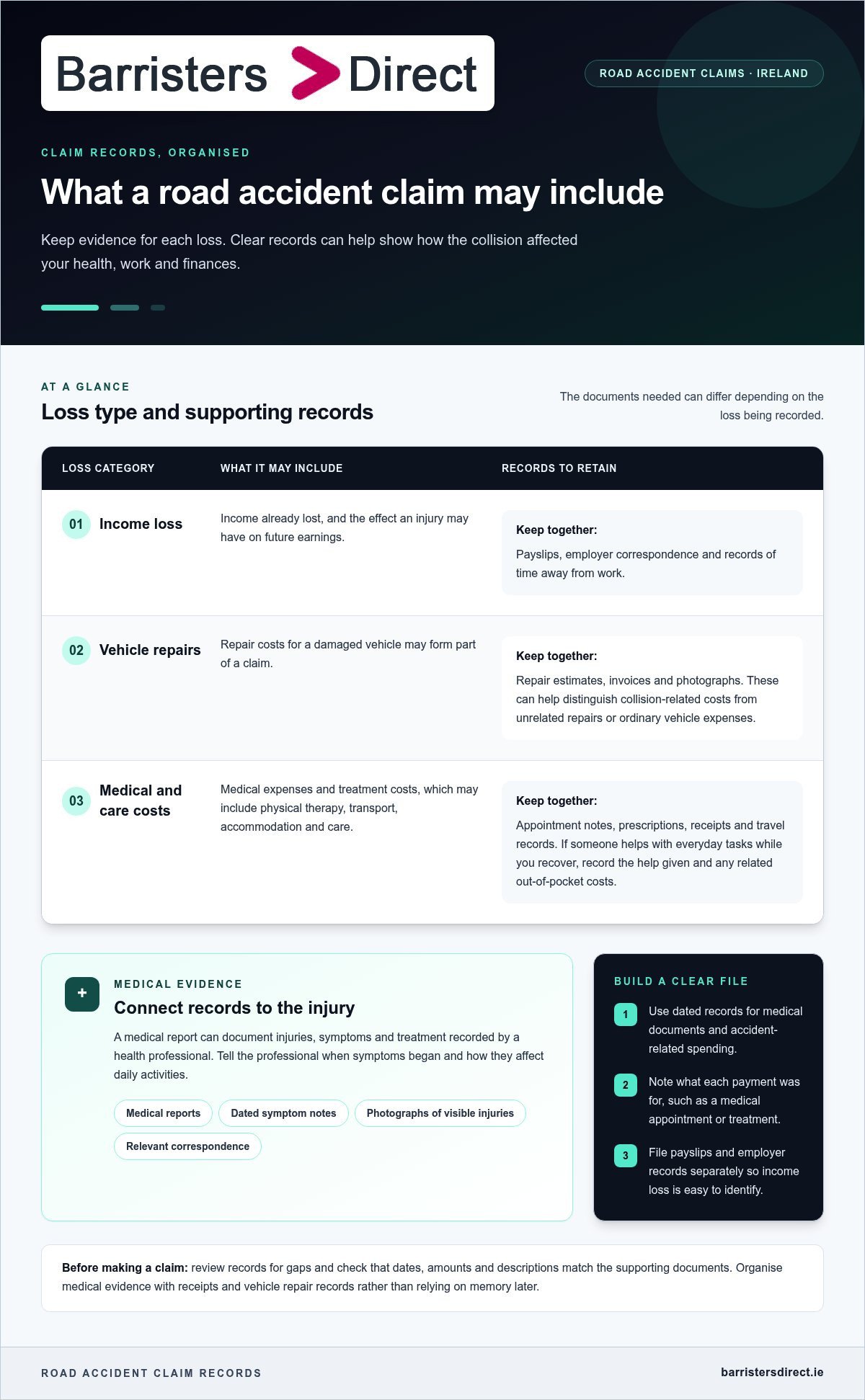
A road accident claim may involve injury-related losses as well as property damage. Keep evidence for each expense, as records help show how the collision affected your health, work and finances.
Income loss and vehicle repairs
Compensation may include income already lost and the effect of an injury on future earnings. Keep payslips, employer correspondence and records of time away from work together, so you can explain the loss clearly. For a damaged vehicle, retain repair estimates, invoices and photographs. These documents help distinguish collision-related costs from unrelated repairs or ordinary vehicle expenses.
Medical and care expenses
Medical expenses and treatment costs may form part of an accident claim. These can include physical therapy, transport, accommodation and care. Seek medical attention promptly after a collision, even if an injury seems minor, and follow the treatment plan provided. If someone helps with everyday tasks while you recover, record the help given and any related out-of-pocket costs.
Keeping medical and expense records
Create a dated file for medical documents and accident-related spending. Keep appointment notes, prescriptions, receipts and travel records together, and note what each payment was for. For example, record whether a journey was for a medical appointment or treatment. File payslips and employer records separately so income loss is easy to identify. Consistent records help connect each expense to the injury and its effects.
Evidence and medical reports
A medical report can document injuries, symptoms and treatment recorded by a health professional. Tell the professional when symptoms began and how they affect daily activities, then keep copies of relevant reports and correspondence. Photographs of visible injuries and dated notes of changing symptoms can provide useful context. Organise this evidence with receipts and vehicle repair records rather than relying on memory later.
Review the records for gaps before making an accident claim: check that dates, amounts and descriptions match supporting documents. If a medical record raises a separate concern about negligent treatment, medical negligence legal advice can help you understand that issue. Keep it distinct from evidence about the road collision itself.
Exchanging driver and insurance details
Accurate details help identify the drivers, vehicles and insurers involved in a collision. Record the information clearly, then notify your insurer promptly, even if you don’t believe you caused the accident.
Exchange each driver’s name and address, vehicle registration number and motor insurance details, including the policy expiry date. Check that the registration matches the vehicle, and note the time and place of the exchange. If a Garda is not present, a driver must provide specified information when requested by an injured person, someone acting for them, a property owner or representative, or an independent witness if none of those people are present. The information includes the driver’s name and address, where the car is kept, the owner’s name and address, and the vehicle’s registration and insurance details.
If details are missing or a driver leaves before exchanging them, write down what you observed and pass it to Gardaí. Leaving the scene without exchanging details is a criminal offence. If no Garda is present, report the collision at a Garda station as soon as possible. Record any reference details you receive and keep them with your photographs, witness contacts and correspondence.
Notify your insurer as soon as possible and provide an accurate account. Many Irish motor insurance policies require notification within 24 to 48 hours, regardless of fault. Check your policy wording and keep a copy of your notification. If you’re unsure about a detail, distinguish what you saw from what you inferred. Avoid statements that could be interpreted as admitting negligence; give a factual account instead.
Before accepting an insurer’s settlement offer, get legal advice on whether it reflects the available evidence, injuries and losses. Compare the offer with your records, including medical information and documented expenses, and ask the insurer to explain the basis of its assessment in writing.
To complain about an insurer or challenge its decision, write to its complaints team. Set out the decision you dispute, explain why and attach relevant records or correspondence. Keep copies and request a written response. This creates a clear record of the issue and the insurer’s reasoning.
Keep communications about an injury claim separate from routine insurance correspondence. For example, save letters and emails relating to the Injuries Resolution Board with their dates and any response deadlines. If a solicitor is handling communications, promptly share new insurer letters and documents so they can account for the latest position.
When a driver, insurer or witness gives information by telephone, note their name, the date and the substance of the conversation. Follow up important points in writing. A dated, consistent record can help resolve differences about what was said and keep communications clear as the claim progresses.
Reporting an accident to An Garda Síochána
Report a collision promptly if someone is injured or property is damaged. A Garda record can document the incident and help address later questions about liability.
In Ireland, legal obligations after a motor collision are set out in Section 106 of the Road Traffic Act 1961 (as amended), according to the Irish Statute Book. If anyone is injured, call 999 or 112 and contact Gardaí immediately. Wait for them to arrive when someone is hurt. After a serious collision, don’t move the car unless necessary for safety or directed by Gardaí.
If no Garda attends the scene, report the collision to a nearby Garda or at a Garda station as soon as possible. This applies when a collision causes injury or damage to a vehicle or other property. If nobody is injured, either party can report it to Gardaí at the scene or at the nearest station. Give a clear account of the location, time, vehicles involved and damage observed.
Keep your report factual. Describe what you saw rather than guessing about speed, distance or another driver’s intentions. If you’re unsure about a detail, say so. A useful account might identify the junction, direction of travel, road conditions and sequence of events. Separate your observations from anything another person told you. This helps Gardaí record the circumstances accurately.
When Gardaí attend, note the investigating Garda’s name and any reference details provided. Record when and where you made a report if you attend a station later. Keep that information with photographs, witness details and insurer correspondence. If the collision involved damage to a wall, sign or other property, identify what was damaged and where it was located.
- Injury: call 999 or 112, contact Gardaí immediately and wait for their arrival.
- No Garda at the scene: report the collision to a nearby Garda or Garda station as soon as possible.
- Serious collision: avoid moving the car and follow Garda instructions.
- After reporting: keep the investigating Garda’s details and any report reference with your records.
Reporting a collision and making a compensation claim are separate steps. A Garda report records information about the incident; it does not, by itself, decide who is legally responsible. If accounts differ, preserve your notes and supporting evidence. For example, record each vehicle’s direction of travel and where it stopped rather than drawing conclusions about liability.
Prompt reporting gives Gardaí an opportunity to record relevant details while events are recent. If you later need to explain the collision to an insurer or as part of a claim, use the same accurate timeline and distinguish confirmed facts from recollection.
Common causes of road traffic accidents
Speeding is a serious road safety danger in Ireland: it makes up 40% of fatal crashes. The Road Safety Authority also identifies preventable behaviour as a common factor in road collisions. These points give a useful starting place, but they don’t establish the cause of any individual crash. That depends on the evidence about what happened.
Speed can affect how much time a driver has to respond and how severe a collision becomes. For example, if one vehicle strikes another at a junction, relevant questions include each vehicle’s direction, position and movements before impact. Treat a speed estimate as unconfirmed unless evidence supports it. Photographs, witness accounts and available dashcam footage may help establish the sequence.
The RSA’s observation about preventable behaviour covers more than speeding. It focuses on decisions and actions leading up to impact, rather than just the damage afterwards. Record what you personally saw, such as a vehicle’s movement or the location of impact. Separate those observations from assumptions about another driver’s attention, intentions or speed.
Road conditions and the setting of the collision provide useful context. Note the junction, road layout, visibility and surface conditions as they appeared at the time. If the crash happened near a bend, for instance, record where the vehicles came to rest and what could be seen from each approach. These details help explain the scene, but do not, by themselves, prove legal responsibility.
Preserve relevant evidence as soon as possible after a collision. If it is safe and practicable, photograph the scene and vehicle positions before the cars move. Keep the original files, note when the photographs were taken and collect witness contact details. If a witness describes what they saw, record their words accurately rather than turning them into a conclusion about liability.
- Speed: distinguish a measured or recorded fact from an estimate.
- Movements: note each vehicle’s direction, position and actions before impact.
- Scene: capture the road layout, visibility and surface conditions.
- Accounts: preserve witness details and dashcam footage, and record observations separately from assumptions.
For personal injury claims, the cause matters because evidence can help explain how the collision occurred and whether another person’s actions contributed. A serious injury does not, on its own, prove fault; nor does partial responsibility necessarily rule out a claim. If you’re injured, organise the evidence and seek legal advice soon as possible. Discuss your personal injury claim with a legal professional if you need help understanding the evidence and your options.
Barristers Direct: Commercial Dispute Resolution
Barristers Direct arranges expert consultations with specialist barristers, including on commercial dispute resolution. If a road collision has also led to a dispute involving a business, contract or unpaid debt, a consultation can help clarify the legal issues, assess relevant documents and identify practical next steps. This is separate from assessing personal injury losses or vehicle damage: the key question is whether a distinct commercial dispute has arisen.
Bring relevant contracts, correspondence, invoices and a concise timeline to an initial consultation. Clear records help counsel understand the dispute and focus advice on the issues that matter. If you have a business dispute connected with the aftermath of a collision, contact Barristers Direct to arrange a fixed-fee initial consultation.
Choose a clear next step
After a collision, organise your records and identify the legal question that needs attention. If you’re considering a claim, road traffic accident legal advice in Ireland can help you understand how the evidence, injuries and losses relate to your options.
Barristers Direct arranges fixed-fee initial consultations with specialist barristers, including for personal injury legal advice. Other areas include commercial dispute resolution, wills and probate legal advice, and employment law consultation. The relevant area depends on the issue you need advice about.
A focused discussion can help you understand the relevant considerations and decide how to proceed. Contact Barristers Direct for advice about your circumstances and the legal guidance you need.
Frequently Asked Questions
What Types of Injuries can I Claim for?
Injuries that may be relevant to a personal injury claim include whiplash, neck or back injuries, concussion and soft tissue injuries. Psychological pain and suffering may also be relevant. Symptoms can appear hours or days after a collision, so note when they begin and how they affect daily activities. Seek medical attention promptly, even if pain seems minor, and follow the treatment advice you receive.
Can I make a claim if the accident was only partly my fault?
Yes. Partial responsibility does not automatically prevent a claim in Ireland. Someone injured in a collision that was not their fault, or was only partly their fault, may have a valid compensation claim. The circumstances and evidence matter, including each driver’s actions and the sequence of events. Avoid deciding fault based only on an apology or an initial impression at the scene.
Should I contact a solicitor immediately?
Seek legal advice promptly because time limits apply to personal injury claims in Ireland. Early advice can help identify relevant deadlines, evidence and next steps, particularly if another driver disputes responsibility. A solicitor can advise on the claim and its progression. If you’re still receiving treatment, keep relevant medical records and explain any developing symptoms during your consultation.
Should I contact my insurance company?
Yes. Notify your insurer as soon as possible and give an accurate account, even if you believe the other driver caused the collision. Many Irish motor insurance policies require notification within 24 to 48 hours, regardless of fault. Check your policy for its reporting requirements, record when you notified the insurer, and keep copies of any forms or correspondence exchanged.
What Counts as Evidence?
Evidence may include photographs of the scene and damage, witness contact details, dashcam footage, medical records, repair documents and written accounts. Preserve original files where possible, with dates and context, and avoid editing footage or images. For example, a photograph showing a damaged vehicle’s position may help explain the circumstances. Evidence should support what happened, not assumptions about another person’s actions.
What Should I Do Next?
Start by keeping a dated record of appointments, symptoms, correspondence and expenses. Use separate folders for medical information, vehicle damage and insurer communications, so documents are easy to find. If you receive a settlement proposal, read its terms carefully and seek legal advice before accepting. A clear timeline also helps you explain what has happened since the collision and what remains unresolved.
What are my legal obligations?
After a motor collision in Ireland, a driver must stop and remain at the scene for a reasonable time. The driver must provide appropriate assistance to injured people. If Gardaí are absent, drivers may also have to provide identifying and insurance details when requested by people specified in the law. Section 106 of the Road Traffic Act 1961 (as amended) sets out legal obligations after a collision.
What should I do if I am involved in a motor collision?
First, prioritise anyone who may be injured. Call 999 or 112 if someone has been hurt, and use hazard lights to alert nearby traffic. If safe, note the vehicles’ positions and the conditions at the scene before anything changes. Exchange details with the other driver, identify witnesses, and report the collision to Gardaí as required. Keep your account factual and seek medical care for symptoms.
Disclaimer
_This article does not constitute legal advice. Barristers Direct does not provide legal advice. To obtain legal advice, you should contact a legal practitioner._