

Full article
Published 10/10/2026
When negotiating an exit package in Ireland, the headline payment is only one part of the offer. Notice pay, accrued annual leave, any additional payment and the wording of the agreement can all affect what you receive and what you agree to in return. Looking at each term separately makes it easier to spot what is clear, what needs clarification and what matters most to you.
It’s understandable to hesitate before questioning an offer, particularly if you’re concerned that negotiating could complicate matters. A measured response starts with understanding the package as a whole and identifying your priorities. This guide explains how to review the offer, prepare an evidence-led position and decide when specialist employment advice could help you understand your options. If the proposed terms or their implications are difficult to assess, Barristers Direct can arrange a paid initial consultation with a qualified employment-law barrister. The barrister provides any advice, so you can consider the issues before deciding how to respond.
Key Takeaways
- Treat an exit offer as a set of financial and non-financial terms, not simply a headline sum.
- Before negotiating an exit package, gather the offer, relevant employment documents and communications, then identify your priorities.
- Compare each proposed term separately and note any details that remain unclear before deciding what to request.
- Keep your response calm and specific: clarify the offer, explain your priorities and record what you propose.
- If the wording, disputed facts or personal consequences are difficult to assess, a specialist employment-law consultation may help you understand your options.
Table of Contents
- Negotiating an exit package: what the offer may include
- How to prepare before negotiating an exit package
- How to compare an exit package beyond its headline figure
- How to negotiate an exit package: a measured response
- When specialist advice can help with an exit package
Negotiating an exit package: what the offer may include
An exit package is a proposed set of terms for ending an employment relationship. It may combine financial and non-financial terms, but the exact mix depends on the circumstances and the documents involved. The headline payment is just one part of the proposal to review.
For an executive, the written offer might also address notice, accrued entitlements, bonus arrangements, benefits or reference wording. Some terms may be expressly included; others may be unclear or absent. Severance Package Overview provides general context on the elements a severance package can contain, although local rules and individual agreements vary.
Read the proposal alongside your employment contract and any relevant incentive or benefits documents. Make a note of what is confirmed, what is conditional and what needs clarification. For example, a stated payment may not explain how a bonus is treated, whether benefits continue during a notice period or what reference wording is proposed. Those details can matter as much as the headline figure when negotiating an exit package.
Which terms might appear alongside a payment?
Depending on the offer, check whether it addresses:
- Notice: Whether notice will be worked, paid or dealt with another way under the proposal.
- Accrued entitlements: Any outstanding annual leave or other amounts identified in the documents.
- Bonus or incentives: How a pending, discretionary or performance-related payment will be treated.
- Benefits: Whether items such as health cover or other benefits continue, and for how long.
- Reference and communications: Any proposed wording for a reference or announcement of your departure.
These are issues to examine, not terms that apply automatically to every exit. Contract wording, company arrangements and your individual circumstances affect what is relevant. Whether a payment is legally due, and how a particular amount is taxed, requires qualified Irish employment-law review. Keep those questions separate from requests for additional terms in a negotiated proposal.
What makes an exit offer different from redundancy?
An exit proposal sets out terms offered for ending employment. Redundancy describes a particular context in which a role ends. An offer can arise in different circumstances, so don’t assume every departure agreement is a redundancy arrangement or that the same legal and financial questions apply in each case.
If redundancy is involved, the reason for the proposed departure and the documents setting out the offer may need careful consideration. If it is not, the focus may instead be on the circumstances of the proposed exit and the terms put forward. The label alone does not answer those questions. For broader context on workplace issues and specialist advice, see Barristers Direct’s employment law consultation information.
How to prepare before negotiating an exit package
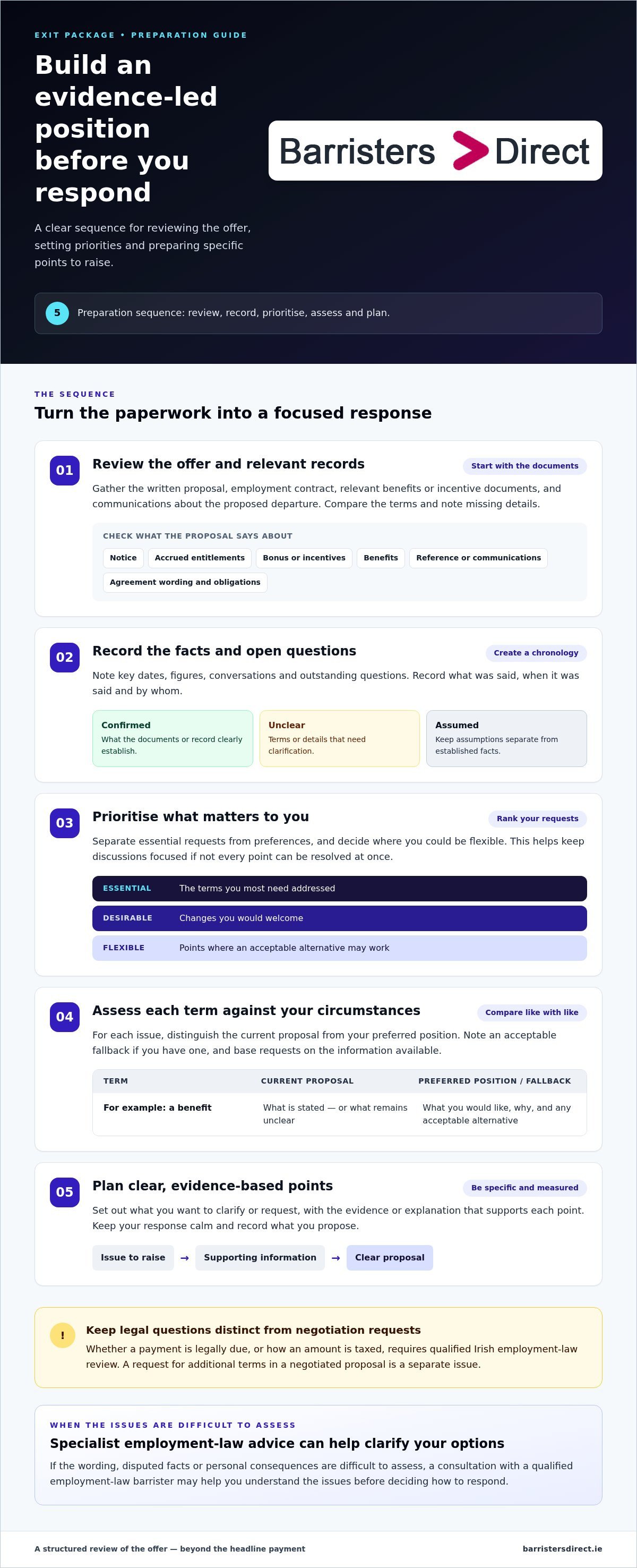
A considered response starts with a reliable record of what’s been offered and what you need clarified. Before replying, gather the proposal, your employment contract, relevant benefit or incentive documents, and communications about the proposed departure. Keep them together so you can compare the written terms with what has been discussed.
Use this sequence to turn that information into a clear negotiating position:
- Review the offer and relevant employment records, noting each term and any missing detail.
- Record key dates, figures, conversations and outstanding questions in a chronology.
- Prioritise what matters most, separating essential requests from preferences.
- Assess the proposal against your documents and circumstances, without treating assumptions as established facts.
- Plan the points you want to raise and the evidence or explanation that supports each request.
Review the offer and your employment records
Compare each proposed term with your contract, any relevant incentive or benefits documents, and written communications. Record what was said, when it was said and by whom. Keep confirmed facts, unanswered questions and assumptions distinct. If wording is unclear, flag it for advice rather than guessing at its legal effect. If the offer refers to redundancy payments, Citizens Information provides guidance on Irish Redundancy Payments.
Set priorities and define your negotiating position
Decide in advance which terms are essential, which would be desirable and where you could be flexible. Your priorities might include the departure date, continuation of benefits, reference wording or future obligations in the proposed agreement. A ranked list helps keep discussions focused if not every request can be resolved at once.
Then map out your position for each point. For example, the content of a reference may be essential, while a particular form of wording could be negotiable. A simple comparison can help you prepare:
- Term: Name the issue, such as timing or a benefit.
- Current proposal: Record what the offer actually says, or mark it as unclear.
- Preferred position: State what you would like and why.
- Fallback position: Note an acceptable alternative, if you have one.
Base each request on the information available. A documented commitment is different from an assumption about what should apply, so label each accordingly. If you need help assessing the employment-law issues before responding, specialist advice can help clarify the questions to consider. Barristers Direct arranges access to a qualified barrister through a paid consultation; any advice is provided by the barrister. You can read about Barristers Direct consultation options if specialist input would help you plan your next steps.
How to compare an exit package beyond its headline figure
A larger headline payment doesn’t automatically make an offer more favourable. Consider the amount alongside payment timing, benefits, reference wording and any conditions attached. A comparison that separates each item shows what’s offered, what remains uncertain and what matters most to you.
As you assess the proposal, don’t treat different types of payment or benefit as interchangeable. A payment due at a later date may not meet an immediate need, while a benefit that ends on departure could have practical significance. A substantial figure may also come with wording or obligations you need to understand before deciding whether to accept or negotiate.
Assess the financial and practical trade-offs
List each payment or benefit separately rather than combining them into one total. Compare the proposed timing and any stated conditions with your priorities. Mark anything unclear instead of filling gaps with assumptions. Tax treatment, legal entitlement and the value of any potential claim depend on individual facts and require current, qualified Irish advice.
Term
What to compare
What to clarify
Payments
Each proposed amount and when it is due
Any stated conditions or unclear calculation
Benefits
What continues, changes or ends
The relevant dates and scope of cover
Reference
Whether wording is proposed
The exact wording and how it may be used
Conditions
Any obligations attached to the offer
The intended meaning and practical effect
This comparison doesn’t calculate what you’re legally owed. It helps identify which issues need explanation before you weigh the package against your personal circumstances.
Review proposed conditions and future obligations
Read beyond the payment clauses. If the offer includes confidentiality wording, restrictions, release language or other continuing obligations, note each separately. In general terms, a release clause may describe claims the parties intend to settle or waive; its precise scope depends on the wording and context. Don’t assume that a label alone tells you its full legal effect.
Restrictions or commitments in the documents may affect future work, so flag terms that could influence your next role, professional activities or other rights. If wording is unfamiliar or consequential, specialist review can help clarify what it says and what questions to raise. This is particularly useful when negotiating an exit package, as it helps you assess the proposed terms as a whole rather than focusing only on the headline sum.
How to negotiate an exit package: a measured response
A clear, measured reply can keep discussions focused on the terms that matter to you. It can’t guarantee that an offer will remain open or that negotiations will proceed in a particular way. Before responding, check any stated deadlines. Keep your communication calm, specific and grounded in documents and facts you can establish.
Use this sequence to organise your response:
- Acknowledge receipt of the proposal and confirm that you’re considering its terms.
- Clarify wording or details you don’t understand, using focused questions.
- Prioritise the changes that matter most, rather than raising every possible point at once.
- Propose specific adjustments and explain the practical reason for each request.
- Record what you sent, what was discussed and any agreed next steps.
Make a clear and proportionate counterproposal
Link each request to a documented concern or practical priority. For example, if the proposed departure date creates a timing issue, explain the impact and state the date or arrangement you’re requesting. If a clause is unclear, ask what it is intended to cover before proposing a change. Distinguish established facts from requests, and avoid threats or unsupported claims about legal rights or the employer’s likely response.
Be specific. Instead of saying the offer is unfair, identify the term you want changed and explain why. You might request clarification of a benefit’s end date or propose alternative wording for a reference. Keep the tone professional, even if you disagree with the proposal. A counterproposal is part of a discussion, not a guarantee of agreement.
Record discussions and assess the response
Keep a dated record of emails, calls, revised proposals and stated next steps. After each response, compare the changes with the priorities you set before negotiations began. Note what has been resolved, what remains open and whether any new wording raises questions. If a point is agreed verbally, record your understanding and seek written confirmation as appropriate.
Negotiating an exit package can raise detailed employment-law questions, particularly where wording or underlying facts are disputed. Barristers Direct arranges access to qualified barristers for employment-law consultations. Any advice is provided by the barrister, and further engagement is agreed directly between you and them. The employment-law consultation information gives further context on this specialist area.
If specialist input would help you understand the issues before deciding how to respond, read about arranging an employment-law consultation through Barristers Direct.
When specialist advice can help with an exit package
Some proposals are straightforward to understand; others contain detailed wording or raise questions that are difficult to resolve from the offer alone. Specialist employment-law input may be useful if important facts are disputed, the proposed terms could affect future work or other rights, or the decision carries significant personal or financial consequences. A focused consultation can help you understand the issues and options before deciding how to respond.
Consider seeking advice before agreeing to terms if you’re unsure what a clause means, how it relates to your circumstances or what questions to raise with your employer. Advice doesn’t guarantee a particular result or require you to take a particular course. It can give you a clearer basis for considering the proposal and deciding on your next step whilst negotiating an exit package.
What to prepare for a barrister consultation
Organise the proposed package, relevant employment documents and a brief chronology of key events. Mark the clauses or terms you want considered, then write down the decisions you need to make and your questions. Preparing this information helps keep the discussion centred on your circumstances. Consultations arranged through Barristers Direct can take place online or by telephone.
- The offer: Include the full proposal and any related documents.
- Relevant records: Gather your contract, applicable benefit or incentive documents, and important written communications.
- Your chronology: Note key dates, discussions and any points that remain disputed.
- Your questions: Identify unclear wording and the practical decisions you need to make.
You don’t need to resolve every uncertainty before seeking input. Make clear which details are confirmed and which are your understanding or assumption. That distinction gives the barrister a useful starting point and helps focus the discussion on the issues that matter to you.
Understand the consultation and possible next steps
Barristers Direct arranges a paid initial consultation with a qualified barrister in the relevant area of law. The barrister provides any advice; Barristers Direct arranges access and does not itself provide that advice. A consultation can help you clarify questions and possible next steps, but it isn’t a promise of a particular outcome or full representation in formal proceedings.
If formal proceedings become relevant, you may need a solicitor. Barristers and solicitors have distinct roles, and understanding how they can work together may help you decide what support is appropriate. Further work, if agreed, is arranged directly between you and the barrister. You can read about the difference between barristers and solicitors for broader context.
Explore access to specialist employment-law expertise through Barristers Direct if you would like a barrister’s perspective on the offer and your next steps.
Make your next decision with confidence
Before taking your next step, identify the question that is holding you back. It might concern the meaning of a clause, the basis for a proposed term or how to raise a concern constructively. A precise question can help focus further discussion on what you need to understand.
Negotiating an exit package doesn’t require you to make every decision at once. If you’re unsure how a term could affect your position, specialist employment-law advice can help you understand the issues and consider your options. You can then decide how to proceed with a clearer view of what matters to you.
Barristers Direct arranges access to specialist barristers, whose advice is grounded in their legal expertise. If you’d value that perspective before responding, arrange a paid specialist employment-law consultation through Barristers Direct.
Frequently Asked Questions
What should I consider when negotiating an exit package?
When negotiating an exit package, check that the written offer matches your understanding of discussions and that each figure or condition has a clear explanation. For an executive, compare any bonus or incentive terms with the relevant scheme documents rather than assuming the package overrides them. Note deadlines for responding and clarify which terms are open for discussion. If a clause could affect future work or rights, seek advice before treating its meaning as settled.
Should I accept the first exit package offer?
First consider whether you understand the offer and its consequences. You can ask for time to review it, clarify an unclear point or obtain advice, but don’t assume the employer must extend a deadline. Check whether the proposal states how long it remains open and whether acceptance requires signing further documents. If you’re weighing acceptance against a counterproposal, consider both the written terms and your practical priorities before deciding.
Can I negotiate an exit package without a solicitor?
You can communicate your questions or proposed changes directly with your employer. That doesn’t mean every legal or procedural issue is straightforward. Barristers Direct arranges access to a qualified barrister for a paid employment-law consultation, and the barrister provides any advice. A solicitor may be needed if formal proceedings become necessary. If you already have a solicitor, their advice and role can remain important to your circumstances.
What can be included in an exit package?
Possible terms include payments, notice arrangements, outstanding entitlements, benefits, reference wording and conditions about future conduct or claims. For an executive, documents may also address an incentive plan or share-related arrangements, if relevant to the role and offer. Don’t assume these items are included automatically. Check the proposal and associated documents to see what is expressly covered, what is left out and whether any term is conditional on signing or taking another step.
Could negotiating an exit package put an offer at risk?
Raising questions or requesting changes could affect the discussion, but there’s no reliable way to promise that an offer will stay available. The position depends on the proposal and the employer’s response. Keep your tone constructive, focus on specific points and check any stated expiry date. If timing is unclear, ask in writing whether the offer remains open while you review it. Don’t treat a request as confirmation unless it is given.
When should I get legal advice on an exit package?
Consider specialist advice if you can’t tell what a clause means, key events are disputed, or accepting could have significant consequences for your work or rights. Advice may also help if you’re unsure whether the offer reflects relevant contractual documents or how to frame a response. Prepare the documents and questions you want addressed. A qualified employment-law barrister can advise on the issues; any further engagement is agreed directly between you and the barrister.
Is an exit package the same as redundancy pay?
No. Redundancy pay refers to a payment connected with redundancy, while an exit package can cover broader terms for ending employment. If an offer is described as redundancy-related, distinguish any redundancy payment from other proposed amounts and conditions. Don’t assume the label settles whether redundancy applies to your circumstances or what you may be entitled to receive. If that distinction affects your decision, seek current Irish employment-law advice based on your employment history and documents.
Disclaimer
_This article does not constitute legal advice. Barristers Direct does not provide legal advice. To obtain legal advice, you should contact a legal practitioner._