
Full article
Published 16/11/2026
An unfavourable medical outcome does not, by itself, establish negligence. For medical negligence legal advice in Ireland, the central question is whether a healthcare professional breached the required standard of care and whether that breach caused harm. In most cases, proceedings must be issued within two years less one day from the date of knowledge.
That distinction can be difficult to assess when you’re dealing with an injury or delayed diagnosis. A claim generally depends on evidence about the care provided, the harm that followed and whether the care caused that harm.
This guide explains what may qualify as medical negligence, how specialist legal advice can help assess the evidence and clarify next steps, and what compensation may cover. It also covers financial losses, future care needs and factors that can affect costs.
Key Takeaways
- Learn why an unexpected outcome after surgery does not automatically establish negligence, and which details can matter when assessing a potential claim.
- Understand how specialist legal advice can help make sense of medical records and expert evidence.
- See how compensation may address more than immediate losses, including ongoing care and treatment needs.
- Find out what to consider when deciding on your next step and how Barristers Direct’s specialist advice may help clarify your options.
- Explore the factors that can shape the value of a claim without relying on a one-size-fits-all figure.
Table of Contents
- What Qualifies as Medical Negligence in Ireland?
- Getting specialist legal advice
- Surgical errors
- Compensation for injury, financial losses and future care
- Medical negligence legal advice
- Barristers Direct: Medical Negligence Legal Advice
What Qualifies as Medical Negligence in Ireland?
A poor outcome alone does not prove negligence. A claim requires evidence of a duty of care, a breach of that duty and harm caused by the breach.
According to the Irish Statute Book, medical negligence claims in Ireland are governed in part by the Civil Liability Act 1961. The standard of care is assessed against a practice accepted as proper by a responsible body of practitioners skilled in the relevant area. This can apply to diagnosis as well as treatment, including surgical care.
A claimant must show, on the balance of probabilities, that the breach caused or materially contributed to the injury. The “but for” question is whether the harm would have happened without the breach. A claim may fail if care fell below the required standard but the evidence does not connect that failure to the injury. For example, a delayed diagnosis may be relevant if earlier diagnosis would have changed treatment options or prevented avoidable complications.
Causation in Medical Negligence Claims
Causation connects the alleged mistake to the harm claimed. Independent medical evidence can assess the care provided and explain whether a breach caused or materially contributed to the injury. The records, timeline and likely outcome with appropriate care all matter. It is not enough to show poor care: the evidence must also establish its effect on health.
Birth Injury and Acquired Brain Injury Claims
Claims involving cerebral palsy, birth injuries or acquired brain injuries require careful assessment of the medical events and resulting harm. Relevant records may include treatment notes, test results and the timeline of care. Independent medical experts can assess whether care met the appropriate standard and whether a breach caused or contributed to the injury. The extent of the effects can also inform the claim’s assessment.
You can make a formal complaint to the hospital about the care you received. A complaint raises concerns about that care. A legal claim assesses whether duty, breach and causation can be proved, and seeks compensation for resulting harm.
To start a claim, relevant medical records are reviewed and independent medical evidence is obtained. If the evidence supports the case, a Letter of Claim is sent to the practitioner, hospital or their insurers. Negotiations may follow, although some medical negligence cases proceed to court.
In most cases, proceedings must be issued within two years less one day from the date of knowledge. The date of knowledge generally concerns when the injured person became aware, or reasonably could have become aware, that negligence may have caused harm. A claim can fail if breach or causation cannot be established. Its duration depends on gathering evidence, negotiations and whether court proceedings are needed.
Getting specialist legal advice
Specialist advice can help a patient understand the evidence, legal issues and practical steps involved in presenting a claim. A lawyer can review the timeline of care, identify records needed for assessment and explain how independent medical evidence may address a healthcare professional’s actions. This can help distinguish a treatment failure from harm caused by an alleged failure.
There is no single cost for a medical negligence case. Legal costs depend on factors such as the complexity of the issues, the records to be reviewed, the medical evidence required and whether the case proceeds to court. Ask for clear information about fees and potential outlays before deciding how to proceed.
A “no-win, no-fee” description does not, by itself, explain who pays legal fees or other costs if a claim is unsuccessful. Irish rules require legal practitioners’ advertising statements about fees or charges in contentious business to say that these may not be calculated as a percentage or proportion of an award or settlement. Clarify the proposed fee arrangement and its terms before entering an agreement.
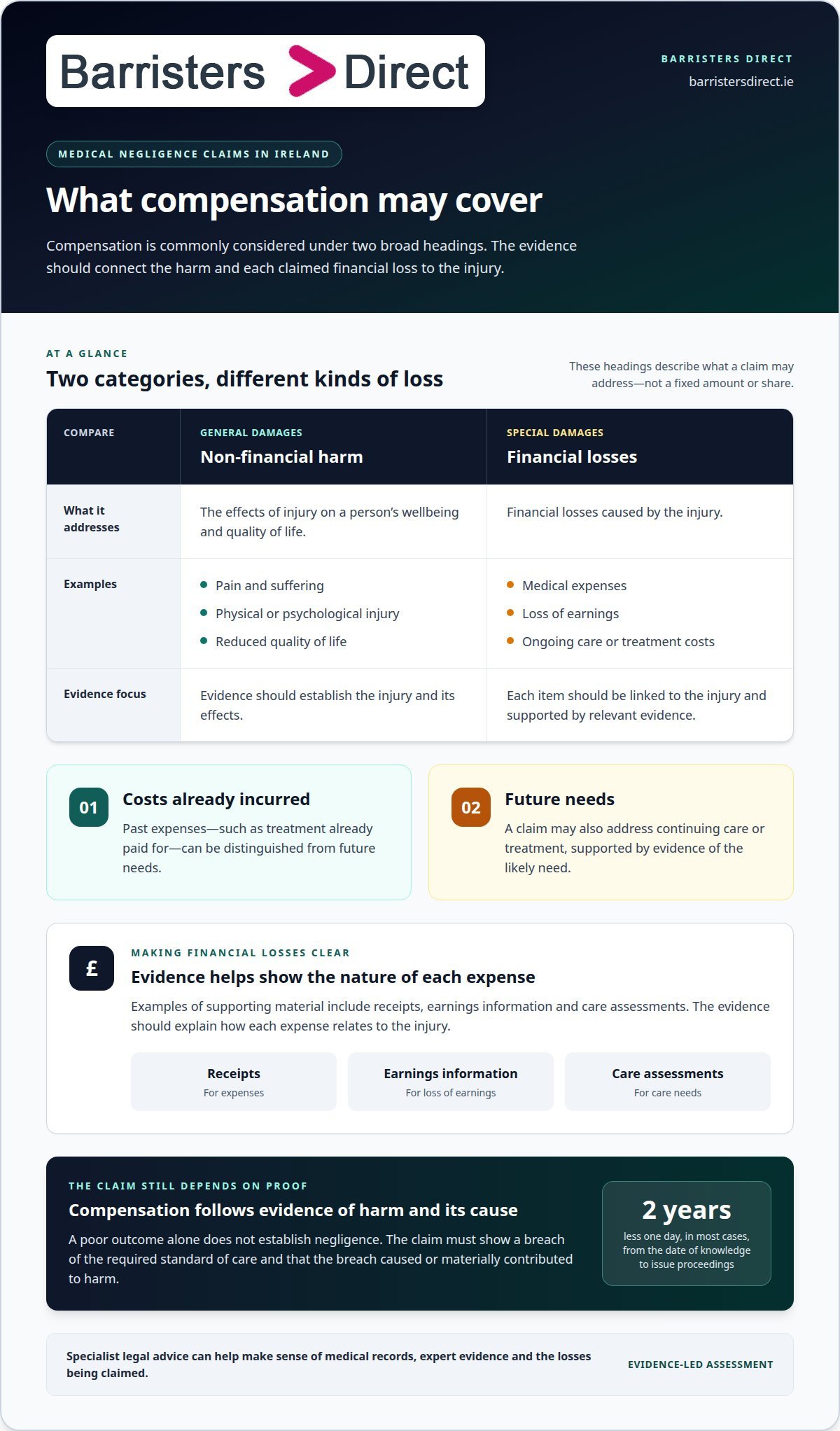
Compensation is commonly considered under two broad headings. General damages address non-financial harm, such as pain, suffering, physical or psychological injury, and reduced quality of life. Special damages relate to financial losses caused by the injury. They may include medical expenses, loss of earnings, and ongoing care or treatment costs. Each item must be connected to the injury and supported by relevant evidence, such as receipts, earnings information or care assessments.
When assessing special damages, costs already incurred can be distinguished from future needs. For example, a patient may have paid for treatment and also need continuing care. The evidence should explain the nature of each expense and its connection to the injury. This distinction helps present a claim that addresses both immediate financial effects and likely future needs.
The Legal Aid Board’s Medical Negligence Unit is located at Law Centre Smithfield, 48/49 North Brunswick Street, Georges Lane, Dublin 7, D07 PE0C. Its listed phone number is 066 947 1000. This gives people seeking information about legal aid a named service to contact; it does not determine whether a particular person qualifies for assistance.
Before a claim is presented, specialist advice can help organise the case around the alleged failure, the resulting injury and the losses being claimed. If you need focused guidance on those issues, explore specialist legal advice for medical negligence claims.
Surgical errors
Surgical care can involve decisions before, during and after an operation. A serious outcome does not, by itself, show that an error amounted to negligence.
Distinguishing Errors from Negligence
A medical error and medical negligence are not interchangeable. A complication may occur even when treatment meets the required standard. The assessment considers whether a healthcare professional departed from accepted practice and whether that departure caused harm. The professional’s decisions are considered in their clinical context, using available records and independent medical evidence. The label “error” alone does not establish a claim.
For example, an unfavourable result after surgery needs to be considered alongside the treatment provided and the injury alleged. A suitably qualified independent expert can assess the care and its connection to the harm. This helps distinguish a recognised complication from a failure to meet the appropriate standard. The evidence must address both the professional’s actions and their effect on the patient.
Surgical and Post-operative Errors
Surgical errors may concern the operation itself, anaesthesia or care afterwards. A claim assessment looks at the sequence of treatment, what the records document and the injury attributed to the alleged error. Anaesthesia errors are one recognised example of a potential medical negligence claim. The medical evidence must still explain how the alleged error caused or contributed to harm.
Post-operative concerns may relate to the care recorded after an operation and whether the patient’s condition was properly addressed. Relevant evidence can include post-operative notes, test results and details of subsequent treatment. If the records indicate a possible failure, an independent expert can consider whether the care met the appropriate standard. The legal assessment then considers the harm linked to that failure.
Errors of Professional Judgment
A difference of opinion between medical professionals does not automatically establish negligence. The question is whether the decision accorded with a practice accepted as proper by a responsible body of practitioners skilled in that area. For a high-risk treatment decision, properly explained risks and informed consent matter. An unfavourable outcome alone does not usually make the decision negligent.
Ordering an unnecessary test may amount to professional misconduct rather than medical negligence. That distinction matters because a claim concerns a breach of duty that caused injury, not simply a decision later viewed as unhelpful. The specific treatment, the reasons recorded and the resulting harm all form part of the assessment.
Prescription errors are another potential example. An incorrect prescription must be examined in context: what was prescribed, what treatment followed and what injury is said to have resulted. Prescription records and relevant medical notes can help establish the sequence. Solicitors and independent medical experts can assess this evidence, including whether the alleged failure caused harm. A claim needs evidence of both the error and its consequences.
Compensation for injury, financial losses and future care
Compensation focuses on harm caused by negligence, not every health problem a patient experiences. The evidence must connect the injury and its financial consequences to the care provided.
Injury and Causation
For a spinal injury, birth injury or harm following surgery, the assessment considers how the injury happened and what the practitioner did. The key questions are whether care met the appropriate standard and whether a breach caused or materially contributed to the injury. Medical records and independent expert evidence can help explain that connection, including whether diagnosis or treatment affected the outcome.
Different events require different evidence. After a surgical error, records may clarify what treatment took place and what injury followed. For an incorrect prescription, the relevant sequence includes the prescription, its effects and the resulting harm. In a birth injury claim, medical evidence must address the care provided and its relationship to the child’s condition. The alleged failure must be linked to the harm claimed.
That causal link also limits what compensation addresses. If a patient already had a condition, the assessment must distinguish its effects from any additional injury attributable to negligence. A practitioner’s failure to diagnose may matter if earlier treatment would have changed the outcome. The evidence should explain what happened, what harm followed and how the alleged breach contributed.
Financial Losses and Future Care
Financial losses can include medical expenses, lost earnings and ongoing care or treatment costs. Future care needs require consideration of the support and treatment arising from the injury. For example, a spinal injury may involve continuing care needs. The claim must connect those needs to the injury attributed to negligence.
A clear account separates losses already incurred from future costs. Medical expenses and lost earnings relate to financial effects, while care or treatment needs may continue beyond the initial injury. Relevant records and assessments help explain each claimed loss and its connection to the harm. This allows settlement discussions to address the injury, financial losses and future care needs together.
For a child’s claim, compensation is not paid directly to the child as an ordinary settlement. It is paid into a court account and held until the child reaches adulthood. A judge may approve a child’s settlement to ensure it serves the child’s best interests. This court oversight is an important part of how a child’s compensation is handled.
In practice, the compensation assessment brings together the injury, its effects and the losses linked to it. Pain and suffering, physical or psychological injury, and reduced quality of life may be considered as general damages. Special damages address financial loss. The evidence must show which effects arise from the negligence, particularly where healthcare needs or diagnosis history are complex.
Medical negligence legal advice
Useful medical negligence legal advice in Ireland turns concerns about care into a structured assessment. It identifies the decisions in question, the evidence needed and the legal issues to address. This is particularly important where hospital treatment involved several departments or mistakes occurred over time.
A specialist barrister can analyse the case’s legal merits and explain how the facts relate to relevant duties and evidence. If formal legal action is being considered, specialist legal advice can help clarify the next steps. A solicitor can manage practical work such as correspondence and assembling records. The right advice should clarify what evidence supports the allegation, what remains unresolved and what procedural options are available.
A focused initial assessment can organise the key questions:
- Identify the alleged failure. Set out the decision, treatment or omission at issue, such as a missed test result or an incorrect prescription.
- Trace the effects. Connect the alleged mistake to the injury, including any physical, psychological or financial consequences.
- Assess the evidence. Consider whether medical records and independent expert opinion support a breach and its connection to harm.
- Set a practical direction. Clarify whether further evidence, a formal complaint, settlement discussions or court proceedings are relevant.
Each step shapes how a claim is presented. A delayed diagnosis, for example, requires attention to what the records show and whether earlier treatment would have made a difference. An expert opinion can address both the appropriate standard of care and the medical consequences. The legal analysis then considers whether the evidence supports the necessary connection between the alleged failure and the injury.
Case law can also provide context. In _Morrissey v Health Service Executive_ [2020] IESC 6, the Supreme Court considered failures in cervical screening. The case illustrates why the precise circumstances and evidence matter. A claim involving screening, surgery or treatment in a hospital needs analysis tailored to the clinical events, rather than assumptions drawn from a different type of case.
Medical negligence claims are declined for assessment by the Injuries Board. The usual process for other personal injury claims therefore does not provide an assessment route for these cases. A legal adviser can explain how the evidence is assembled and how a claim proceeds through correspondence, negotiations or court proceedings. If a case reaches court, a judge decides it on its merits.
The practical value of specialist advice is a clear analysis of the alleged negligence, the evidence and the next procedural step. If you need an expert view on how those issues apply, seek specialist legal advice.
Barristers Direct: Medical Negligence Legal Advice
Barristers Direct connects you with a specialist barrister for medical negligence legal advice. You can instruct senior or junior counsel directly for an initial consultation, with the option to seek advice from a solicitor as well.
The initial consultation is paid and fixed-fee. It can help clarify the legal issues, assess the evidence and outline possible next steps. Turn to specialist advice for an informed view of how the care, alleged breach and resulting harm relate to your potential claim. This can help you understand your position before deciding how to proceed.
Contact Barristers Direct to discuss medical negligence legal advice.
Choose your next step with clarity
The next useful step is to identify the decision you need help making. You may want to understand whether to pursue a claim, how to approach discussions with a hospital or which legal options suit your circumstances. Clear priorities can help keep the advice focused on the issues that matter to you.
Medical negligence legal advice in Ireland can help you consider the legal and practical implications before deciding how to proceed. Specialist barrister advice can bring a clear legal perspective to a complex situation and help you make an informed decision about your next move.
You don’t need to have every question resolved before seeking advice. Start with the issue causing most concern, then discuss what you need to understand. Arrange a conversation with Barristers Direct and take your next step with greater clarity.
Frequently Asked Questions
Is there a time limit to make a Medical Negligence Claim?
Yes. In most cases, proceedings must be issued within two years less one day from the date of knowledge. This is when you first became aware, or ought reasonably to have become aware, that negligence may have caused harm. For example, the relevant date may not be the treatment date if the possible connection between care and injury emerged later. Seek advice promptly to assess the deadline.
What Compensation Can You Claim?
Compensation can include general damages for non-financial harm and special damages for financial losses caused by negligence. General damages may address pain, psychological injury or reduced quality of life. Special damages can include medical expenses, lost earnings and ongoing care or treatment costs. The claim needs evidence connecting each loss to the injury, such as treatment invoices or records showing earnings affected by time away from work.
What Evidence Should You Gather?
Gather records that help establish what care you received and when. These may include your medical file, prescriptions, test results and appointment details. Keep relevant letters or messages about treatment, and note important dates while your recollection is clear. You can request a full copy of your medical file. A clear sequence of events can help a barrister assess the legal issues and identify evidence an independent medical expert may need to consider.
What Is a Duty of Care?
A duty of care is the responsibility a healthcare provider owes a patient when providing treatment or diagnosis. In a claim, it is considered alongside whether the care fell below the appropriate standard and whether that breach caused harm. For instance, a doctor’s duty may be relevant to a decision about investigating symptoms. The care relationship and clinical circumstances help define what conduct is being assessed.
What qualifies as medical negligence under Irish law?
Medical negligence involves care falling below the required professional standard and causing harm. A poor outcome alone is not enough. For example, a delayed diagnosis may be relevant if earlier diagnosis would have changed treatment options or prevented avoidable complications. The assessment considers the healthcare professional’s actions and the evidence connecting those actions to injury. The same principles apply to allegations about diagnosis and treatment.
How do I prove a medical negligence claim in Ireland?
You generally need to establish, on the balance of probabilities, that a duty existed, the care breached that duty and the breach caused or materially contributed to harm. Independent medical evidence can assess the standard of care and explain the medical consequences. In a delayed diagnosis case, for example, evidence may need to show whether effective treatment would have been available earlier and made a difference.
What is the time limit for bringing a medical negligence claim in Ireland?
In most cases, proceedings must be issued within two years less one day from the date of knowledge. That date concerns when you knew, or ought reasonably to have known, that negligence may have occurred and caused harm. The limitation period may be extended for children or people with mental disabilities. A barrister can assess how the limitation rules apply to your circumstances and help identify the relevant deadline.
What steps should I take before contacting a medical negligence solicitor in Ireland?
Keep the records you already have, including prescriptions, test results and appointment information, and request a copy of your medical file. Write a brief timeline of treatment, symptoms and when you became concerned about possible negligence. You may also make a formal complaint to the hospital, but that is separate from pursuing a legal claim. An independent medical opinion is an important early step in assessing the care.
Disclaimer
_This article does not constitute legal advice. Barristers Direct does not provide legal advice. To obtain legal advice, you should contact a legal practitioner._