

Full article
Published 23/08/2026
A poor medical outcome is not always proof of a legal error, but the distinction between a "bad result" and clinical negligence is often too complex for a lay person to identify alone. If you are searching for a medical negligence lawyer in Ireland, you are likely seeking the highest level of legal scrutiny to determine if your standard of care was fundamentally breached. You probably feel overwhelmed by the density of medical records and the daunting prospect of challenging a healthcare institution. It’s natural to feel anxious about the potential costs and the confusing layers of the Irish legal system.
This article demonstrates how you can bypass traditional hurdles to access specialist legal strategy through a direct consultation with an experienced barrister. You’ll gain a clear understanding of the legal requirements for a medical negligence claim and the current two-year statute of limitations in Ireland. We provide a preview of how a transparent, fixed-cost initial assessment provides a strategic path forward. If you require expert clarity on your situation, then starting with a specialist’s opinion is the most efficient way to navigate the road ahead.
Key Takeaways
- Understand the precise legal criteria required to distinguish between a poor medical outcome and actionable clinical negligence under Irish law.
- Learn how consulting a medical negligence barrister Ireland directly provides the strategic intelligence needed to determine the viability of your claim.
- Discover the advantages of the Direct Access model, which offers a transparent, fixed-fee consultation for expert advice without an initial solicitor referral.
- Clarify the critical timelines for your case, including the current two-year statute of limitations that governs clinical negligence claims in Ireland.
- Identify the essential medical records and documentation required to maximise the value and efficiency of your initial legal assessment.
Table of Contents
Understanding Medical Negligence Claims in Ireland
Medical negligence is defined by a specific legal failure rather than a simply undesirable clinical outcome. Within the common-law legal system in Ireland, these cases are governed by the principles of tort law and civil liability. If a healthcare provider fails to meet the expected professional standard, they have breached their duty of care. However, the burden of proof rests entirely on the plaintiff to demonstrate this failure. It’s a high bar to clear. Proving that a doctor acted incorrectly requires objective evidence that their actions deviated from accepted medical norms.
Under the established "Dunne" principles, which remain the cornerstone of Irish clinical law in 2026, medical negligence is defined as a practitioner’s failure to do what no other practitioner of equal specialist status and skill would have failed to do when acting with ordinary care. Identifying this threshold is a complex task. Consulting a medical negligence barrister from the outset ensures that your case is evaluated against these rigorous legal benchmarks before you commit to significant litigation costs. If the evidence doesn’t meet this specific test, then a claim is unlikely to succeed in the High Court.
The Three Pillars of a Negligence Claim
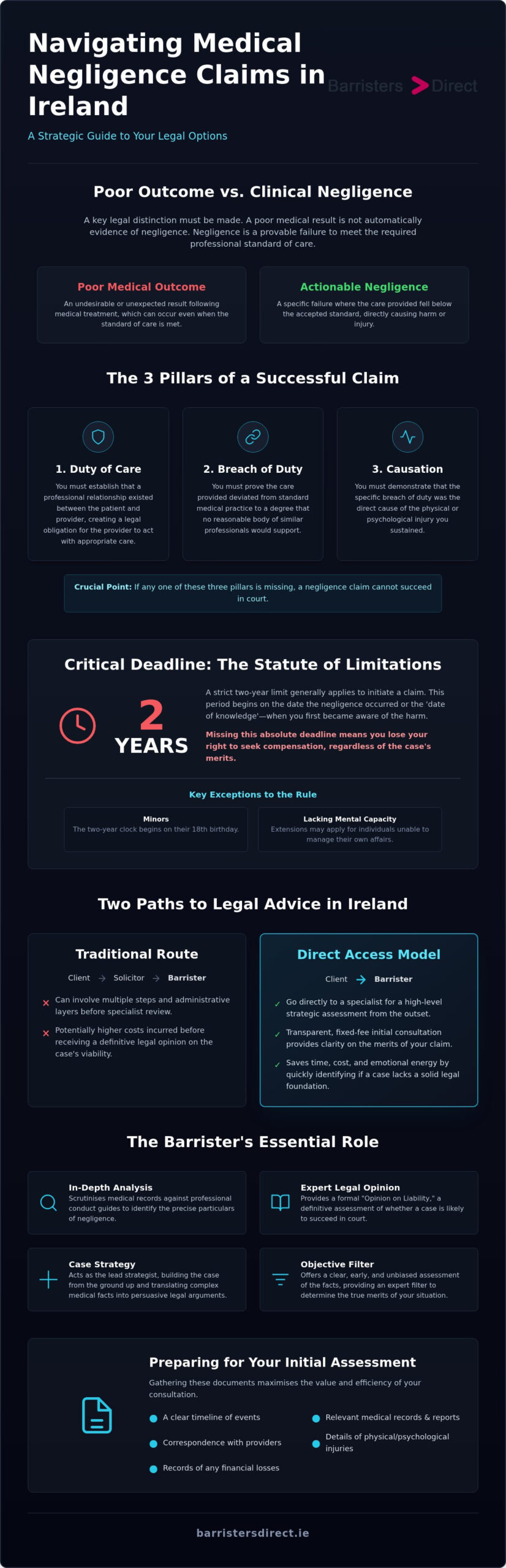
A successful claim must satisfy three distinct legal requirements. If any one of these pillars is missing, the case will not succeed. These include:
- Duty of Care: You must establish that a professional relationship existed between the patient and the healthcare provider, creating a legal obligation for the provider to act with care.
- Breach of Duty: You must prove that the treatment provided deviated from standard medical practice in Ireland to a degree that no reasonable body of similar professionals would support.
- Causation: It’s not enough to prove an error occurred; you must demonstrate that the specific breach of duty directly caused the physical or psychological injury in question.
Statute of Limitations for Clinical Claims
Time is a critical factor in medical law. In Ireland, a strict two-year limit generally applies to initiate a claim. This period begins either on the date the negligence occurred or the "date of knowledge," which is when the injured party first became aware of the harm. Despite discussions regarding legislative changes, as of August 2026, the two-year rule remains the binding deadline for adults. If you wait too long, you lose your right to seek compensation.
Specific exceptions exist for minors, where the two-year clock only starts ticking on their 18th birthday. Similarly, extensions may apply for individuals who lack the mental capacity to manage their own affairs. Because these deadlines are absolute, early legal consultation is vital. If you miss this window, your claim will likely be statute-barred, regardless of the merits of your case. Seeking a specialist’s opinion early protects your legal standing.
The Essential Role of a Barrister in Clinical Negligence
While a solicitor manages the administrative lifecycle of a legal file, the barrister is the specialist advocate who provides the definitive expert opinion on whether a case will succeed. In the context of High Court litigation, your medical negligence barrister acts as the lead strategist. They don’t just present the case; they build it from the ground up by analysing medical records against the Guide to Professional Conduct and Ethics issued by the Medical Council. This analysis helps determine if a practitioner’s behaviour constituted a breach of duty. By working closely with medical experts, the barrister translates complex clinical reports into persuasive legal arguments.
Instructing a barrister directly allows for a high-level assessment of your situation before you incur the significant costs associated with full litigation. It’s a modern approach that focuses on precision. If the legal merits aren’t there, the barrister will tell you clearly and early. This prevents you from pursuing a claim that lacks a solid foundation, saving both time and emotional energy. The barrister’s role is to provide an objective, expert filter for the facts of your care.
Drafting the Legal Strategy
Identifying the specific "particulars of negligence" is a precision task that requires deep legal intelligence. A barrister produces a formal "Opinion on Liability," which serves as the essential roadmap for any serious claim. This document outlines exactly where the healthcare provider failed and how that failure caused the injury. For high-value or complex clinical claims, involving senior counsel early ensures that the most sophisticated legal nuances are addressed. If the strategy is flawed at this initial stage, the entire claim is at risk of being dismissed by the court.
Bypassing the Traditional Referral Model
The traditional legal path in Ireland requires a solicitor to act as the primary point of contact and then "brief" a barrister for an opinion. This often adds unnecessary time and administrative layers to the process. Direct access provides a streamlined route to the expert who will ultimately argue the case. You get a "barrister’s eye view" on the merits of your claim from the very beginning. It’s a pragmatic way to secure elite advice without the traditional delays. If you want to understand your strategic options, you can access specialist medical negligence legal advice through our direct consultation model, ensuring you move forward with total clarity.
Direct Access vs Traditional Legal Routes in Ireland
The traditional legal model in Ireland has long positioned the solicitor as the mandatory first port of call. In this arrangement, the solicitor gathers records and eventually briefs a barrister to provide a specialist opinion. While effective for administrative management, it can delay the moment you receive the high-level legal strategy you actually need. Direct access disrupts this by allowing you to consult medical negligence barristers in Ireland at the very start of your journey. This shift ensures that the person who will eventually argue the case in the High Court is the same person providing the initial assessment of its merits.
Understanding where clinical claims sit in the wider legal landscape is essential for managing expectations. Unlike most motor or workplace accidents, which follow the Personal Injuries Assessment Board process, medical negligence cases are generally excluded from IRB assessment. They require immediate expert legal and medical evaluation to proceed. Because these cases skip the standard assessment board, the barrister’s role in defining the "particulars of negligence" becomes the core foundation of the entire claim.
Fixed-Fee Consultations: Transparency in Costs
Standard solicitor billing often relies on hourly rates or instruction fees that can be difficult to predict. This creates anxiety for clients already dealing with the trauma of a medical injury. A fixed-fee barrister consultation replaces this uncertainty with total transparency. You pay a single, one-time fee for a specialist review of your situation. If the barrister determines that the claim lacks legal standing, you’ve saved thousands in potential solicitor fees and court costs. This model prioritises pragmatic intelligence over traditional, open-ended billing structures.
When a Solicitor Becomes Necessary
Direct access is a tool for strategy, not a replacement for the entire legal team. If your barrister confirms that your claim is viable and litigation is the recommended path, then a solicitor must be instructed. In the Irish system, barristers don’t issue court proceedings or manage the daily administrative tasks of a lawsuit directly. Barristers Direct facilitates a seamless transition to a solicitor once the strategic foundation is laid. This ensures that you have a complete, expert team ready for the High Court whilst maintaining the strategic direction established by your counsel.
Efficiency and Speed of Resolution
By removing the initial referral phase, you arrive at a decision much faster. Direct communication with senior or junior counsel ensures that the nuances of your medical history aren’t lost in translation between multiple offices. This streamlined approach reflects a modern, efficient way to resolve complex disputes, focussing on results rather than traditional hierarchy. It’s a faster route to clarity, allowing you to decide your next steps with confidence.
Preparing for Your Medical Negligence Legal Consultation
Preparation is the most effective way to ensure you extract maximum value from your fixed-fee consultation. When you consult a medical negligence barrister in Ireland, you are paying for strategic intelligence rather than administrative data entry. Arriving with a disorganised stack of papers forces the barrister to spend time sorting rather than analysing. To avoid this, you should gather all hospital records, clinical correspondence, and relevant emails into a coherent file. It’s also helpful to define your objectives clearly. Whilst the legal system primarily awards financial compensation, knowing if you are also seeking a formal apology or a change in hospital policy helps the barrister frame their strategic advice.
Drafting a detailed personal impact statement that chronicles your daily physical and psychological challenges allows the barrister to quantify the human cost of the clinical error. This document bridges the gap between clinical facts and the reality of your lived experience. It is often the most persuasive piece of evidence when establishing the "causation" pillar discussed earlier in this guide. If you are ready to move forward, you can book an initial medical negligence consultation to receive a clear, expert assessment of your case.
Organising Your Medical Evidence
In Ireland, you have a legal right to access your clinical data under GDPR and Data Protection legislation. You can initiate a Subject Access Request to obtain your full medical file from any HSE facility or private clinic. It is essential to identify the specific dates of treatment and the names of the clinicians involved. This precision allows your medical negligence lawyer to pinpoint exactly where the breach of duty occurred. In complex cases, the barrister may suggest engaging an independent medical expert to provide a peer review of your records, which adds significant weight to your legal position.
Questions to Ask Your Barrister
Your consultation is an opportunity to get direct answers from a High Court specialist. You should feel empowered to ask the following questions:
- What are the specific legal strengths and weaknesses of my claim?
- What is the realistic timeline for a medical negligence case in the High Court, and what are the key milestones?
- What additional expert reports or evidence will be required to prove that a breach of duty actually occurred?
Asking these questions ensures that you leave the meeting with a clear "path forward" and a realistic expectation of the legal journey ahead. If the barrister identifies a strong case, they will advise on the next steps for instructing a solicitor and initiating formal proceedings.
Expert Medical Negligence Strategy via Barristers Direct
Barristers Direct serves as a bridge to the elite legal intelligence of the Law Library of Ireland. Our platform allows you to engage a specialist medical negligence lawyer without the traditional delays of a solicitor-led referral. We provide a solution-oriented environment where your medical history is scrutinised by senior and junior counsel who specialise in clinical law. This model simplifies a system that often feels designed to be impenetrable. By prioritising direct communication, we ensure that you receive an expert legal opinion on the viability of your claim with maximum efficiency.
The transparency of our fixed-fee model is central to this approach. If you require a medical negligence barrister ireland to review your files, you’ll know exactly what your initial strategic meeting will cost before you even speak to a professional. This eliminates the financial unknowns that often prevent people from seeking the justice they deserve. Obtaining a high-level assessment is the only way to determine if you have a sustainable case in the High Court. You pay for precision.
A Modern Approach to Irish Legal Services
Traditional legal structures in Ireland often rely on a slow, hierarchical process. Barristers Direct bypasses these outdated methods to provide immediate access to independent sole practitioners. These barristers are experts in strategic intelligence and practical results. Because we maintain a national network of counsel, we can connect you with a specialist regardless of your location. We focus on providing a clear "path forward" rather than just administrative support. This modern approach ensures that the legal strategy for your claim is built on precision and experience from day one.
Taking the First Step Toward Resolution
The period following a medical injury is defined by confusion and anxiety. Our initial consultation is designed to replace that uncertainty with professional clarity. You’ll meet with your barrister in a respectful, confidential environment where the facts of your care are assessed with the highest degree of confidence. This meeting isn’t just about identifying errors; it’s about providing you with a realistic roadmap for resolution. If you are ready to gain control of your legal situation, you can Secure your fixed-fee medical negligence consultation today and begin the process of expert review.
Securing a Specialist Strategy for Your Clinical Claim
Navigating the complexities of clinical law requires more than just medical records; it demands a precise legal strategy built on elite experience. Engaging a medical negligence barrister through direct access allows you to bypass traditional administrative delays and move straight to the core of your case. This modern approach ensures that your claim is assessed by senior or junior counsel who are members of the Law Library of Ireland, providing you with the highest level of strategic intelligence from the outset.
Our fixed-fee model provides total transparency, allowing you to secure expert advice without the uncertainty of open-ended billing. If you’ve suffered due to a medical error, then gaining clarity on your legal standing is the most important first step toward resolution. You deserve a clear path forward that is defined by professional confidence and pragmatic results. Book your fixed-fee consultation with a specialist medical negligence barrister today to begin your assessment. Taking this initial step empowers you to make informed decisions about your future with total peace of mind.
Frequently Asked Questions
Can I talk to a barrister in Ireland without going through a solicitor first?
Yes, you can consult a barrister directly for legal advice without a solicitor’s referral. This "Direct Access" route is permitted under the Legal Services Regulation Act 2015. It allows you to obtain an expert strategic opinion on your case at an early stage. Whilst a solicitor is still required for issuing court proceedings and managing formal litigation, talking to a medical negligence barrister directly provides immediate clarity on the legal merits of your situation.
What is the average cost of a medical negligence consultation with a barrister?
The cost of an initial consultation is €395 plus VAT, whereas the traditional model often relies on opaque hourly rates. Choosing a fixed-fee structure ensures total cost transparency from the outset. You pay a single, one-time fee for the initial strategic assessment of your case. This prevents the financial uncertainty associated with traditional legal billing. It allows you to budget effectively whilst accessing the highest level of clinical legal expertise in the country.
How long do I have to make a medical negligence claim in Ireland?
In Ireland, the statute of limitations for clinical negligence is generally two years from the date of the injury or the date of knowledge. This two-year rule is strictly enforced under the Statute of Limitations (Amendment) Act 1991. Exceptions apply for minors, whose two-year period begins on their 18th birthday, and for those lacking mental capacity. Because these deadlines are absolute, you must seek legal advice early to ensure your claim isn’t statute-barred.
What happens if my barrister advises that I have a strong case for negligence?
If your barrister identifies a viable claim, they may provide a formal Opinion on Liability. This document outlines the strategic path forward and the specific particulars of negligence. Since barristers don’t manage the administrative side of litigation or issue court proceedings directly, you will then need to instruct a solicitor. Your barrister will facilitate this seamless transition by recommending solicitors that specialise in your type of caase, ensuring that the expert legal strategy established by your medical negligence barrister is maintained throughout the court process.
Do I need to have all my medical records before I meet with a barrister?
You don’t strictly need every single document to begin, but having your core medical records is highly beneficial. The more evidence you provide, the more precise your barrister’s assessment will be. At a minimum, you should have a timeline of events and any relevant correspondence from the healthcare provider. If records are missing, your barrister can advise on how to obtain them through a Subject Access Request under Irish data protection laws before proceedings begin.
Is a fixed-fee consultation better than an hourly rate for legal advice?
A fixed-fee model is often superior for initial advice because it removes the "ticking clock" anxiety of hourly billing. You can focus entirely on the details of your case without worrying about the cost of every minute spent in the meeting. This structure provides a predictable, transparent entry point into the legal system. It allows you to obtain a specialist’s view on a complex clinical matter without the risk of escalating, unquantified costs.
What is the difference between a Junior Counsel and a Senior Counsel in a negligence case?
A Junior Counsel is a qualified barrister who manages the majority of legal drafting and advisory work. A Senior Counsel, or "Silk," is a barrister with extensive experience and recognised expertise in complex or high-value litigation. In clinical negligence, a Junior Counsel often provides the initial assessment, whilst a Senior Counsel may be brought in for catastrophic injury cases or complex High Court trials. Both levels of counsel are independent practitioners and members of the Law Library.
Disclaimer
_This article does not constitute legal advice. Barristers Direct does not provide legal advice. To obtain legal advice, you should contact a legal practitioner._