

Full article
Published 13/11/2026
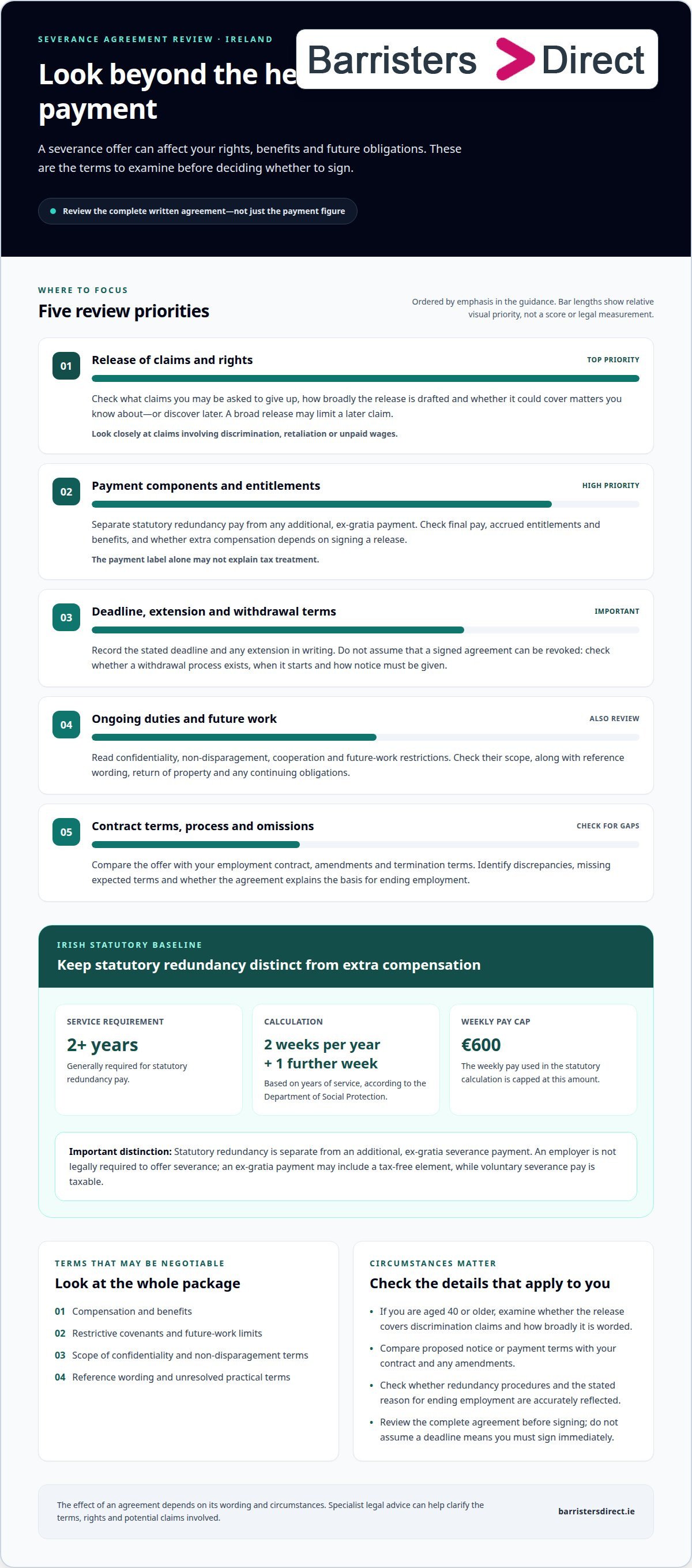
The headline payment is only one part of a severance offer. A legal review of a severance package can clarify what you’re agreeing to, including whether a release could limit claims against your employer. In Ireland, statutory redundancy pay is calculated as two weeks’ pay for each year of service, plus one further week’s pay, according to the Department of Social Protection.
If you’ve been offered a severance agreement, it’s understandable to focus on the payment and deadline. But its wording can also affect your rights, benefits and future obligations, so getting legal advice before signing can help you understand the terms.
This guide explains what a severance agreement may cover, when a review can help and which terms may be negotiable. It also outlines the factors that can affect the cost of legal advice, so you can understand the process and decide on your next step.
Key Takeaways
- A severance agreement can cover more than a payment; its release and other clauses may affect your rights and future obligations.
- Review the wording before signing, particularly if the offer includes a deadline or asks you to give up potential claims.
- Negotiation may cover compensation, benefits, restrictive covenants and the scope of confidentiality or non-disparagement terms.
- Separate statutory redundancy pay from any additional payment, and understand how the agreement treats each part.
- Consultation costs depend on the work involved; the article explains what may shape the fee and the legal advice can help clarify your next steps.
Table of Contents
- What Is a Severance Agreement?
- When Do You Need a Severance Package Review?
- Negotiating compensation, benefits, and restrictive covenants
- Confidentiality and non-disparagement clauses
- Severance package consultation and fees
- Barristers Direct
What Is a Severance Agreement?
A severance agreement sets out the terms on which an employment relationship ends. In Ireland, consider the payment alongside every release, deadline and continuing obligation before deciding whether to accept.
Agreement terms and omissions
A severance agreement may set out an additional payment, final pay arrangements, benefits, confidentiality obligations and a release of claims. The release is especially important: it may ask you to give up claims against your employer in return for the package. The payment figure alone does not show the full value or effect of the proposed agreement.
Compare the written terms with what your employer offered. For example, if discussions refer to a payment but the agreement makes it conditional on signing a broad release, that condition matters. Check whether the document also addresses accrued entitlements, references, return of property or cooperation with future business matters. It may omit issues you expected it to resolve, so identify any gaps before signing.
Review deadlines and revocation periods
An employer’s deadline is a practical consideration, not a reason to sign terms you haven’t read. A stated deadline does not necessarily mean you must sign immediately. Ask for more time to get legal advice, record the deadline and any extension in writing, and use the time to review the complete agreement and payment terms.
Do not assume you can revoke an agreement after signing. Check whether it includes a withdrawal process, when that process starts and how notice must be given. If there is no clear revocation term, seek advice before signing rather than relying on an assumed cooling-off period. The applicable timeframe depends on the agreement and circumstances.
Employment rights and statutory entitlements
In Ireland, employees generally need two or more years of continuous service to qualify for statutory redundancy pay. According to the Department of Social Protection, the calculation is two weeks’ pay for every year of service, plus one further week’s pay. The weekly pay used in that calculation is capped at €600.
Statutory redundancy is distinct from an additional, ex-gratia severance payment. Employers are not legally required to offer severance, and an additional payment may be conditional on signing a release. Redundancy procedures also matter: procedural errors can lead to an unfair dismissal claim. Check that the agreement distinguishes statutory entitlements from extra compensation and accurately records the basis for ending employment.
Clauses, waived rights and signing risks
Read the release, confidentiality and cooperation clauses, along with any restrictions on future work or statements about your employer. A release may cover claims involving discrimination, retaliation or unpaid wages. Check how broadly it is drafted, which claims it identifies and whether it applies to matters you know about or might discover later.
Signing without legal advice can limit or waive important rights, including potential claims against your employer. The risk is not only accepting less compensation than you might negotiate: a broad release may prevent a later claim. Legal review can assess the wording, explain what the agreement leaves unresolved and help you consider terms to negotiate before accepting.
When Do You Need a Severance Package Review?
A review can be useful when an offer depends on signing a release, differs from your contract or leaves practical terms unresolved. Your age, employment history and circumstances may also affect which claims and documents deserve closer attention.
Reviewing offers and review periods
If you’re aged 40 or older, examine whether the release covers discrimination claims and how broadly it is worded. Age alone does not tell you what rights the agreement affects, so review the actual terms and your employment circumstances.
Do not assume that review periods described in another country apply in Ireland. Read the deadline in the offer and seek advice on how much time you have before accepting or signing. If you need more time, request an extension from your employer in writing.
Termination clauses and employment documents
Compare the severance offer with your employment contract, later amendments and any termination clause. Whether a termination clause is enforceable can depend on its wording and the circumstances in which you received the relevant document. A review should identify whether the offer follows those terms or proposes a different settlement.
Gather the documents that record your role, pay and employment terms, including the offer itself. For example, if your contract provides for notice but the settlement describes a different payment, the discrepancy needs explaining. Reviewing the full set helps distinguish contractual entitlements from any additional sum offered in exchange for signing a release.
References, future employment and tax implications
Consider practical terms as well as compensation. If a reference matters for your next role, check whether the agreement includes reference wording or a process for providing one. Identify any continuing restrictions or cooperation obligations that could affect future employment, and check whether their scope is clear.
An employer in Ireland is not legally required to offer severance. An ex-gratia payment may include a tax-free element, while voluntary severance pay is taxable. The payment’s label alone may not explain its tax treatment. Identify each component and get advice on how the proposed settlement describes it before accepting.
A review can also test whether the proposed terms leave a route to raise unresolved employment claims. If you need advice on your contract, offer or proposed release, seek legal advice about your employment situation before agreeing to settle.
Employers may offer severance in exchange for a broad release intended to resolve potential claims. An Irish employer may offer an ex-gratia payment above statutory redundancy, and part of it may be tax-free.
Negotiating compensation, benefits, and restrictive covenants
A settlement offer can combine statutory redundancy, notice-related amounts and additional compensation. Review each component separately, then consider how benefits and post-employment restrictions affect the overall terms.
Severance compensation and notice requirements
According to the Department of Social Protection, statutory redundancy pay is calculated as two weeks’ pay for every year of service, plus one further week’s pay. Check the service record and pay figure used in the calculation, then compare the result with the offer.
Keep statutory redundancy distinct from any additional payment offered in exchange for a release. Check how the agreement treats notice, salary, accrued benefits and other sums. If a notice-related amount appears lower than your contract suggests, ask for the calculation and contractual basis before negotiating the additional compensation.
Negotiation can address more than the headline payment. Identify the gap between your employer’s offer and the financial terms you consider appropriate, then explain the basis for your proposal. Relevant details may include your contract, role, length of service and the terms already offered. A clear breakdown helps both sides discuss whether a revised settlement could resolve the dispute.
Benefits during a notice period also deserve attention. Check what the agreement says about benefits, pension contributions and other contractual arrangements, and when they end. For example, if salary continues for a period but a benefit stops earlier, ask whether the agreement can clarify or adjust the difference. Don’t assume a lump sum is equivalent without comparing its components.
Before accepting, check whether each payment is conditional on signing the release and whether the agreement states when payment is due. If compensation is described as covering several items, request a clear breakdown. This helps you understand what you are entitled to under the contract, what your employer is offering in addition and which terms remain open for discussion.
Non-compete and non-solicitation restrictions
A non-compete clause may restrict work for certain businesses after your employment ends. A non-solicitation clause may limit contact with customers or colleagues. Read the precise wording and identify the activities, people or businesses covered, any locations specified and the period of restriction.
If a restriction could affect a planned role or consultancy, consider proposing a narrower scope that addresses your employer’s stated concern while preserving realistic work options. For example, you could discuss limiting covered clients to those you worked with directly. Review any related confidentiality or release wording too, so separate clauses do not create overlapping obligations.
Confidentiality and non-disparagement clauses
Confidentiality and non-disparagement clauses can shape what you may say after your employment ends. Review their wording alongside the release, especially if the agreement covers discussions with clients, colleagues or future employers.
A confidentiality clause may cover the settlement amount, the agreement’s terms or information obtained during employment. Check whether it distinguishes confidential business information from the fact that your employment ended. For example, a clause covering “all matters relating to employment” could reach further than one limited to specified business information. Ask for clarification if broad wording could restrict ordinary conversations.
Non-disparagement wording may restrict critical or negative statements about your employer, its staff or its clients. Check whether it applies to spoken comments, written messages and online posts, and whether it binds both sides. A mutual clause may cover statements by your employer as well as your own. If the wording is one-sided, discuss whether a reciprocal obligation is appropriate.
Consider practical exceptions before agreeing. You may need to discuss your departure with a close family member or professional adviser, or provide information to meet a legal obligation. The agreement should explain permitted disclosures. If it requires prior notice or consent, establish how that process works and whether it could delay a necessary disclosure.
Review the termination date and stated reason for ending employment as separate terms. For example, the agreement may describe the departure as redundancy, resignation or another basis. If that description conflicts with your employer’s communications or your understanding, ask for it to be corrected before signing. A clear, accurate record can help you explain the departure in future employment discussions.
Check whether the agreement treats confidentiality, non-disparagement and the release as separate obligations. A release may address legal claims, while confidentiality concerns disclosure of information; one clause should not obscure the effect of another. Identify who is bound, what conduct is restricted and how long each obligation applies. Discuss amendments in writing so the final agreement reflects the terms negotiated.
Breaching a clause can lead to a dispute about compliance with the agreement, so do not rely on an informal explanation that differs from its written terms. If a clause seems to prevent you from discussing legal rights or raising concerns, get advice before accepting it. A careful review can distinguish confidentiality protections from wording that reaches into unrelated personal or professional conversations.
Severance package consultation and fees
A consultation can assess the proposed agreement, explain its legal effect and identify points for negotiation. The fee depends on the case and is provided after a quote request; relevant factors include document length, urgency and the work required.
Prepare the offer, employment contract and any related correspondence for the lawyer’s review. A clear set of documents helps an experienced employment lawyer understand the proposed payment, release and deadline. Explain what outcome matters most, such as correcting a termination date, clarifying a reference or negotiating a particular clause. The consultation can then focus on the advice and practical next steps relevant to your circumstances.
Ask what the consultation covers before proceeding. For example, find out whether the advice includes reviewing the complete agreement, identifying negotiation points and explaining the risks of signing. If negotiations are needed, establish whether that work forms part of the initial consultation or requires a separate arrangement. A precise scope helps you understand what legal work the fee relates to.
This is an employer contribution, not a stated consultation fee, and it may not cover all legal work. Check how the contribution is applied and whether you remain responsible for additional fees. The agreement or employer’s offer should explain any conditions attached to it.
Solicitors may not calculate fees or other charges as a percentage or proportion of an award or settlement in contentious business. A fee should not be framed as a share of the compensation secured. Instead, understand the charging basis and scope of work before engaging a lawyer. Barristers Direct arranges a fixed-fee initial consultation, making the cost of that session clear; any further work requires a separate arrangement.
Use the consultation to leave with a defined plan: which terms need amending, what response to send and when to send it. For example, if the release is broad and the deadline is approaching, prioritise those issues. The barrister can explain whether the payment and clauses warrant negotiation, helping you make an informed decision rather than signing under pressure.
If you need advice on an employment agreement or severance offer, request an employment law consultation.
Barristers Direct
Barristers Direct helps individuals in Ireland access specialist advice on employment matters, including severance agreements. It matches you with senior or junior counsel suited to your legal issue, so you can discuss the proposed terms, understand their implications and consider a practical way forward.
An employment law consultation may help if you need advice on a release, payment terms or restrictions before signing. The initial meeting is fixed-fee, and gives you expert advice and a clearer understanding of possible next steps. It does not mean that every term can be changed, but it can help you assess the agreement with informed legal guidance.
If you would like advice on your severance agreement, contact Barristers Direct.
Choose your next step with confidence
Before responding to an offer, decide what you need from the next conversation: a clearer explanation, changes to particular terms or advice on whether to accept. Keep the agreement and correspondence together, and note any unresolved points. This gives your adviser a focused starting point.
A legal review of a severance package can help you understand the legal effect of the proposed terms and make an informed decision. If negotiation is appropriate, specialist employment advice can help you frame your position and communicate it clearly. The aim is a considered choice based on your circumstances, not a rushed signature or an assumed outcome.
For advice tailored to your employment situation, arrange a consultation with Barristers Direct. Take the next step with a clearer understanding of your options.
Frequently Asked Questions
How Do I Proceed?
Gather the offer and related employment documents, then book an initial consultation with a barrister specialising in employment law through Barristers Direct. You can discuss the agreement and your priorities with counsel matched to your matter. Before the meeting, note unclear wording, proposed changes and correspondence with your employer. This helps focus the discussion on the decisions you need to make before responding.
What’s Included in a Typical Settlement Agreement?
A typical settlement agreement sets out how the employment relationship ends and the terms attached to any payment. It may address the payment date, tax treatment, benefits, confidentiality, references and continuing obligations. For example, an agreement might state that payment follows receipt of a signed copy. Read the operative wording and any schedules or attachments, as they may add conditions or define terms used elsewhere.
What does a legal review of a severance package cover in Ireland?
A legal review of a severance package in Ireland considers how the agreement relates to your employment documents and the circumstances of your departure. It can clarify the effect of the release, identify ambiguous or inconsistent wording and assess whether the payment terms match the offer. For instance, a review may flag a reference to an attachment you haven’t received, so you can understand the complete terms before deciding.
Can an employee negotiate severance pay or other terms in Ireland?
Yes, an employee can propose changes to severance pay and other agreement terms in Ireland. The employer may accept, reject or make a counterproposal. A focused proposal could request clearer wording about the payment date, a reference or the scope of an ongoing obligation. Identify the changes that matter most, explain why they are relevant and keep proposed revisions in writing so the final document reflects any agreed changes.
What steps should an employee take before signing a severance agreement in Ireland?
Before signing, make sure you have the complete agreement, including schedules and documents it refers to. Compare the written terms with your employer’s offer and note discrepancies, such as a different payment description or termination reason. Seek legal advice on unclear clauses and request more time if needed to understand the document. Keep the final signed copy and written record of agreed amendments with your employment papers.
What are the tax rules for severance payments in Ireland, including tax-free limits?
Statutory redundancy payments are tax-free. An ex-gratia payment may include a tax-free element, while voluntary severance pay is taxable.
Disclaimer
_This article does not constitute legal advice. Barristers Direct does not provide legal advice. To obtain legal advice, you should contact a legal practitioner._