

Full article
Published 26/10/2026
A second legal opinion can clarify your options without dismissing advice you have already received. In Ireland, a lawyer’s opinion reviews the legal reasoning, considers relevant law and precedents, and explains what they mean for your situation in plain language. It can also identify risks or assumptions that may affect your next decision.
It is reasonable to want a clear explanation before deciding how to proceed, particularly when the issue is complex or the consequences matter. A second opinion is a focused review, not a criticism of your existing solicitor or a guarantee of a particular outcome.
This article explains what a review can cover, how a barrister examines legal arguments and changes in the law, and how to understand the options that follow. You will also learn what information helps make an opinion useful and when a written opinion or ongoing legal advice may be a better fit.
Key Takeaways
- A second opinion can test the reasoning behind existing advice while respecting the role of your current solicitor.
- Reviewing the relevant law and precedents can reveal how changes or conflicting decisions may affect your options.
- Prepare the key facts and documents so the barrister can focus on the legal question and the reasoning behind it.
- A useful opinion should explain the law in plain language and set out practical options, risks and possible next steps.
- If you need advice on a commercial dispute, Barristers Direct can connect you with specialist counsel for expert legal guidance.
Table of Contents
- Second opinions and existing legal representation
- Checking for changes in law and conflicting precedents
- Examining a lawyer’s reasoning and alternative arguments
- The process of obtaining an opinion
- Understanding applicable law in plain language
- Barristers Direct: Commercial Dispute Resolution
Second opinions and existing legal representation
A second opinion offers an independent review of the legal reasoning behind advice you have received. It can identify risks and help you decide whether to seek clarification, take action or obtain ongoing support.
A lawyer’s opinion is advice, not a court judgment, so it does not itself determine your rights or bind a court. A client’s legal opinion is usually covered by solicitor-client privilege and is not public, but that does not make every document confidential in every situation.
Solicitor and Barrister Opinions
In Ireland, a written legal opinion is a formal solicitor’s view on a specific legal question, set out on solicitor-headed paper. A barrister can provide specialist legal analysis as counsel; when comparing opinions, focus on the question addressed, the reasoning, the relevant law and how clearly each explains practical options.
Keep your existing solicitor involved if they are managing ongoing legal work. Give the reviewing lawyer the original advice, key correspondence and relevant documents, then ask which facts or legal assumptions matter most. For example, a contract dispute may turn on a particular clause, date or communication between the parties, rather than a general disagreement about the outcome.
An opinion can help you identify and assess legal risks before deciding what to do. It may also help an organisation show that it considered the law responsibly. But do not treat an untested conclusion as if it settles the matter. Ask what could make the analysis wrong, which facts remain uncertain and what alternative argument the other side might raise.
Warning Signs in Legal Advice
Look for reasoning that fails to connect the facts to the law, overlooks a key document or presents a conclusion without explaining its limits. A useful opinion should be practical and specific, support its analysis with legal reasoning, and recommend action. If advice about a contract, employment issue or property question leaves you unsure what it means in practice, ask for a plain explanation of the relevant law and its effect.
Ask your solicitor to clarify any assumptions, risks or next steps you cannot identify in the advice. A second review can be particularly useful when a decision has serious consequences or you need to understand the strengths and weaknesses of competing arguments. It need not undermine your existing representation. It can give you a clearer basis for discussing the matter with your solicitor.
If your situation is complex and you need continuing legal advice, ongoing support from a solicitor may be appropriate. The Legal Aid Board is Ireland’s independent statutory body responsible for civil legal aid and advice, family mediation, and services relating to vulnerable witnesses. If you may be eligible for state support, the Board is one route to explore. An opinion can help clarify the legal issue, but it does not replace continuing representation when your matter requires it.
Checking for changes in law and conflicting precedents
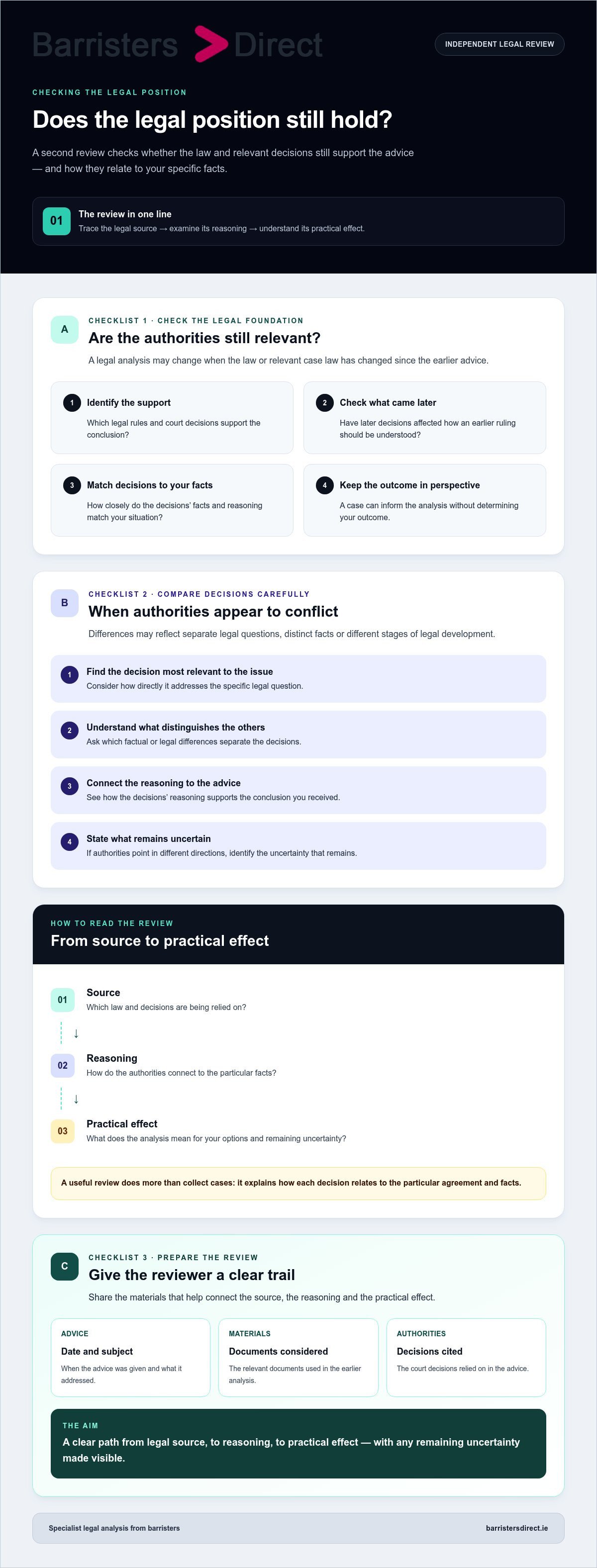
A legal analysis can change if the law or relevant case law has changed since earlier advice. In Ireland, published court opinions form case law, a major source of law in common law systems. A second review should therefore consider whether the authorities relied on still apply to your specific facts.
Start by asking which legal rules and decisions support the conclusion. The reviewer can identify relevant court decisions, explain their reasoning and assess how closely their facts match yours. For example, a decision about one contract clause may not settle a dispute involving different wording or circumstances. A case can inform the analysis without determining your outcome.
Courts may publish opinions at their direction. Those opinions can reinforce, change, establish or overturn legal precedent. An older decision may therefore no longer provide the complete picture. A sound review considers the current line of authority and whether later decisions have affected how an earlier ruling should be understood.
When authorities appear to conflict, examine their differences before treating them as irreconcilable. The decisions may concern separate legal questions, distinct facts or different stages of legal development. Ask the reviewer to explain:
- Which decision is most relevant to the specific issue?
- What factual or legal differences distinguish the other decisions?
- How does the reasoning support the advice you received?
- What uncertainty remains if the authorities point in different directions?
For a practical example, imagine advice that relies on a published decision about whether a contract term is enforceable. A later opinion might examine whether another court considered similar wording and whether its reasoning affects the earlier decision. The point is not simply to collect cases, but to understand how each decision relates to the particular agreement and facts.
Give the reviewer the date and subject of the advice, the documents it considered and any decisions it cites. Ask whether the legal position has changed, which authorities carry the most weight, and what facts might alter the analysis. This creates a clear trail from source, to reasoning, to practical effect. If you need a fresh legal perspective on a dispute or question, explore independent legal advice relevant to your circumstances.
Examining a lawyer’s reasoning and alternative arguments
A second opinion should test how the conclusion follows from the facts, not simply repeat it. In a contract dispute, the reviewer can trace the analysis from the wording of the clause to each party’s actions and the outcome being advised.
Ask the lawyer to identify the key facts supporting the conclusion and the assumptions it depends on. If an email, signed document or agreed date changes the factual picture, the analysis may change too. This makes it easier to discuss gaps with your solicitor and understand which evidence matters most.
A useful review should examine the other side’s strongest argument too. For example, one party may interpret a contract term according to its ordinary wording, while the other relies on the surrounding negotiations. The opinion should explain how each interpretation fits the documents and facts, rather than dismissing one without analysis.
To make the reasoning clear, ask the reviewer to set out:
- The legal question being answered and the facts that matter to it.
- The rule or principle applied to those facts.
- The strongest argument for the other party’s position.
- The practical effect if that alternative argument succeeds.
These steps help distinguish a firm conclusion from an assumption. In a debt dispute, for instance, the analysis might depend on whether the records show an agreed amount, a payment date and any response to an invoice. If an item is missing or disputed, ask how that affects the reasoning and what further evidence could address the issue.
Alternative arguments are not automatically stronger arguments. A reviewer should assess their support, explain their weaknesses and show how they could affect the available options. In a data protection question without a precedent directly addressing the activity, an interpretation may provide an argument that the activity is compliant. The reasoning should make clear which facts and legal principles support that view.
Bring focused questions to the discussion: “Which fact could change your conclusion?” and “What is the strongest response to this argument?” Then compare the answers with the written analysis. If the conclusion relies on a particular interpretation, ask the lawyer to explain the practical consequences of taking a different view before deciding what to do next.
For a dispute where competing interpretations affect your position, a further specialist legal opinion can help you understand the reasoning and assess the arguments before deciding how to proceed.
The process of obtaining an opinion
In Ireland, a written legal opinion begins with a clearly defined question. A short consultation can help establish whether a written opinion is the right format. For example, you may need a focused answer about a contract clause, employment right or property issue, rather than continuing advice on a wider matter.
To seek a written opinion, send the solicitor a concise account of the issue and the relevant documents or correspondence. If you are seeking a second view, include the original advice, along with related letters, contracts, notices and records. A clear timeline shows how the issue developed and which events may affect the legal analysis.
The solicitor may then ask you to complete a questionnaire. Answer each point accurately, distinguish what you know from what you believe, and explain any missing documents. If the question concerns an unpaid invoice, for example, provide the invoice, the agreed payment terms and any reply from the other party. This helps keep the opinion grounded in the facts.
Before work starts, the solicitor must provide a written costs estimate, known as a section 150 letter. Read it alongside the proposed scope of work. It should help you understand what question the solicitor will address and what work the estimate covers. If the issue changes, discuss the revised scope before assuming the original estimate covers it.
Once instructed, the solicitor researches the relevant law, applies it to the information you supplied and prepares the opinion. A written legal opinion can set out a solicitor’s view on a specific legal question. Check that the final document answers the agreed question and reflects the key facts you provided.
A practical sequence is:
- Define the legal question and decide whether a written opinion suits it.
- Send the solicitor the relevant documents, correspondence and timeline.
- Complete the questionnaire carefully and clarify any uncertain facts.
- Review the section 150 letter before the solicitor starts work.
- Read the emailed opinion and note any recommendations or further questions.
For a focused question, this process produces a written analysis you can revisit when discussing next steps with your solicitor. If you need continuing advice on a complex matter, a single opinion may not cover later developments. Tell the solicitor what decision you need to make, such as whether to respond to a demand or clarify a contractual obligation. That purpose helps define the question, the documents to examine and the practical guidance the opinion should provide.
Understanding applicable law in plain language
A written opinion should connect the relevant Irish law to the facts of your specific question. It should explain the legal reasoning and what that analysis means for the decision you face, rather than leaving you with unfamiliar terminology.
Under Irish law, a solicitor must prepare a written legal opinion. The document can address a specific issue, such as interpreting a contract, understanding employment rights, a property query or a compliance question. Ask the solicitor to state the question being answered, identify the relevant law and explain how it applies to your circumstances.
Published court opinions are collectively known as case law. They are a major source of law in common law systems, including Ireland. If an opinion relies on a court decision, ask what principle it established and how its facts compare with yours. A ruling about one contract clause, for example, may help explain a similar clause without resolving every dispute involving different wording.
Plain language does not mean sacrificing legal precision. It means explaining technical terms when they first appear and showing their practical effect. Ask the solicitor to distinguish the legal rule from how it applies to your facts. For a contract interpretation, that could mean separating what the clause says from what it requires you to do under the agreement.
When reviewing the explanation, look for a clear path through these points:
- The legal question: What specific issue is the opinion addressing?
- The applicable law: Which legal rules or decisions inform the answer?
- Your facts: Which documents, events or circumstances affect the analysis?
- The practical meaning: What options or actions follow from the conclusion?
Cross-border finance shows why jurisdiction matters. An opinion in that context may assess whether transaction documents are valid and enforceable under the law of the relevant jurisdiction, and whether they comply with it. A lender may also seek analysis of a borrower’s corporate capacity. These questions depend on the applicable jurisdiction, so ask the lawyer to identify which law the opinion considers.
Before accepting a conclusion, discuss any term that remains unclear. Ask for a straightforward example of how the rule affects your decision, and whether a different fact would change the analysis. For instance, if an employment opinion relies on a particular contractual term, ask how the advice changes if that term differs from your signed agreement.
If you need a specialist to explain how Irish law applies to your circumstances, seek clear, expert legal advice focused on the question you need answered.
Barristers Direct: Commercial Dispute Resolution
Barristers Direct connects businesses and individuals with specialist barristers for advice on commercial disputes. If you need a second view on contract interpretation, a disagreement with a supplier or another business issue, you can arrange an initial consultation with counsel directly. The specialist barrister can review the legal question, explain the reasoning and help you understand practical options for moving forward.
The right next step depends on your issue. Barristers Direct also provides advice on employment law, debt recovery, wills and probate. If you need focused legal insight before deciding how to proceed, an initial consultation can help clarify the question and possible way forward.
To discuss your circumstances, contact Barristers Direct.
Make your next decision with clarity
A second legal perspective is most useful when it helps you decide what to do next. Before acting, identify the decision in front of you, the points you need clarified and the outcome you want to understand. A focused opinion from a lawyer can put those questions into context and support a more informed discussion of your options.
Barristers Direct connects clients with specialist barristers for Commercial Dispute Resolution, Wills and Probate Legal Advice, and Employment Law Consultation. If one of these areas relates to your situation, the relevant expertise can help you consider the legal question and a practical way forward. A lawyer’s opinion can also help you frame the issues to discuss with your existing solicitor.
You don’t need to resolve every uncertainty before seeking advice. Set out the issue and the decision you’re facing, then discuss what legal insight would help. A clear lawyer’s opinion can give you a firmer basis for considering your next step. Contact Barristers Direct to discuss an opinion and move forward with greater clarity.
Frequently Asked Questions
What does a lawyer’s opinion mean in Ireland?
A lawyer’s opinion is an analysis of a defined legal issue, intended to help someone understand its implications. For example, a business considering a proposed agreement may want to know what obligations particular clauses create. The opinion’s usefulness depends on how closely the analysis addresses the question, facts and documents involved. Check that its conclusion speaks to the decision you need to make, rather than a broader issue you have not asked about.
When might you need a legal opinion from a solicitor or barrister in Ireland?
You might seek one when a legal decision has meaningful consequences and you need focused analysis before acting. For example, an employer considering a proposed change to an employment arrangement may want the relevant rights and risks explained. A second opinion can also help if you need an independent assessment of existing reasoning. Identify the decision at hand and the specific point causing uncertainty to keep the opinion focused on your practical needs.
How long does it take to get a legal opinion in Ireland?
The time required depends on the legal question, the volume of material and the research needed. A focused issue with a clear document trail may require less analysis than a matter involving several agreements, events or disputed facts. Explain any decision deadline at the outset and provide the relevant papers together. If documents arrive gradually or the question changes, the lawyer may need to revisit the scope and analysis.
What information and documents should you provide to a lawyer for an opinion?
Provide a concise account of what happened, what decision you face and what you need the opinion to address. Include relevant signed agreements, draft terms, letters, emails and notices. For example, in an employment matter, the contract and written communications about the issue may establish the context. Put events in date order, label documents clearly and distinguish confirmed facts from your recollection or assumptions.
Can you rely on a lawyer’s opinion if it turns out to be wrong?
An opinion is an analysis, not a guarantee that a court or another party will adopt its conclusion. If new facts emerge or an assumption proves inaccurate, the reasoning may need reassessment. Ask the lawyer to explain the assumptions, limits and evidence underlying the conclusion. If you later discover a material error, raise it promptly and ask how it affects the advice and any decision already made.
What are the risks of relying on informal or verbal legal advice?
Verbal advice can be harder to recall accurately, especially if it covers several issues or depends on facts discussed briefly. You may misunderstand a qualification or overlook a practical step. After a conversation, write down what you understood, the action discussed and any uncertainty. Ask the solicitor to clarify important advice in writing when you need a dependable record to consider a significant decision.
Disclaimer
_This article does not constitute legal advice. Barristers Direct does not provide legal advice. To obtain legal advice, you should contact a legal practitioner._