

Full article
Published 15/10/2026
Before taking formal action in a landlord-tenant dispute, get clear on the facts and the options available. A notice, repair problem, rent disagreement or lease dispute can leave either party unsure of their rights and responsibilities. Reliable landlord tenant dispute legal advice Ireland can help you understand the issue and consider what to do next.
It can be difficult to know whether to consult the Residential Tenancies Board (RTB), speak to a solicitor or seek a barrister’s specialist view. The right route depends on the circumstances, and not every disagreement needs to end up in court. This guide explains what information can help clarify your position, how the different routes compare and when specialist advice may be useful.
Barristers Direct arranges a paid initial consultation with a barrister matched to the relevant area of law. You can discuss your circumstances and possible options directly with the barrister. If the matter proceeds to litigation, a solicitor may also be needed. The consultation is an opportunity to get a clearer view of the issues and possible next steps.
Key Takeaways
- Identify whether the disagreement concerns rent, repairs, access, a deposit, a notice or the meaning of a lease term.
- Prepare a neutral timeline and gather the tenancy agreement, notices and relevant correspondence before seeking advice.
- RTB information, solicitor support and a barrister’s case-specific analysis each serve different purposes.
- Use this guide to landlord tenant dispute legal advice Ireland to identify a practical next step, without assuming court proceedings are necessary.
- Barristers Direct arranges a consultation with a barrister matched to the relevant legal area, giving you an opportunity to discuss your circumstances.
Table of Contents
- Landlord-tenant disputes in Ireland: identify the issue before it escalates
- How specialist barrister advice can clarify a landlord-tenant dispute
- RTB, solicitor or barrister: compare routes for a tenancy dispute
- How to prepare for landlord-tenant legal advice in Ireland
- Arrange a specialist landlord-tenant barrister consultation through Barristers Direct
Landlord-tenant disputes in Ireland: identify the issue before it escalates
A tenancy dispute can feel urgent and personal, particularly when it affects someone’s home, income or property. Before deciding what to do, distinguish what has happened from what either party believes the agreement or law requires. The relevant documents, circumstances and type of tenancy all matter. Residential and commercial arrangements may call for different considerations.
Disagreements can centre on one event or several connected issues. A tenant might report an unresolved repair, question a rent change or challenge a notice. A landlord might raise concerns about unpaid rent, access to the property or whether a lease term is being followed. These examples do not establish who is right. The details and context need to be assessed before anyone can reach a view about an obligation or breach.
- Rent: a disagreement about payments, a proposed increase or how rent has been recorded.
- Repairs: different accounts of a problem, when it was reported or what action followed.
- Access: questions about requests to enter the property or arrangements for access.
- Deposits: a dispute about returning a deposit or making proposed deductions.
- Notices: uncertainty about a notice’s contents, timing or circumstances.
- Lease interpretation: disagreement about the meaning or application of a written term.
The type of tenancy matters too. Don’t assume that guidance about a home tenancy applies to business premises, or vice versa. Landlord-tenant law provides a general overview, but it cannot explain how Irish law applies to a particular agreement. Barristers Direct arranges landlord and tenant legal advice through a barrister matched to the relevant area of law.
What kinds of landlord-tenant disagreement may need advice?
Advice may be useful when the parties disagree about conduct, responsibilities or the meaning of an agreement. For example, a landlord and tenant may give different accounts of a repair request or interpret a clause about access differently. A landlord may question a claim about a notice, while a tenant may be unsure how to respond. These examples don’t determine the outcome. A case-specific assessment can consider the relevant terms, evidence and circumstances.
Why the timeline and paperwork matter
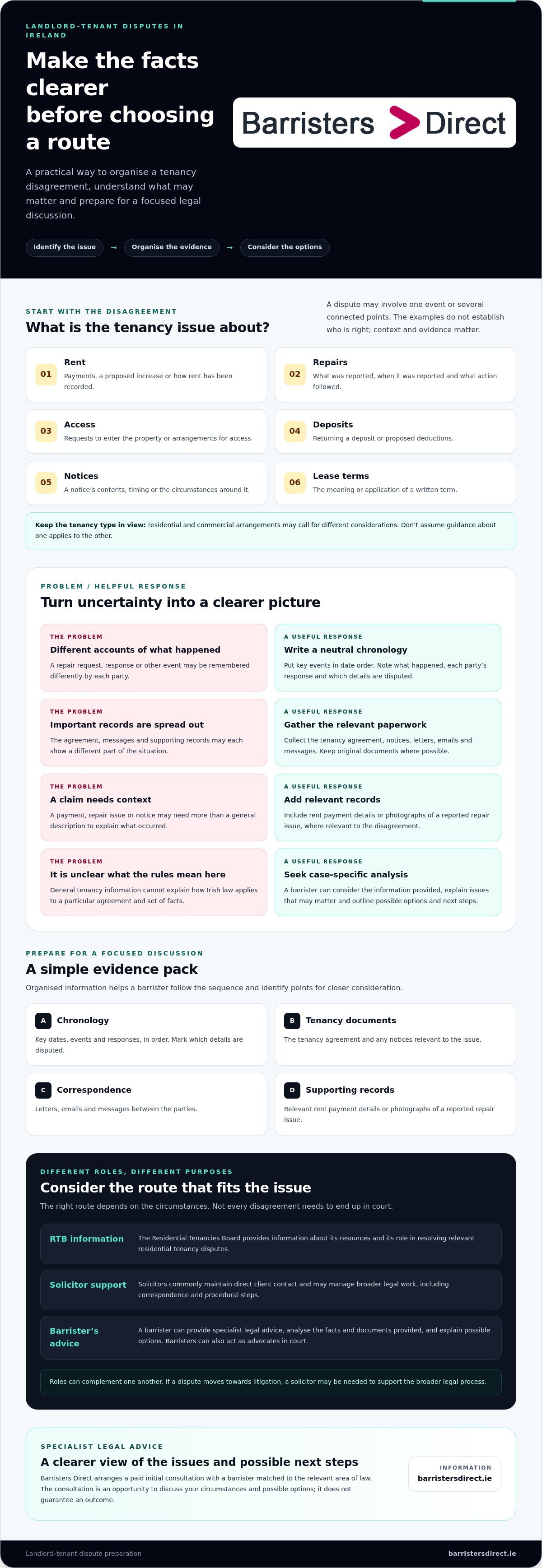
Write down key events in chronological order, including dates, what happened and how each party responded. Gather the tenancy agreement, notices, letters, emails and messages, along with relevant records such as rent payment details or photographs of a reported repair issue. Keep original documents where possible, and note which details are disputed. A clear chronology helps the barrister follow the sequence and identify which points need closer consideration. If you need landlord tenant dispute legal advice Ireland, this preparation gives the discussion a more precise starting point.
How specialist barrister advice can clarify a landlord-tenant dispute
Once you have identified the disagreement, the next question is how the relevant legal principles apply to your circumstances. A barrister can consider the information you provide, explain the issues that may matter and outline possible options, risks and next steps. The purpose is a considered assessment of the information presented, not a promise of a particular result.
In Ireland, barristers are independent practitioners who provide specialist legal advice and can act as advocates in court. Early advice can help you understand your position before deciding whether further action is appropriate. It may also help you frame questions for a solicitor or a discussion with the other party. If the dispute moves towards litigation, a solicitor may be needed to support the broader legal process.
Early advice helps you understand your options; formal representation means acting for you in proceedings.
What can a barrister help you understand?
A barrister can analyse the facts and documents you provide, then explain how the agreement and relevant legal issues may affect the dispute. For example, the barrister can help identify the central question, information that may need clarification and possible routes forward. The assessment is limited to the material considered. It cannot determine how the other party will respond or guarantee a settlement, success or any other outcome.
For landlord tenant dispute legal advice Ireland, focus on what the evidence and applicable rules mean in your particular situation rather than relying on a general account of tenancy rights. You can also use official information from the Residential Tenancies Board (RTB) to understand its resources and role in resolving relevant residential tenancy disputes. A barrister’s advice can help you consider how general information relates to the facts of your case.
How barristers and solicitors can work alongside one another
Solicitors commonly maintain direct contact with clients and may manage broader legal work, including correspondence and procedural steps. Barristers provide specialist advice and can offer courtroom advocacy. Their roles can complement one another: a solicitor may coordinate the wider matter, while a barrister provides focused analysis or advocacy where appropriate. The right arrangement depends on what the case requires.
Knowing the difference between solicitors and barristers can help you decide what support may be useful at this stage. If you want an initial discussion with a barrister whose expertise is relevant to your dispute, Barristers Direct can arrange an introduction and consultation. The barrister provides any legal advice directly, so you can discuss your circumstances with the specialist practitioner.
RTB, solicitor or barrister: compare routes for a tenancy dispute
The right route depends on what you need: reliable information, ongoing legal support, specialist analysis or a formal dispute process. These options have different purposes, and one doesn’t automatically replace another. For landlord tenant dispute legal advice Ireland, start by considering whether the issue concerns a residential tenancy and what guidance or outcome you’re seeking.
| Route | What it may help with | Key distinction | | RTB information | Understanding the RTB’s role, published guidance and dispute resolution options for matters within its remit. | RTB information isn’t the same as case-specific legal advice. | | Solicitor support | Managing broader legal work, advising on a matter over time and assisting with formal processes. | The scope depends on your needs and the solicitor’s involvement. | | Barrister consultation | Getting specialist analysis of a particular legal issue, the available information and possible next steps. | A consultation is advice, not a formal RTB process or a guarantee of representation in proceedings. |
These routes can complement one another. You might consult official information to understand a process, then seek legal advice if your documents or circumstances raise questions that need individual analysis. If the matter becomes formal litigation, a solicitor may be needed for ongoing work or representation arrangements.
When might the RTB be relevant?
The Residential Tenancies Board (RTB) is a possible route for certain residential tenancy matters. Its remit and procedures depend on the issue, so use the RTB’s current guidance to understand the options and any applicable process before acting. Don’t assume that every disagreement, or every type of tenancy, falls within its remit. The landlord and tenant legal advice page covers issues such as rent, repairs, notices and lease interpretation that may benefit from a case-specific view.
When might you seek a barrister or solicitor?
A barrister consultation may be useful if the legal position is complex or contested, or if you need an expert to assess how the agreement and facts fit together. Direct access gives you a way to arrange an initial consultation with a relevant barrister; learn more about the advantages of instructing a barrister directly. A solicitor may be better placed to manage ongoing correspondence or formal proceedings, and can work alongside a barrister when specialist advice or advocacy is needed.
Commercial tenancy disputes need a separate assessment of the agreement and circumstances. Don’t assume residential tenancy procedures apply to a commercial lease. If the premises are used for business, explain that context when seeking advice so the relevant issues can be considered.
How to prepare for landlord-tenant legal advice in Ireland
Preparing a concise account of the dispute helps a barrister understand what happened and what you need clarified. This applies whether you’re a landlord or a tenant. You don’t need to resolve every uncertainty before seeking advice; separate what you know from what you want assessed.
- Define the issue. In a sentence or two, describe the disagreement and identify the tenancy type. Note whether you need to understand a notice, discuss a repair, address a rent disagreement or interpret a term in the agreement.
- Build a neutral chronology. List important events by date, including communications, actions taken and any response. Record what you can verify. If the other party disputes an event, mark it as disputed rather than presenting it as agreed fact.
- Gather relevant documents. Collect the tenancy agreement, notices, letters, emails and messages. Depending on the issue, include payment records, repair reports, photographs or other relevant material. Keep original documents where possible and organise copies in date order.
- Set out your aims and concerns. Explain what practical outcome you’re hoping for and flag anything that feels time-sensitive, such as a recent notice or an upcoming step in a process. Check current rules rather than assuming a particular legal deadline applies.
Build a clear timeline and document bundle
Keep the documents relevant and easy to follow. A short index can identify each item and its date, while clear filenames make electronic records easier to locate. Include material that supports your account, but don’t leave out information simply because it may complicate the picture. A balanced account gives the barrister a better basis for assessing the issue and identifying what remains unclear.
Prepare focused questions for the consultation
Prepare questions that will help you understand the legal issues and practical choices. Ask what appears central to the dispute, what further information may be needed and what next steps could be available. You can also ask whether a solicitor may be needed if the matter proceeds to litigation. Advice can clarify options, but it can’t guarantee a particular result.
Before acting on a notice or taking a formal step, check relevant deadlines and procedural requirements against current rules and guidance. The position may depend on the type of tenancy, the document and the circumstances, so don’t rely on a general timeline as if it automatically applies to your case.
Preparing these materials can make a consultation more focused, whether you’re seeking landlord tenant dispute legal advice Ireland as a landlord or a tenant. Barristers Direct arranges an initial consultation with a barrister matched to the relevant legal area. If you’re ready to discuss your circumstances with a specialist, arrange an introduction to a relevant barrister.
Arrange a specialist landlord-tenant barrister consultation through Barristers Direct
Once you have a clearer picture of the dispute and the questions you need answered, a consultation with a barrister whose expertise is relevant to the legal issue gives you a focused opportunity to discuss your circumstances. Barristers Direct arranges the introduction and paid consultation. The barrister, not Barristers Direct, provides any legal advice.
The consultation is arranged after payment of the advertised fee. It can take place online through Zoom, Microsoft Teams or Google Meet, or by telephone. These formats let you discuss the matter without an in-person meeting. You can explain the issue, provide relevant context and discuss possible options directly with the barrister.
What happens when you arrange a consultation?
- Identify the legal issue. Say whether your concern relates to a residential or commercial tenancy and describe the main point you want advice on. A concise summary helps establish the relevant area of law.
- Arrange the matched consultation. Barristers Direct matches you with a barrister based on the relevant legal area and arranges an initial meeting. Payment of the advertised fee is required for the consultation to be arranged.
- Discuss the facts and possible next steps. Use the meeting to explain the circumstances and raise your questions. The barrister can consider the case as presented and discuss a strategic path forward, including options and issues that may need further attention.
An automatically generated recording and/or synopsis of the consultation is provided only to you and the specific barrister. It can help you revisit the discussion and its main points. Barristers Direct does not provide the advice or become responsible for the legal relationship between you and the barrister.
Know what the consultation does and does not cover
Barristers Direct arranges access to a relevant barrister; it does not itself provide legal advice. Any advice, engagement or contract is solely between you and the introduced barrister. A consultation gives you an opportunity to obtain an expert view on the circumstances discussed. It is not a guarantee of a particular outcome or a substitute for every step that may later be required.
If the dispute proceeds to litigation, a solicitor may be needed to manage ongoing legal work or formal proceedings. The barrister can discuss the issues raised in the consultation, but Barristers Direct does not provide direct litigation representation. That distinction helps you use the initial consultation for what it is: focused specialist advice to inform your decisions.
If you’re ready to discuss your landlord-tenant matter with a relevant barrister, arrange a landlord-tenant barrister consultation.
Choose your next step with confidence
A tenancy disagreement can create pressure to respond quickly, but a measured decision is often more useful than reacting in haste. If you’re unsure what the dispute may mean for your position, landlord tenant dispute legal advice Ireland can help you consider your circumstances before deciding how to proceed.
The aim isn’t to pursue formal action for its own sake. It’s to understand the choices available and make a decision that fits the facts, your priorities and the nature of the dispute. Specialist advice can help you approach that decision with informed judgement, whether the next step is a conversation, further advice or a formal route.
If you’re ready to have your situation considered by a barrister with relevant expertise, arrange a consultation with a relevant barrister. A clear next step can make a difficult situation feel more manageable.
Frequently Asked Questions
Can I speak to a barrister about a landlord-tenant dispute without first instructing a solicitor?
Yes. You can arrange an initial consultation with a relevant barrister without first instructing a solicitor. This may help if you want a specialist view before deciding what support the matter needs. For example, you could ask about a lease clause or how to approach a disagreement. If the issue progresses towards litigation, a solicitor may be needed for ongoing work or formal proceedings.
Is the RTB the right place to resolve every landlord-tenant dispute in Ireland?
No. The RTB is relevant to certain residential tenancy matters, but it isn’t the route for every dispute or type of tenancy. First identify whether the issue concerns a residential tenancy and check the RTB’s current remit and procedures. If you’re unsure how they apply to your circumstances, case-specific legal advice can help you consider whether an RTB process or another route is appropriate.
What should I do if I receive a notice from my landlord?
Keep the notice and note when and how you received it. Read what it says, including the reason given and any dates or actions it refers to, but don’t assume from a quick reading that it is valid or invalid. If you’re uncertain about its effect, seek advice promptly. Relevant requirements and time limits can depend on the circumstances, so check current rules before deciding how to respond.
Can a tenant get legal advice about repairs or a deposit dispute?
Yes. A tenant can seek advice about either issue, and a landlord may also seek advice if the parties disagree about what happened or what the agreement requires. For a repair concern, records of reports and responses may be relevant. For a deposit disagreement, the agreement and communications about proposed deductions can help explain the context. An adviser can assess the material without assuming either party is at fault.
How do I prepare for a landlord-tenant barrister consultation?
Before the meeting, decide which question you most need answered and what practical outcome you’re seeking. Bring relevant documents and mark any points the other party disputes. It may also help to prepare questions, such as what further information could affect the advice or whether a proposed response carries risks. Clear questions help you use the discussion efficiently, without expecting a guaranteed result.
Can a barrister represent me in court after an initial consultation?
An initial consultation doesn’t itself include representation in court. Barristers can provide courtroom advocacy, but any later engagement is separate and depends on the case and arrangements made with the barrister. Barristers Direct arranges consultations, not direct litigation representation. If court proceedings may follow, ask what further legal support is needed; a solicitor may be required to manage ongoing work or proceedings.
Is an online consultation available for landlord-tenant legal advice in Ireland?
Yes. A consultation can take place online or by telephone, so you can discuss the dispute without an in-person meeting. Online meetings are available through Zoom, Microsoft Teams or Google Meet. Once the advertised fee has been paid, the consultation is arranged with a barrister matched to the relevant area of law. Any legal advice is provided by that barrister, not by Barristers Direct.
Disclaimer
_This article does not constitute legal advice. Barristers Direct does not provide legal advice. To obtain legal advice, you should contact a legal practitioner._