

Full article
Published 22/09/2026
Table of Contents
Removing an uncooperative board member is rarely just an administrative formality; under Irish law, it is almost always two distinct legal disputes disguised as one. If commercial deadlock is stalling your business you will want to know how to remove a director from a company in Ireland and the prospect of costly unfair dismissal claims or minority oppression proceedings often leaves leadership paralysed. You already recognise that boardroom friction imperils company value, but moving forward without procedural precision creates substantial litigation exposure for the organisation and its remaining officers.
This guide helps you master the statutory procedures, constitutional requirements, and legal risks of removing a company director under the Companies Act 2014. From calculating the mandatory 28-day special notice timeline and meeting voting thresholds to untangling employment contracts from corporate directorships, you will gain the practical roadmap needed to safeguard your enterprise and resolve governance deadlock lawfully.
Key Takeaways
- Mastering how to remove a director from a company in Ireland requires strict adherence to Section 146 of the Companies Act 2014, including the mandatory 28-day special notice procedure and simple majority voting rules.
- Removing an executive board member from office does not terminate their employment contract, exposing unprepared companies to significant unfair dismissal claims before the Workplace Relations Commission.
- Excluding an owner-manager or founder risks triggering High Court minority oppression proceedings under Section 212, which can halt boardroom decisions or mandate costly share buyouts.
- Companies must formally notify the Companies Registration Office via Form B10 within 14 days of removal to avoid Category 3 offences and statutory fines.
- Accessing independent specialist barristers early through commercial dispute resolution provides an objective case assessment, helping boards resolve deadlocks before formal conflict escalates.
Table of Contents
Understanding the Legal Framework: Statutory Powers and Company Constitutions
Under the Companies Act 2014, a company director holds a distinct corporate office charged with managing business affairs and fulfilling strict statutory and fiduciary duties. While a board of directors controls day-to-day operations, the company members retain ultimate sovereign power. When determining how to remove a director from a company in Ireland, the Act provides shareholders with an unyielding statutory mechanism that curtails board-level entrenchment.
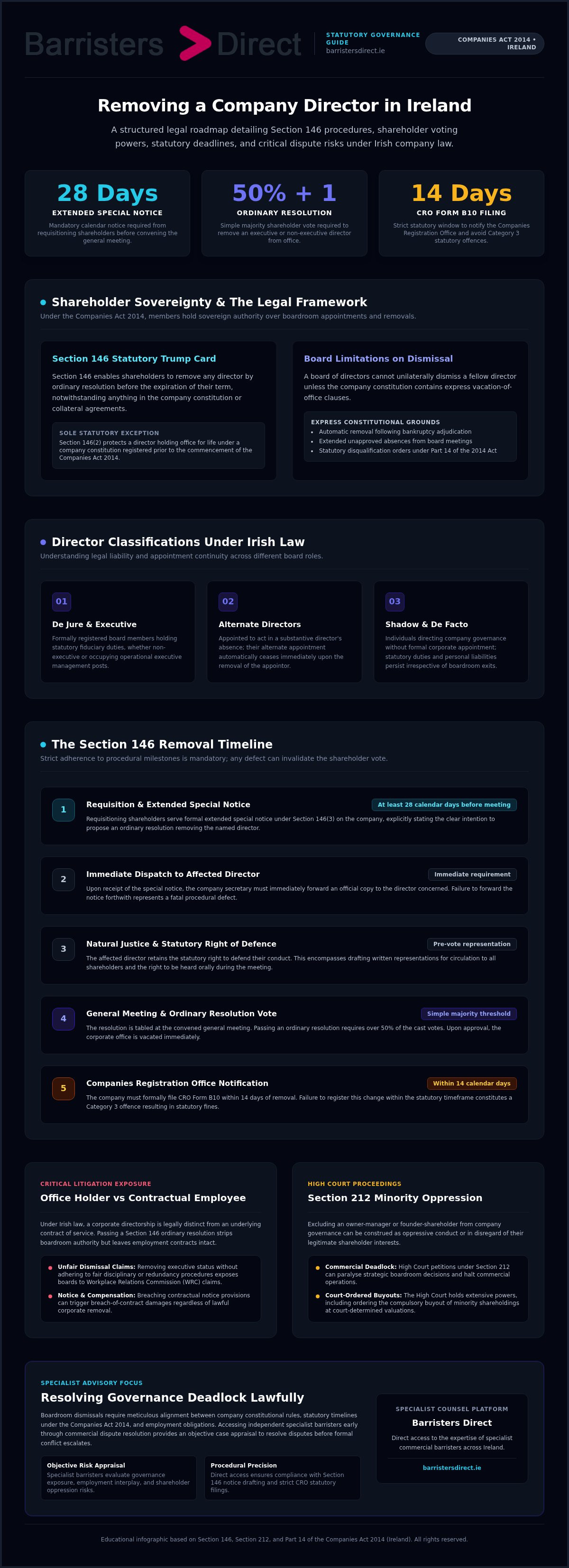
A board cannot unilaterally dismiss a fellow director unless the company constitution contains express vacation-of-office provisions, such as automatic removal following bankruptcy, extended unapproved absences, or statutory disqualification under Part 14 of the 2014 Act. In the absence of such specific clauses, the authority rests exclusively with the shareholders. This legal balance applies across different types of directors:
- De Jure and Executive Directors: Formally appointed board members, whether non-executive or holding operational management roles.
- Alternate Directors: Appointed to act in a director's absence; their appointment automatically ceases if the appointor is removed.
- Shadow and De Facto Directors: Individuals who direct company affairs without formal appointment, whose liability persists regardless of boardroom restructuring.
The Interplay Between the Companies Act 2014 and Company Articles
Section 146 of the Companies Act 2014 serves as the ultimate trump card for shareholders. It establishes that a company may remove a director by ordinary resolution before the expiration of their term, notwithstanding anything in the company's constitution or any agreement between the parties. Private shareholders' agreements cannot extinguish this statutory right, though breach-of-contract liabilities may follow if removal breaches collateral terms. The sole statutory exception under Section 146(2) protects a director holding office for life under a constitution registered prior to the commencement of the 2014 Act.
Office Holder Status versus Contractual Employment
A corporate office is legally separate from an underlying contract of service. If you are assessing how to remove a director from a company in Ireland, this requires careful separation between corporate governance and employment law. Passing an ordinary resolution vacates the directorship immediately, but it does not terminate an executive director's employment contract.
Discarding this distinction invites immediate exposure. Terminating boardroom status without adhering to fair disciplinary procedures, contractual notice periods, or redundancy protocols breaches employment contracts and triggers potential actions before the Workplace Relations Commission. Before initiating board restructuring, seeking an objective legal appraisal via commercial dispute resolution allows leadership to align corporate statutory actions with employment obligations.
The Section 146 Removal Procedure: A Step-by-Step Guide
Executing a lawful boardroom exit requires disciplined adherence to statutory milestones. If you need to understand how to remove a director from a company Ireland enforces a strict timeline under Section 146 of the Companies Act 2014. Omitting a single procedural step can invalidate the entire shareholder vote, leaving the company vulnerable to High Court challenges.
Drafting and Serving the Extended Special Notice
The procedure begins when requisitioning shareholders serve formal "special notice" on the company. Under Section 146(3), this notice must be delivered at least 28 calendar days before the general meeting where the resolution will be tabled. The document must explicitly state the intention to propose an ordinary resolution removing the named director. Once received, the company secretary must dispatch a copy to the affected director immediately. Failing to forward the notice straight away represents a fatal procedural defect.
Protecting the Director: Right to Natural Justice and Fair Hearing
Irish company law strictly safeguards natural justice during boardroom removals. The affected director holds the statutory right to defend their position through both written submissions and oral representations:
- Written Representations: The director may draft written representations of reasonable length and request that the company distribute them to all voting members.
- Circulation Timelines: If the company receives these representations in time, it must circulate them alongside the notice of the meeting, at least 21 days prior to the vote. If received late, the director can insist they be read aloud at the meeting.
- Right to Speak: The director is legally entitled to attend the general meeting and address the shareholders directly, regardless of whether they hold shares.
Passing the Ordinary Resolution at the General Meeting
At the extraordinary general meeting, the removal resolution succeeds if it secures a simple majority of more than 50% of the votes cast. Company chairs must verify that a valid quorum is present according to the corporate constitution. Voting rights attach to share classes, meaning leadership must review the capital register for any weighted voting rights or special privileges before calling the vote. Proxies must be checked and recorded systematically.
If boardroom deadlock threatens commercial operations, scheduling a strategic appraisal through Barristers Direct connects your board with independent counsel to assess voting thresholds and procedural steps before serving formal statutory notices.
High-Risk Complexities: Employment Claims, Section 212, and Deadlocks
Removing a corporate officer rarely occurs in a vacuum. When shareholders examine how to remove a director from a company in Ireland, the law enforces complex layers of statutory protection that extend far beyond simple company voting rules. If leadership fails to account for employment status or minority shareholdings, a seemingly routine board reshuffle can trigger parallel proceedings in the Workplace Relations Commission (WRC) and the High Court. Understanding these surrounding legal obligations is essential, as detailed in our guide on director duties and liability.
Managing Unfair Dismissal and Breach of Contract Exposure
Executive directors usually hold contracts of service alongside their boardroom seats. If an individual qualifies as an employee under the Unfair Dismissals Acts 1977 to 2015, removing them from the board without establishing substantial grounds and observing fair procedures invites serious financial exposure. The WRC can award statutory compensation of up to 104 weeks' gross remuneration (two years' pay) where financial loss is established, with claims required within six months of termination. Meanwhile, bypassing contractual notice periods allows the outgoing officer to initiate common-law wrongful dismissal proceedings for unliquidated salary, bonuses, and accrued benefits.
Navigating Minority Oppression Petitions Under Section 212
Where a director also owns shares, sudden removal frequently generates minority oppression petitions under Section 212 of the Companies Act 2014. The risk intensifies in "quasi-partnerships", small private enterprises formed on mutual trust where co-founders share a legitimate expectation of participating in executive management.
Irish courts scrutinise boardroom expulsions in these enterprises strictly:
- Oppressive Conduct: Excluding a founder from management or withholding dividends without a commercial justification often constitutes oppressive conduct or disregard of their interests as a member.
- Interlocutory Injunctions: High Court authorities demonstrate that while statutory removal powers remain broad, courts can grant interim injunctions restraining a Section 146 vote pending full trial.
- Judicial Remedies: Under Section 212, judges routinely direct the majority to purchase the minority's shares at fair value with or without a minority discount, and they retain the power to order company winding-up in acute deadlocks.
Post-removal fallout also threatens valuable business assets. Leadership must verify that IP assignment clauses and non-compete covenants remain legally enforceable after office vacation. Early assessment through an employment law consultation provides the strategic clarity required to isolate corporate restructuring from catastrophic employment liabilities.
Post-Removal Obligations: CRO Filings and Corporate Handover
Passing an ordinary resolution terminates a directorship instantly, but statutory responsibilities do not conclude when the meeting adjourns. In mastering how to remove a director from a company in Ireland, the law enforces strict administrative rules that demand prompt compliance. Overlooking post-removal filings or delaying operational cut-offs exposes the business to regulatory sanctions and commercial vulnerabilities.
Filing Form B10 with the Companies Registration Office
Irish companies must formally notify the Companies Registration Office (CRO) of any officer cessation by submitting Form B10 electronically through CORE. This notification must occur within 14 calendar days of the removal date. Failing to deliver Form B10 on time constitutes a Category 3 offence under the Companies Act 2014, carrying summary conviction fines of up to €5,000 against the company and each defaulting officer. If an uncooperative board refuses to notify the authorities, the departing individual can submit a statutory declaration via Form B69 to rectify public records.
The company secretary must simultaneously update the statutory register of directors and secretaries at the registered office. The company secretary must confirm also that the board still satisfies Section 137 of the Companies Act 2014, which mandates at least one European Economic Area (EEA) resident director unless the firm holds an active €25,000 non-EEA director bond or Section 140 certificate.
Executing an Orderly Corporate and Operational Handover
Isolating the business from potential administrative disruption requires a methodical operational handover. Boards should execute the following controls immediately after the vote:
- Financial Controls: Revoke commercial banking authorisations, remove signing rights from electronic payment platforms, and cancel corporate credit facilities.
- Digital and Physical Security: Terminate remote server credentials, administrative permissions, email accounts, and building access cards.
- Asset Recovery: Secure the prompt return of all proprietary equipment, confidential hard-copy records, client files, and corporate intellectual property.
Outgoing directors must also recognise that fiduciary duties do not extinguish completely upon departure. Under Irish common law and statute, former directors remain legally prohibited from exploiting confidential information or diverting ripening corporate opportunities that they encountered while in office.
To ensure your corporate restructuring adheres strictly to company law without exposing remaining officers to statutory penalties, book a consultation through Barristers Direct to review your procedural roadmap with an independent barrister.
Resolving Boardroom Impasses: The Value of Specialist Legal Counsel
Boardroom deadlocks frequently paralyse daily enterprise operations. When shareholders explore how to remove a director from a company Ireland offers formal statutory routes, yet escalating straight to contentious shareholder votes without strategic review often inflames conflict. Obtaining an objective, specialist legal assessment early shields leadership from procedural defects, uncalculated liabilities, and reputational harm.
Before serving formal statutory notices, taking time to explore the advantages of instructing a barrister directly allows directors to pinpoint legal vulnerabilities and examine alternatives like commercial mediation or structured settlement agreements. Where an exit cannot be negotiated amicably and formal High Court proceedings or injunction applications arise, independent counsel works seamlessly alongside your instructing solicitors to build a robust, litigation-ready posture.
Early Tactical Assessment to Avoid Protracted Litigation
A measured, pre-emptive legal appraisal prevents costly missteps before contentious statutory machinery is set in motion:
- Identifying Vulnerabilities: Counsel evaluates the company constitution, shareholder agreements, and voting rights to ensure proposed resolutions rest on solid procedural foundations.
- Assessing Section 212 Exposure: An independent review gauges whether an unseat attempt could be characterised as oppressive conduct, allowing the board to structure appropriate share valuation mechanisms.
- Negotiated Exits: Exploring confidential severance terms often delivers a cleaner commercial outcome than public EGM debates, protecting sensitive business goodwill.
Accessing Expert Legal Insight via Fixed-Fee Direct Consultation
Direct access arrangements empower Irish businesses to consult practising, specialist barristers without bureaucratic delays. Barristers Direct facilitates secure remote consultations nationwide, delivering cost certainty through transparent, fixed-fee structures rather than open-ended hourly billing. Following the consultation, participants receive an automated recording alongside a written synopsis outlining the barrister's objective strategic analysis.
Whether you need targeted guidance on company law procedures or broader commercial dispute resolution, specialist counsel provides the precise roadmap required to address corporate impasses decisively. If your leadership team faces mounting boardroom tension, take proactive control by arranging an expert legal consultation today to protect your enterprise before serving statutory removal notices.
Take Decisive Control of Your Corporate Governance Today
Boardroom deadlock does not resolve on its own. When considering how to remove a director from a company Ireland demands rigorous statutory precision under Section 146 alongside proactive defence against employment claims and Section 212 shareholder oppression petitions. Treating corporate office removal and contractual employment as separate legal matters ensures your enterprise moves decisively without exposing remaining officers to procedural defects or operational paralysis.
You don't have to tackle complex board disputes in isolation. Through Barristers Direct, Irish enterprises can instruct an independent barrister directly for strategic corporate advice under a transparent fixed-fee structure that provides complete cost certainty without hidden retainers. Strategic consultations are delivered nationwide by experienced independent barristers practising across Ireland, complete with an automated consultation recording and an objective written summary for your company records. With specialist legal analysis guiding your next steps, you can resolve executive impasses cleanly and lead your business forward with confidence.
Frequently Asked Questions
Can a company board of directors vote to remove a fellow director directly?
No, a board of directors has no inherent statutory power to vote a fellow director out of office under the Companies Act 2014. That authority belongs exclusively to company shareholders acting through an ordinary resolution. A board may only remove a peer if the company constitution contains an explicit, bespoke vacation-of-office clause granting directors that power, or if an automatic disqualification event occurs, such as personal bankruptcy or a statutory restriction order.
How much notice must be given to remove a director under Irish law?
Shareholders must provide the company with at least 28 calendar days' extended special notice before the general meeting where the removal resolution will be considered. Once received, the company secretary must dispatch a copy to the director immediately. The company must then give members at least 21 days' notice of the meeting itself. Mastering how to remove a director from a company Ireland demands strict adherence to these statutory notice intervals to prevent procedural invalidity.
Can a director be removed if they are also an employee of the company?
Yes, shareholders can remove an executive director from the board, but doing so does not terminate their employment contract. Directorship and employment are distinct legal relationships. If the company dismisses the individual as an employee without fair procedures, valid grounds, or contractual notice, they may initiate an unfair dismissal claim before the Workplace Relations Commission or bring a High Court breach-of-contract action for wrongful dismissal damages, irrespective of their board departure.
What happens if a removed director holds shares in the Irish company?
Removing a director does not automatically affect their share ownership or member rights. They retain their equity, dividend entitlements, and voting power unless a shareholder agreement or constitution contains compulsory transfer provisions. However, when evaluating how to remove a director from a company Ireland recognises that stripping an owner-manager of boardroom involvement can prompt minority oppression proceedings under Section 212, often resulting in court-mandated share buyouts at fair market value without discounts.
What is the consequence if the company fails to file Form B10 on time?
Failing to submit Form B10 to the Companies Registration Office within 14 days of removal constitutes a Category 3 offence under the Companies Act 2014. This default exposes both the company and its officers to summary prosecution, with Class A fines reaching up to €5,000. Late filings also create administrative complications with financial institutions, credit agencies, and corporate registries, whilst leaving public records inaccurate regarding authorised signatories and current governance structures.
Can a director sue for compensation following their removal from the board?
While Section 146(1) allows shareholders to remove a director, Section 146(4) explicitly preserves any pre-existing compensation rights. If the director holds an executive service agreement or fixed-term service contract, the removal may trigger substantial claims for wrongful termination, unpaid fees, or contractual notice pay. Executive directors who qualify as statutory employees may also claim statutory compensation before the Workplace Relations Commission for up to 104 weeks of remuneration if dismissed unfairly.
How does Section 212 protect a removed minority shareholder director in Ireland?
Section 212 protects shareholders against oppressive conduct or actions that unfairly disregard their interests. In private companies founded on personal trust and mutual cooperation, courts often find that co-founders hold a legitimate expectation of participating in executive management. If the majority removes a director-shareholder without fair exit terms or valid commercial justification, the High Court can intervene, restrain the removal, or compel the majority to purchase the minority shares at full fair value.
Article by
The Barristers Direct Team
Barristers Direct is a network of independent barristers, who are all highly experienced sole practitioners, and are members of the Law Library.
Disclaimer
_This article does not constitute legal advice. Barristers Direct does not provide legal advice. To obtain legal advice, you should contact a legal practitioner._