

Full article
Published 16/10/2026
What should you do when a disagreement between shareholders starts affecting company decisions or day-to-day work? Knowing how to deal with a shareholder dispute begins with understanding the exact issue, what the company’s documents say and what outcome is practical.
It’s understandable to feel uncertain when rights, obligations and business relationships are all in play. Acting too quickly can intensify the conflict, but leaving it unaddressed may make decisions and operations harder to manage. A measured first step is to organise the facts, review relevant documents and identify what needs to change.
This guide explains how to assess a dispute in an Irish company, including the relevance of the Companies Act 2014 and any shareholders’ agreement. It compares direct discussion, mediation, arbitration and court proceedings, so you can weigh each route against the circumstances and the need to keep the business functioning. A paid consultation with a specialist barrister arranged through Barristers Direct can help clarify your position and possible next steps. Where formal proceedings are appropriate, a solicitor is required where applicable.
Key Takeaways
- To understand how to deal with a shareholder dispute, separate the underlying business disagreement from any potential legal claim before choosing how to respond.
- Build a neutral, dated account of events and note which company records or communications support each point.
- Compare discussion, mediation, arbitration and litigation against the outcome you need, the relationship you want to preserve and the business’s ability to keep operating.
- Use calm, factual communications and practical measures to reduce disruption while the disagreement remains unresolved.
- A focused consultation brief helps a specialist barrister assess the issues and explain possible next steps.
Table of Contents
- How to Deal with a Shareholder Dispute: Identify the Issue Before Acting
- Gather the Documents and Evidence That Explain the Disagreement
- Compare Shareholder Dispute Resolution Routes Before Choosing One
- Take Practical Steps to Protect the Business While the Dispute Continues
- Get Specialist Advice and Decide Your Next Step
How to Deal with a Shareholder Dispute: Identify the Issue Before Acting
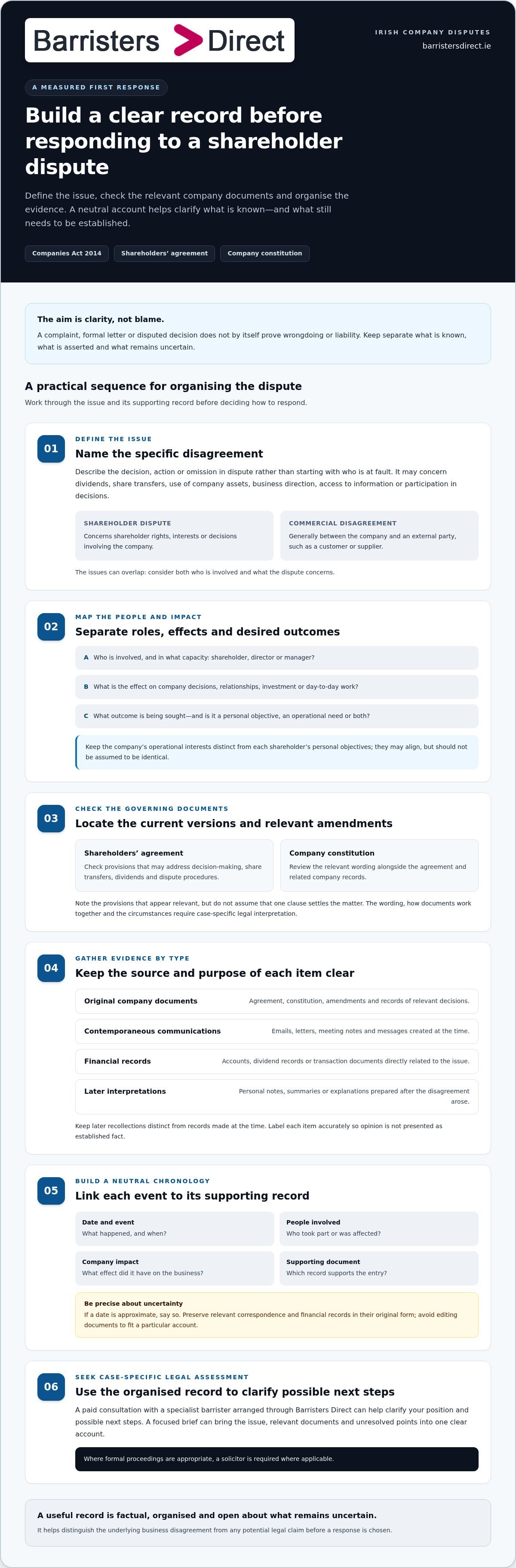
If you’re working out how to deal with a shareholder dispute, start by defining the precise disagreement rather than deciding who is at fault. A difference of view can become a serious business problem, but conflict or a written allegation does not, by itself, establish that anyone has breached a legal duty or is liable.
At a glance: A shareholder dispute concerns disagreement about shareholder rights, interests or decisions involving the company. An ordinary commercial disagreement is generally between the company and an external party, such as a customer or supplier. The issues can overlap, so consider both who is involved and what the dispute concerns.
What counts as a shareholder dispute?
The disagreement may be between shareholders, or involve a shareholder and the directors or management. It might concern whether profits should be distributed as dividends, whether shares can be transferred, how company assets are being used or the direction the business should take. It may also involve concerns about access to information or participation in decisions.
Record allegations as allegations. A shareholder’s complaint, a formal letter or a disputed decision may help identify the issue, but none automatically proves wrongdoing. Whether a person has particular rights or obligations depends on the company’s documents and the circumstances. Keep separate what is known, what is asserted and what still needs to be established.
Why early clarity matters to the company
Unresolved conflict can hold up decisions, unsettle working relationships and make it harder to plan investment or manage everyday operations. For example, if shareholders disagree about a proposed change in business direction, uncertainty over approval or authority may affect planning. If the dispute concerns dividends, expectations about available funds may differ. These effects are important to identify, but they do not establish that one side is right.
Separate the company’s operational interests from each shareholder’s personal objectives. A shareholder may want a particular financial outcome or role, while the company needs decisions that support continuity. Those interests can sometimes align, but don’t assume they are identical.
Identifying the exact decision in dispute turns a broad conflict into an issue the parties can assess and address.
Before deciding what to do next, make a neutral initial assessment:
- Who is involved, and in what capacity: shareholder, director or manager?
- Which specific decision, action or omission is disputed?
- What is the impact on the company’s decisions, relationships, investment or daily work?
- What outcome is being sought, and is it a personal objective, an operational need or both?
This gives the disagreement clearer boundaries. It also helps distinguish a strained business relationship from a potential legal claim that needs to be assessed against the relevant documents and facts.
Gather the Documents and Evidence That Explain the Disagreement
Once you’ve identified the issue, build a reliable record before responding or proposing a solution. A disciplined approach to how to deal with a shareholder dispute means recording what happened, when it happened and what evidence supports each point. Keep the account neutral, so someone unfamiliar with the conflict can follow the sequence without having to accept either party’s interpretation.
Review the shareholders’ agreement and company constitution
Locate the current shareholders’ agreement and company constitution, along with any relevant amendments or related company records. These documents may address decision-making, share transfers, dividends and procedures for handling disputes. Note the provisions that appear relevant, but don’t assume one clause settles the matter. The wording, how the documents work together and the circumstances all require case-specific legal interpretation.
Gather material by type so the source and purpose of each item remain clear:
- Original company documents: the agreement, constitution, amendments and records of relevant decisions.
- Contemporaneous communications: emails, letters, meeting notes and messages created at the time of the events.
- Financial records: accounts, dividend records or transaction documents that relate directly to the disputed issue.
- Later interpretations: personal notes, summaries or explanations prepared after the disagreement arose.
Keep later interpretations separate from records created at the time. For example, an email confirming a decision is different from a later recollection of what someone intended. Both may help explain the dispute, but labelling them accurately avoids presenting opinion as established fact.
Create a useful record without escalating the conflict
Prepare a dated chronology that links each event to its supporting document. Include the decision or communication, the people involved, the effect on the company and any points that remain uncertain. If a date is approximate, say so rather than presenting it as exact. Preserve relevant correspondence and financial records in their original form, and avoid editing documents to fit a particular account.
Use a simple structure for each entry:
- Date and event: what happened, stated as fact.
- Source: the document or record that supports it.
- Business impact: any observable effect, such as a delayed decision.
- Open question: what is unclear or disputed.
Keep assumptions, accusations and proposed remedies in separate notes. If a shareholder alleges that a decision breached an agreement, record who made the allegation and which document or event it concerns. Don’t present the allegation as a proven breach.
A clear evidence chronology helps distinguish agreed facts from disputed ones, making it easier to identify what needs explanation or legal review. A specialist barrister can help assess how the relevant documents and evidence fit together. Barristers Direct arranges paid consultations with qualified barristers. Learn more about accessing specialist legal expertise.
Compare Shareholder Dispute Resolution Routes Before Choosing One
There isn’t one route that suits every shareholder dispute. The right approach depends on the governing documents, the facts, any urgency and what the parties want to achieve. Consider how much control each party retains, whether the process could preserve working relationships, what privacy considerations arise and how formal the process is. The comparison below is a starting point, not a ranking.
| Route | Control and relationship | Formality and privacy | | Direct discussion | The shareholders retain control over any proposed compromise. A focused conversation may help preserve a working relationship, but depends on the parties being willing and able to engage constructively. | Usually less formal than a third-party process. Agree how proposals and communications will be handled. Don’t assume that every discussion has a particular legal status or privacy protection. | | Mediation | A neutral mediator facilitates discussion, while the parties decide whether to settle and on what terms. It may help parties explore practical options, but does not guarantee agreement. | A structured process. In Ireland, mediation is governed by the Mediation Act 2017, which provides for confidentiality subject to its terms. The outcome is binding only if the parties enter into a settlement agreement. | | Arbitration | The parties submit the dispute to an arbitrator for a decision under the process they have agreed to. The degree of control differs from negotiation or mediation, and a formal determination may affect the working relationship. | A formal alternative to court proceedings, with procedures shaped by the relevant agreement and applicable requirements. Specialist advice can help clarify what an arbitration clause covers and what the process involves. | | Litigation | A court determines the issues through formal proceedings. Parties have less control over the outcome than in a negotiated settlement, and the process can place pressure on business relationships. | Highly formal, with procedural requirements and court involvement. Court proceedings are generally public, so consider the implications for company information and reputation with legal advice. |
When discussion or mediation may be worth considering
If the parties can communicate, structured discussion may clarify what each needs and reveal a practical compromise, such as agreeing how a decision will be reviewed. Mediation adds an independent facilitator to help keep the conversation focused. Participation and the nature of the dispute matter: mediation may be unsuitable if a party won’t engage or an urgent formal step needs consideration. A settlement isn’t assured.
When arbitration or court proceedings may need consideration
Arbitration and litigation aren’t interchangeable. An arbitration clause may affect the available route, while court proceedings follow a different formal process. Before taking a step that could affect rights or company operations, obtain specialist legal assessment of the documents, facts and urgency. A solicitor is required where applicable for formal proceedings. For broader context on commercial dispute resolution, consider how the process fits the business issue and the outcome sought.
To decide how to deal with a shareholder dispute, compare each route against the same practical questions: can the parties participate, what decision or outcome is needed, and what effect could the process have on the company? A qualified barrister can provide specialist advice on the options. Barristers Direct arranges paid consultations with barristers matched to the relevant legal area.
Take Practical Steps to Protect the Business While the Dispute Continues
A shareholder conflict can continue while the company still needs to make decisions, serve customers and manage its commitments. A measured interim plan can limit disruption without prejudging the dispute or undermining anyone’s rights. These steps are practical, but the authority to take a particular action depends on the company’s documents and applicable law.
Set objectives and keep communications focused
Before writing or meeting, decide what you are seeking, which alternatives may be acceptable and which concerns are non-negotiable. An immediate objective might be to keep decision-making working while the parties discuss a longer-term disagreement. Distinguish that business need from the personal outcome you ultimately want.
- Identify urgent operational decisions. List matters that cannot reasonably wait, such as a time-sensitive business commitment, and separate them from points that can be discussed later. Don’t use urgency as a reason to bypass required decision-making procedures.
- Check authority before acting. Review the relevant company documents and establish who can make or approve the decision. Don’t assume that being a shareholder, director or manager gives you authority to act alone.
- Communicate the issue calmly. Keep messages concise and factual. Identify the specific decision, explain the practical concern and suggest a clear next step, such as a meeting or an exchange of relevant information. Avoid accusations, threats or statements about another person’s motives.
- Record significant decisions and their rationale. Note what was decided, who was involved, the information considered and why the action was taken. Keep a record of discussions and relevant company documents so the business can understand its decisions later.
- Review the plan as circumstances change. If the dispute affects a new decision or creates a different operational concern, reassess what needs attention and whether specialist advice is appropriate. Don’t treat an interim arrangement as a final resolution unless the parties have agreed that outcome.
Manage company decisions and records carefully
Keep the company’s operational interests distinct from the arguments between individuals. For example, if a decision must be made before the shareholders resolve a separate disagreement, record the business reason for the timing and the process followed. A director’s authority and duties depend on the company’s documents and applicable law, so avoid assumptions about what a director may do in the circumstances.
Don’t assume you can restrict another person’s access to company information, premises, systems or participation in decisions simply because relations have deteriorated. A restriction may affect rights or the company’s operations. Before changing access or decision-making arrangements, obtain advice on the relevant documents, the person’s role and the specific circumstances.
Careful, even-handed steps can help keep the business functioning while leaving room for constructive resolution. If you need advice on what you can appropriately do next, consider a specialist barrister consultation through Barristers Direct, which arranges paid consultations with qualified barristers matched to the relevant legal area.
Get Specialist Advice and Decide Your Next Step
Once you’ve organised the documents and identified the decisions at stake, a focused legal consultation can help you understand your position and consider proportionate next steps. Advice from a barrister with expertise in the relevant area can clarify how the facts and company documents may apply, and which questions need further attention. It won’t predetermine the outcome or replace a decision by the parties or a court.
Prepare for an initial barrister consultation
Make the consultation useful by preparing a concise brief rather than sending an unstructured file of material. Set out the issue in a few sentences, identify the company impact and state what outcome you want. Include any alternative you could accept and flag decisions that need timely advice. If an important fact is uncertain, label it clearly.
Bring or organise the documents most relevant to the issue:
- The company constitution and any shareholders’ agreement, including relevant amendments.
- Key correspondence and records that relate to the disputed decision.
- A concise chronology connecting events to supporting material.
- A short note of the business impact and any immediate decision requiring attention.
Prepare specific questions. For example: What rights or obligations may be relevant? Which parts of the account are established, and which need more evidence? What resolution routes appear open, and what risks should be considered before taking a step? What further information would help assess the position? Focused questions help the barrister address the issues that matter most during the consultation.
Understand direct access and the role of solicitors
Barristers Direct arranges a paid, flat-fee initial consultation with a qualified barrister matched to the relevant legal area. You can instruct a specialist barrister directly for this consultation, which can take place online or by telephone. The barrister provides the advice. Barristers Direct arranges access to that expertise; it does not itself give legal advice or guarantee a particular result. Any further work is agreed directly between the client and barrister.
Direct access doesn’t remove the important role solicitors play in legal work. Depending on the matter and the next steps, a solicitor may be needed to assist with the wider process. A solicitor is required for formal proceedings where applicable. Understanding how each professional contributes can help you plan appropriately; see the explanation of the difference between solicitors and barristers.
For anyone assessing how to deal with a shareholder dispute, specialist advice can turn an organised account of events into a clearer view of options, risks and practical next steps. It can also help identify when further legal input is appropriate, without assuming that a particular route is inevitable.
Arrange a specialist barrister consultation to discuss the dispute with a qualified barrister whose expertise matches the relevant legal area.
Move Forward with a Clear Legal Perspective
The next step doesn’t have to commit you to a particular resolution route. It can help you test your understanding of the dispute, identify what remains uncertain and make a considered decision about what the company and its shareholders should do next. That perspective can help you act with purpose rather than letting pressure dictate the response.
If you’re deciding how to deal with a shareholder dispute, a specialist barrister consultation can focus on the legal questions that matter to your circumstances. Barristers Direct arranges a paid initial consultation with a qualified barrister matched to the relevant area of law. It can take place online or by telephone. Any further work is agreed directly between you and the barrister.
Arrange a specialist barrister consultation to discuss your position and possible next steps. A clearer legal perspective can help you move forward thoughtfully, with the company’s needs and your objectives in view.
Frequently Asked Questions
What happens if there is no shareholders’ agreement?
The absence of a shareholders’ agreement doesn’t mean there are no rules governing the company or its members. The company constitution and applicable law may still be relevant, and other company records can help establish how decisions have been made. Don’t assume that any shareholder can act without restriction. A legal adviser can assess the documents together and explain how they may affect the specific dispute.
Can a minority shareholder challenge a company decision?
A minority shareholder may have grounds to challenge certain conduct, but disagreement with a decision doesn’t automatically establish a legal claim. Section 212 of Ireland’s Companies Act 2014 provides a remedy in cases involving oppression or disregard of a member’s interests. Whether it applies depends on the facts and legal assessment. Record the decision, its effect and the basis for your concern before considering formal action.
How can I protect company records during a shareholder dispute?
Preserve relevant records in their original form and avoid deleting, editing or selectively removing material because it may support one side. Keep a secure, organised copy of key documents and note where originals are held. Continue ordinary record-keeping processes, and don’t use the dispute as a reason to deny someone access they may be entitled to. Get advice before changing access arrangements or handling sensitive records.
Should a company continue trading during a shareholder dispute?
A shareholder dispute doesn’t automatically mean the company should stop trading. Whether it can continue responsibly depends on its circumstances, including whether essential decisions can be made and whether the conflict affects operations or commitments. Keep necessary business activity separate from the disagreement where possible, and document the basis for significant decisions. If the dispute creates immediate operational or financial concerns, seek tailored legal advice promptly.
Can I speak directly to a barrister about a shareholder dispute in Ireland?
Yes. In Ireland, you can arrange an initial paid consultation directly with a qualified barrister. Barristers Direct arranges a consultation with a barrister matched to the relevant area of law. The barrister provides the advice; Barristers Direct arranges access and doesn’t guarantee an outcome. If you later need further legal work, you and the barrister agree it directly, with a solicitor required for formal proceedings where applicable.
What should I prepare before discussing a shareholder dispute with a barrister?
Alongside the relevant company documents and chronology, prepare a short agenda that identifies the decision you need help with and what you want to understand. List questions about the strengths and uncertainties in your position, the implications of any proposed response and what information may still be needed. Flag any upcoming company decision that could be affected, so the barrister can focus the discussion on your priorities.
Does a shareholder dispute always have to go to court?
No. Depending on the dispute and the governing documents, parties may explore direct discussion, mediation or arbitration instead of court proceedings. These routes aren’t interchangeable: arbitration depends on the relevant agreement, while mediation supports discussion but doesn’t ensure settlement. If the parties can’t resolve the matter, court may need consideration. Specialist advice can help assess the available options and their implications before you decide.
Disclaimer
_This article does not constitute legal advice. Barristers Direct does not provide legal advice. To obtain legal advice, you should contact a legal practitioner._