

Full article
Published 08/11/2026
A data breach doesn’t require a hacker: accidental loss, alteration or unauthorised access to personal data can also qualify. For a business, data breach legal advice can help clarify whether the incident must be reported, who needs to be told and what financial exposure may follow. In Ireland, the General Data Protection Regulation (GDPR) and the Data Protection Act 2018 govern data protection duties.
The potential cost goes beyond containment and recovery. According to the European Union, GDPR fines can reach €20 million or 4% of global turnover, while affected people may also claim compensation for financial loss or distress. A business may need to notify Ireland’s Data Protection Commission within 72 hours if the breach is reportable.
It is understandable to focus first on the immediate disruption, but the legal response depends on what personal data was affected and the risk to people. This guide explains what counts as a personal data breach, how to assess notification duties, and when affected individuals must be informed. It also covers documenting the incident and understanding potential fines and compensation claims.
Key Takeaways
- Assess whether personal data was lost, changed, destroyed or accessed or disclosed without authorisation.
- Contain the incident, preserve relevant evidence and keep a record of its facts, effects and remedial action.
- Clarify the processor’s duty to alert the controller and the controller’s responsibility for assessing notification requirements.
- Consider the risk to affected people when deciding whether they need to be informed and how quickly.
- Understand how a breach may lead to claims for financial loss or non-material damage, such as distress.
Table of Contents
- What are the potential costs of a data protection (GDPR) breach?
- Processor notification duties
- Notifying affected individuals about high-risk breaches
- Compensation for material and non-material damage
- What constitutes a personal data breach
- Barristers Direct
What are the potential costs of a data protection (GDPR) breach?
Contact a data protection solicitor promptly after discovering a breach, especially if personal data may have been exposed or reporting duties are unclear. Data breach legal advice for business leaders can help assess the facts, preserve evidence, and determine the next steps.
- Identify the applicable rules. In Ireland, the General Data Protection Regulation (GDPR) and the Data Protection Act 2018 form the data protection framework. If your business collects or uses personal data, assess how the incident affects people’s rights and the safeguards in your policies. A misdirected email, for example, may expose personal information without any cyberattack.
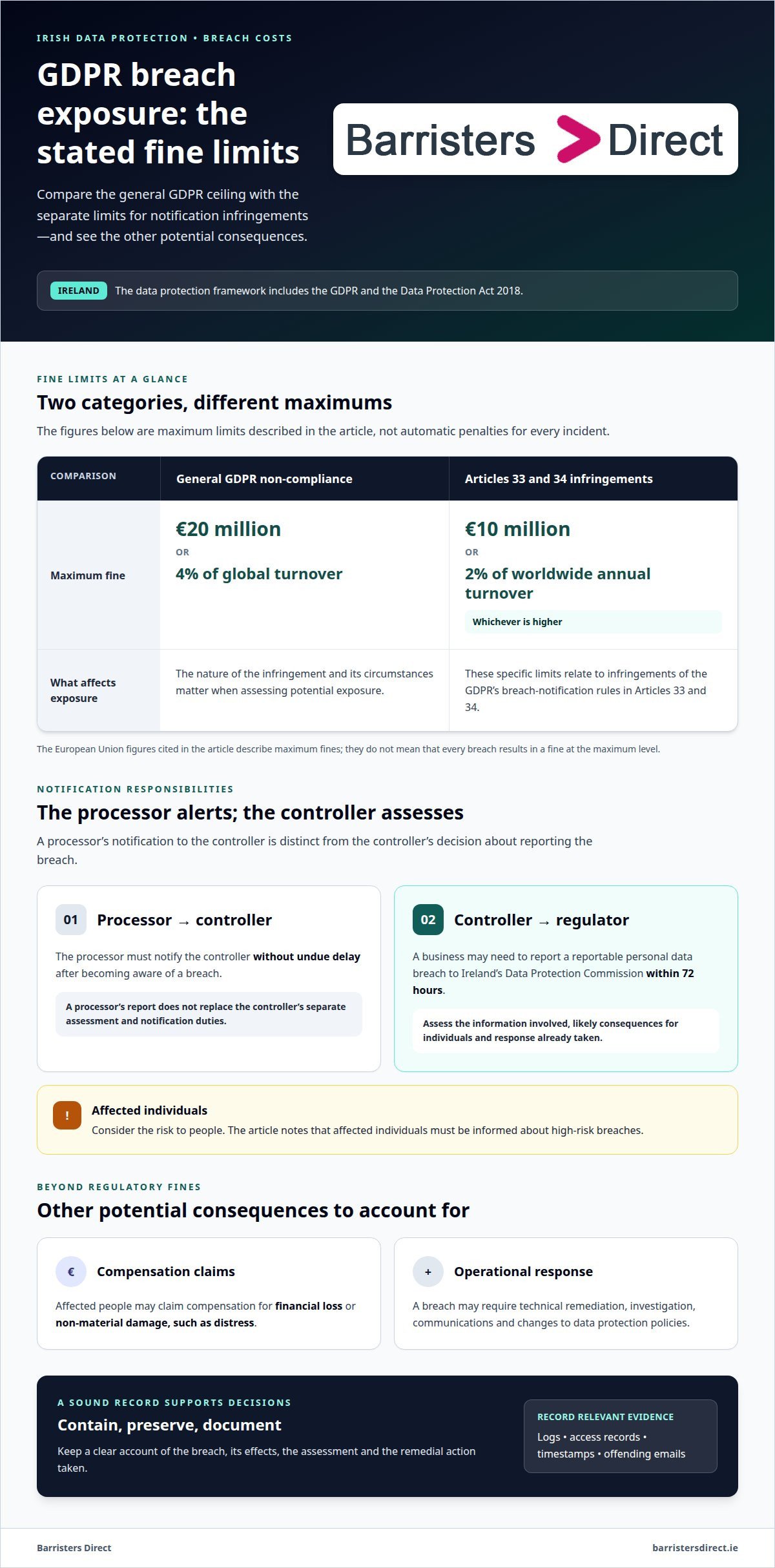
- Assess whether notification is required. In Ireland, a business may be required to report a personal data breach to the Data Protection Commission within 72 hours, according to the European Union. Consider the information involved, its likely consequences for individuals and the response already taken. Document the assessment, including any facts still being investigated.
- Understand possible regulatory exposure. According to the European Union, GDPR non-compliance can result in fines of up to €20 million for businesses, or 4% of global turnover. These are maximum figures, not automatic penalties for every incident. The nature of the infringement and its circumstances matter when assessing exposure.
- Separate notification infringements from other breaches. According to the European Union, infringements of GDPR Articles 33 and 34 can attract fines of up to €10 million or 2% of worldwide annual turnover, whichever is higher. The European Union also states that the limit is 2% of worldwide annual turnover, or €10 million, whichever is higher. Record why your business reported or did not report.
- Contain the incident and preserve evidence. Appoint one person to coordinate the response, then preserve relevant logs, access records, timestamps, and any offending email. Record the facts and effects of the breach, along with remedial action, including steps taken to secure systems or limit disclosure. This creates a clear account of the response and decisions.
- Review operational and financial consequences. A breach may require technical remediation, investigation, communications, and changes to data protection policies. Record the work required and identify weaknesses in access controls or staff procedures. Data breach legal advice for business owners can help clarify potential compensation claims and legal issues arising from the incident.
Processor notification duties
Set clear responsibilities for every processor handling personal data on your business’s behalf. Under the GDPR, a processor’s notification to the controller is distinct from the controller’s assessment of whether to notify the Data Protection Commission.
1.
Check third-party processor compliance
Review each processor’s contract, security arrangements and incident contact details before sharing personal data. Confirm that the agreement requires the processor to tell your business about a breach without undue delay, as Article 33(2) GDPR requires.
Identify what data the processor handles and how it can report an incident. For example, a cloud provider should have a clear route for alerting your organisation to unauthorised access. Record who reviews processor compliance, and update the review when services or data use change.
2.
Establish breach notification procedures
Write a procedure telling staff how to escalate a suspected breach and who receives processor notifications. Include a named internal contact, a backup contact, and a method for recording when the processor became aware of the incident.
Use the information received to assess the breach, its effects, and any required response. The processor must notify the controller without undue delay after becoming aware. Do not treat the processor’s report as a substitute for the controller’s separate assessment and notification duties.
- Document the response and responsibilities. Keep a breach log describing the incident, affected systems, processor communications, and steps taken. Add dates and decision-makers so the record shows how the business responded. If the processor’s first alert lacks detail, note what information is outstanding and follow up through the agreed contact route.
- Review lawful bases for processing. Identify the legal basis for each purpose involving personal data. Consent, contractual necessity, and legitimate interest are possible bases, but they are not interchangeable. For example, a business relying on consent should keep those records distinct from processing needed to fulfil a contract. Clear records help explain why data was collected and used.
- Maintain policies and test the process. Align data protection policies with actual systems, staff responsibilities and processor agreements. Run a practical exercise, such as a supplier reporting a misdirected file, to expose gaps in escalation or record-keeping. Update procedures after changes to suppliers, systems or processing purposes. If a processor dispute becomes a wider contractual issue, commercial dispute advice can help clarify the legal position.
Notifying affected individuals about high-risk breaches
Assess whether the breach is likely to create a high risk to individuals, then decide promptly whether they must be informed. Consider the personal data involved, possible consequences, and safeguards that may reduce the risk.
1.
Assess the risk to individuals
Identify what personal data was exposed and how affected individuals could be harmed. Consider whether the information could enable fraud, expose private details, or cause other serious consequences. Assess the number and circumstances of people affected, along with measures already taken to reduce the risk.
Record the reasoning behind the assessment. A file containing contact details alone may present a different risk from one combining identity and financial information. Focus on the actual consequences for people, not simply the technical cause of the incident.
2.
Decide whether individual notification is required
Inform affected individuals without undue delay if the breach is likely to result in a high risk to them. Explain the nature of the incident, its likely consequences, and steps they can take to protect themselves. Keep the message clear, direct, and relevant to the data exposed.
Article 34(3) GDPR provides exceptions. Individual notification may not be required where effective measures, such as encryption, made the data unintelligible to unauthorised people. It may also be unnecessary if subsequent action means the high risk is no longer likely to materialise. Document the reason for relying on an exception.
3.
Make the initial notification
Assess separately whether the Data Protection Commission must be notified. According to the European Union, a business may be required to report a personal data breach within 72 hours. This reporting duty is distinct from telling affected individuals, which depends on whether the breach creates a likely high risk.
Provide the Commission with the information available and keep the notification accurate. If the investigation is ongoing, identify what remains uncertain and provide further details as they emerge. Preserve a record of the incident, assessment, and communications.
4.
Send phased or late notifications
Provide information in phases when the full facts cannot yet be established. Start with reliable details about the breach and affected data, then update the Commission as the investigation develops. Do not delay an initial report solely because every technical detail is not available.
If notification to the Commission is late, explain the reasons for the delay. Record when the breach was identified, what held up reporting, and the steps taken to address the delay. Keep affected individuals informed promptly where high risk applies.
- Coordinate communications. Assign a responsible person to align the Commission report, individual notices, and internal records. Check that each message describes the same incident and distinguishes confirmed facts from details still under investigation. For example, if a compromised account exposed customer records, explain which records were involved and what protective steps people should take.
Compensation for material and non-material damage
- Separate the breach from the claimed harm. Under the General Data Protection Regulation, an affected person may be entitled to compensation for material or non-material damage. The fact of a breach does not, by itself, describe the loss claimed. For example, an accidental disclosure might expose contact details, while a person may separately report distress or financial consequences. Record each alleged effect clearly.
- Identify material damage. Material damage means a financial loss linked to the incident. Examples include money lost through misuse of disclosed information or costs incurred responding to that misuse. Preserve relevant invoices, account records, and correspondence. A clear timeline can help show what happened, when the loss occurred, and how it relates to the data breach.
- Record non-material damage. Non-material damage can include distress, emotional harm, or reputational harm. These effects may not appear on a bank statement, so document the person’s account and any supporting material. For instance, note when distress was reported and whether the exposed information was sensitive or reached unintended recipients. Do not treat every disclosure as proof of the same impact.
- Assess the connection between the incident and the claim. Compare the alleged harm with the breach facts, affected data, and remedial steps. If someone reports financial loss after an account compromise, preserve relevant transaction records and incident logs. If reputational harm is alleged, record the information disclosed, its audience, and any known consequences. Keep the assessment factual and consistent.
- Preserve records from the response. Keep the breach record, internal decisions, affected-person communications and evidence of corrective action together. The 72-hour reporting period concerns notification duties, not a compensation amount or automatic entitlement. A prompt report to the Data Protection Commission can form part of the incident record, but it does not resolve an individual’s claim.
- Review the claim on its own evidence. Separate documented financial loss from distress or reputational harm, then consider how each relates to the personal data involved. A person affected by a breach may bring a compensation claim, and Irish data protection law recognises that a breach of a controller’s duty of care can result in damages. The claimed harm and supporting evidence remain central to assessing the matter.
- Use the findings to improve practice. Where the incident reveals a weakness, update access controls, staff procedures, or processor arrangements. Record who approved each change and how it addresses the identified problem. This creates a practical record of the business’s response while keeping compensation analysis distinct from regulatory notification and technical remediation.
What constitutes a personal data breach
- Check whether personal data was affected. A breach concerns personal data, not only business files or system outages. Identify the records involved and whose information they contain. For example, a customer spreadsheet sent to the wrong recipient may expose personal data even if nobody hacked the business network.
- Look for loss or destruction. A personal data breach includes accidental or unlawful destruction or loss. Check whether records were deleted, devices went missing, or files became inaccessible. A lost laptop containing customer records is one example. Record what disappeared, when it happened, and whether copies remain available.
- Identify changes to information. Accidental or unlawful alteration of personal data can also qualify as a breach. Compare the affected records with reliable earlier versions, then identify what changed and who or what system made the change. For example, altered employee bank details may affect the accuracy and security of information held by the organisation.
- Check for unauthorised access or disclosure. A breach includes access to or disclosure of personal data without authorisation. Review access records and identify who received or viewed the information. A staff member opening a file outside their role, or an email sent to an unintended recipient, can require assessment even without public exposure.
- Separate the event from its cause. A cyberattack is not essential: human error, a technical fault, or a misplaced device can cause a breach. Establish what happened, which systems or people were involved, and whether the incident was accidental or unlawful. Keep facts distinct from assumptions while the investigation continues.
- Record the controller’s assessment. The controller should document the breach’s facts and effects, along with remedial action, whether or not it reports the incident. Include the affected data, discovery details, containment steps, and reasons for decisions. A clear record helps explain how the controller assessed its responsibilities.
- Assess the consequences before deciding next steps. Identify who may be affected and what the exposed, altered, lost, or inaccessible information could mean for them. A file containing contact details may raise different concerns from records combining identity and financial information. If the controller’s obligations are unclear, obtain legal advice based on the incident’s facts and the information involved.
Barristers Direct
Barristers Direct enables businesses in Ireland to instruct specialist barristers directly for expert legal advice. If a data breach raises questions about contractual responsibilities, liability or a dispute with a supplier, counsel can help clarify the legal issues and possible next steps. Where the incident develops into a commercial disagreement, Commercial Dispute Resolution may be relevant.
Direct access to counsel can help you focus on the legal decisions involved, alongside your operational response and regulatory duties. It may be useful when you need an independent assessment of a developing dispute or advice on your position before deciding how to proceed. Contact Barristers Direct to discuss your circumstances and the legal advice you need.
Turn your response into a clear legal plan
Once the immediate response is underway, consider how the incident affects your business relationships and decisions. If a supplier dispute or questions about employee conduct arise, specialist advice can help clarify responsibilities and possible next steps. Barristers Direct offers consultations in Commercial Dispute Resolution and Employment Law.
Data breach legal advice for a business can help you evaluate the legal position, organise key documents, and decide how to address emerging concerns. The right focus depends on the facts, including the business’s role, the information involved, and any dispute that follows. A legal consultation can complement your technical and operational response, rather than replace it.
If you want to discuss the legal issues arising from your circumstances, contact Barristers Direct for advice. A considered next step can help your business move forward with greater clarity.
Frequently Asked Questions
Does every breach have to be reported to the DPC?
No. A business must assess each personal data breach and report it to Ireland’s Data Protection Commission when required. The likelihood of risk to individuals’ rights and freedoms is central to that assessment. Even if the business decides not to report, it must document the breach, its effects, and the remedial action taken. For example, record why a contained incident did not meet the reporting threshold.
When does the 72 hours start?
The reporting period starts when the controller becomes aware that a personal data breach has occurred, not simply when the incident began. For example, if monitoring later reveals that an account was accessed without authorisation, record when the business had enough information to recognise a breach. The European Union states that a reportable breach may need to be reported within 72 hours.
When does the 72-hour clock start?
The timeline starts when the controller becomes aware of the breach. If a processor discovers an incident first, it must inform the controller without undue delay. The controller then assesses its notification duty. Keep records of when each party discovered the incident and communicated it. This helps establish the timeline and distinguishes the processor’s alert from the controller’s own report to the Data Protection Commission.
What should an Irish business do immediately after discovering a data breach?
Contain the incident, preserve evidence, and appoint one person to coordinate the response. Secure relevant logs, access records, timestamps, and messages, such as an email sent to the wrong recipient. Identify the personal data and people affected, then document the facts, effects, and remedial steps. These actions help the business assess reporting duties and explain its decisions without losing useful evidence during the investigation.
When must a business report a personal data breach to the Irish Data Protection Commission under GDPR?
A business must notify the Data Protection Commission when its assessment indicates that the personal data breach is likely to create a risk to individuals’ rights and freedoms. According to the European Union, notification may be required within 72 hours. If the breach is unlikely to create that risk, notification may not be required, but the business still records the incident and its reasoning.
What information must a GDPR data breach notification include?
Give a clear account of the breach, its known effects, and the response taken. Include what personal data was affected, how the incident happened, and what measures have contained or addressed it. Keep the account factual and distinguish established details from information still being investigated. If further particulars emerge later, send them in phases rather than delaying an initial notification until every detail is known.
What are the GDPR breach reporting deadlines and how are they calculated?
For a reportable breach, the European Union states that a business may need to notify the Data Protection Commission within 72 hours of becoming aware. Record the discovery time, the point at which the controller recognised a personal data breach, and the steps taken to assess it. If notification is late, explain the reasons for the delay and maintain a dated record of the decision.
What fines or other penalties can Irish businesses face for mishandling a data breach?
According to the European Union, GDPR non-compliance can result in fines of up to €20 million or 4% of global turnover. For infringements of GDPR Articles 33 and 34, the European Union states a maximum of €10 million or 2% of worldwide annual turnover, whichever is higher. Individuals may also claim compensation for material damage, such as financial loss, or non-material damage, such as distress.
Disclaimer
_This article does not constitute legal advice. Barristers Direct does not provide legal advice. To obtain legal advice, you should contact a legal practitioner._