

Full article
Published 15/11/2026
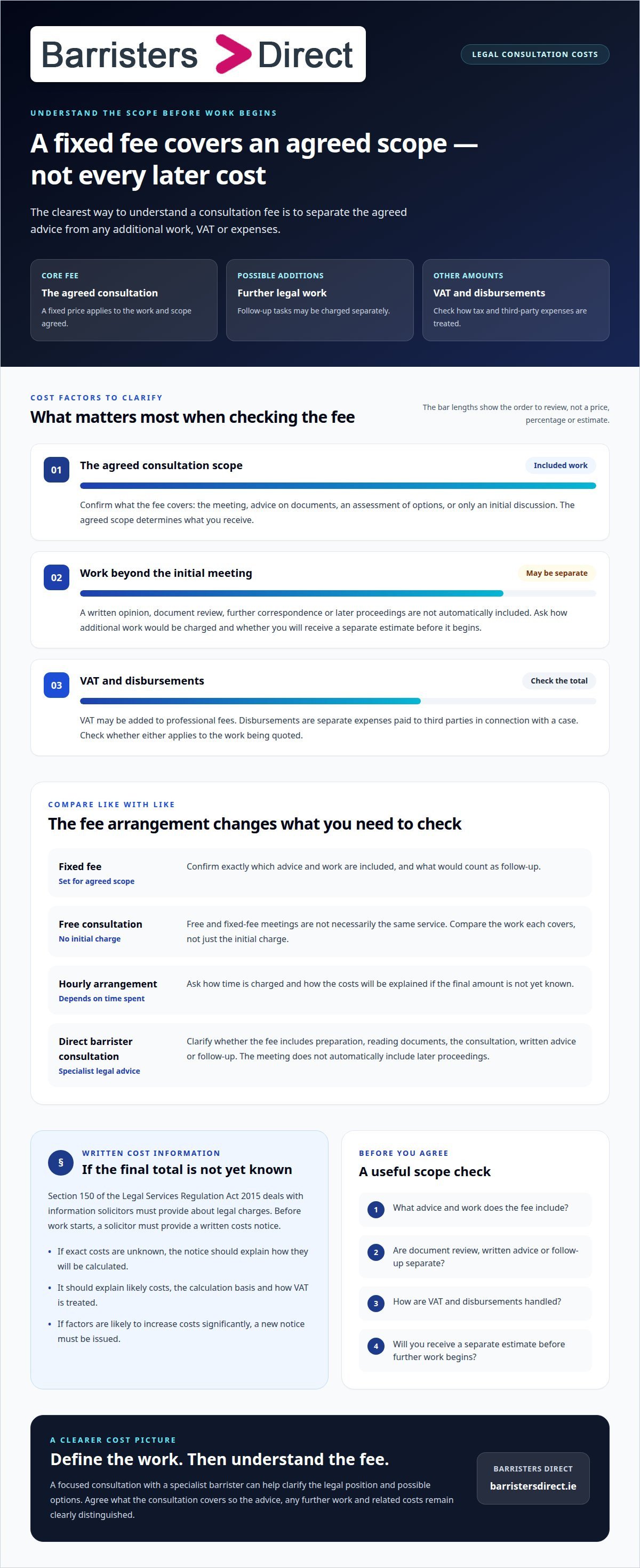
A fixed fee can make the cost of an initial legal consultation clear, but it doesn’t automatically cover every later task or expense. In Ireland, the scope agreed for a fixed-fee legal consultation matters: costs may rise if the work expands or disbursements are needed. Section 150 of the Legal Services Regulation Act 2015 deals with information solicitors must provide about legal charges, according to the Ireland Statute Book.
It’s reasonable to want a clear figure before discussing a legal issue, and to know what could change it. The key is understanding what the fee includes, what falls outside it and how VAT is treated.
This article explains what a fixed fee may cover, why costs can increase, and how VAT and disbursements affect the total. It also explains how a barrister consultation works and what to look for in the agreed scope, so you can understand the likely costs before proceeding.
Key Takeaways
- A fixed fee applies to the work agreed for the consultation; further work or expenses may add to the total.
- If costs are not yet certain, a solicitor can explain in writing how they will be calculated and update you as they become clearer.
- VAT may be added to professional fees, while disbursements are separate expenses incurred for a case.
- A barrister consultation can provide specialist legal advice and help clarify the options and next steps for your matter.
- Understanding the consultation’s scope and what it excludes helps you assess the likely overall cost before proceeding.
Table of Contents
- What if your solicitor doesn’t know what the final charges will be?
- Barrister consultations
- Disbursements and VAT
- Legal consultation availability
- What is in a fixed-fee legal consultation in Ireland?
- Barristers Direct
What if your solicitor doesn’t know what the final charges will be?
An exact final total may not be available before the work is defined. In Ireland, you should still receive clear information about the fixed fee for the agreed consultation and what, if anything, falls outside it.
Free and charged initial consultations
A solicitor’s initial consultation in Ireland may be free or paid, depending on the arrangement. A free meeting and a fixed-fee consultation are not the same: compare the work each covers, not just whether you pay at the outset.
A fixed fee makes the cost of the agreed consultation clear, while an hourly arrangement depends on time spent. Check whether the meeting includes advice on documents, an assessment of options, or only an initial discussion. The agreed scope determines what you receive.
Solicitor charge information
Section 150 of Ireland’s Legal Services Regulation Act 2015 deals with information solicitors must provide about legal charges, according to the Ireland Statute Book. Before work starts, a solicitor must provide a written costs notice; if exact costs are unknown, it should explain how they will be calculated.
Charge information should explain the likely costs, the basis for calculating them and VAT. It should also identify costs already incurred and fixed costs certain to appear in the final bill. If factors emerge that are likely to increase costs significantly, the solicitor must issue a new notice. This gives you a basis to understand changes as the work progresses.
Comparing consultation fees and quotes
A fixed-fee consultation sets a price for an agreed scope; a free consultation has no initial charge, while an hourly rate varies with time spent. When comparing arrangements, check what advice and work are included, how VAT is treated, whether disbursements apply, and whether follow-up work is separate.
Ask whether the quote covers only the meeting or also a written opinion, document review or further correspondence. The distinction between solicitor services and direct access to a barrister also depends on the work each professional is engaged to do. Compare equivalent scopes, not headline figures alone.
Consultation costs and follow-up questions
To understand a fixed fee and possible follow-up costs, ask what the consultation includes and what falls outside it. Clarify how any additional work would be charged and whether you will receive a separate estimate before it begins. This makes the boundary between the initial consultation and later services clear.
Before a fixed-fee consultation, provide the solicitor with a concise description of the issue, key dates, relevant documents and the outcome you want. For example, an employment matter may involve a contract, correspondence and a workplace decision. This helps the solicitor assess the work involved and give a more relevant explanation of scope.
Whether later work requires a solicitor depends on the task, such as advice, document preparation or handling a transaction. Ask the quote to identify the work covered and any further steps separately. The cost depends on the matter’s complexity, documents and agreed scope; the quote for your case gives the exact figure.
Barrister consultations
A barrister consultation gives you direct access to specialist legal advice without a solicitor arranging the initial meeting. In Ireland, direct access is permitted for certain matters, allowing you to discuss a defined issue with counsel and consider possible next steps. The consultation’s purpose and scope should be clear beforehand.
For example, someone facing an employment dispute may want advice on their position, relevant documents and available options. A barrister can assess the information provided and explain the legal considerations. The consultation can clarify whether further work is needed, but it does not automatically include handling later proceedings.
Direct access changes who provides the initial advice, not the need for clarity about the work. The barrister should know the issue, the outcome you are seeking and the material available for review. If documents are extensive or the question covers several legal issues, that may affect preparation and the scope agreed. A focused consultation on one contract clause differs from reviewing a wider dispute.
Before the meeting, establish what the agreed fee covers. Ask whether it includes reading documents, the consultation itself, and any written advice or follow-up. Also ask how additional work would be calculated and whether you would receive a separate notice before it begins. These details distinguish the initial consultation from subsequent legal services.
The Legal Services Regulation Act 2015 sets out duties for solicitors and barristers when charging and billing clients in Part 10. If a solicitor is involved in instructing a barrister, the solicitor must inform you of likely barrister or expert witness costs, where relevant, and be satisfied that you approve engaging them. This approval matters because counsel’s work may be separate from the solicitor’s work.
Court fees and formal legal action are separate matters to clarify. A consultation may provide advice on options, but that does not mean court work or related expenses are included. If a case requires legal action, you may need to arrange further legal support. The agreed scope should make clear what the consultation covers.
For specialist advice on an employment issue, a direct consultation with a barrister can help you understand the legal position before deciding on further steps. Bring the relevant correspondence, agreements and a concise account of events. Clear information helps counsel focus the discussion on the issue requiring advice.
Disbursements and VAT
A legal bill can include professional fees, VAT and disbursements. Professional fees pay for legal work; disbursements are expenses paid to third parties in connection with a matter. A fixed fee for a consultation does not automatically cover later expenses. For example, a registry document or medical report may involve a separate cost.
Any additional expense depends on the work and documents required. Property matters may involve registry records, maps or management company letters. Personal injury matters may require an application or medical report. These costs are separate from professional fees, so ask which expenses are expected and how they are treated.
- An online application to the Injuries Resolution Board costs €45.
VAT is another part of the total. Solicitor fees are subject to VAT at the standard rate, added on top of the quoted professional fee. Medico-legal fees are also subject to VAT unless the expert is below the VAT registration threshold. A quote should therefore make clear whether VAT is included or added, and which professional charges it applies to.
Medical evidence can materially affect litigation costs. These are expert expenses, not the price of a legal consultation, and the report required depends on the issue being assessed.
A straightforward opinion may require 6 to 10 hours of expert time, while a complex case may require 20 hours or more. The report type, complexity, expert’s experience and arrangements with the instructing party all affect the total.
Ask for an itemised explanation showing professional fees, VAT and each anticipated disbursement separately. If an authority, expert or other third party must be paid, the estimate should explain the purpose of that expense. Under Part 10 of the Legal Services Regulation Act 2015, charging and billing duties apply to solicitors and barristers. For a personal injury claim, the online Injuries Resolution Board application is a distinct charge from any legal or medical work.
Legal consultation availability
Access to legal advice depends first on the issue and the professional expertise it requires. In Ireland, an initial solicitor consultation may be free or charged, while a barrister consultation is another route for discussing a defined legal problem. Availability of a suitable consultation is therefore about more than finding an appointment: the professional must be able to address the relevant area of law and the work must fit the agreed scope.
An employment dispute raises different questions from a will or a landlord and tenant disagreement. The subject, documents and decision you face help determine what the initial consultation can address. A technical question about a contract clause may need focused advice; a wider dispute may require further work, considered separately.
Direct access to a barrister provides a way to obtain specialist legal advice without a solicitor arranging the initial consultation. It suits a person who wants counsel’s assessment of a particular issue, such as the implications of an employment decision or the interpretation of a written agreement. A consultation is not automatically the same as ongoing representation. The professional’s role and the work included should be clear from the outset.
To prepare, identify the issue, the decision or action involved, and the advice you need. Relevant documents might include a contract, a solicitor’s letter or correspondence about a dispute. A concise account of events helps the barrister understand the context. If there are several connected issues, explain them so the consultation can address the right questions.
Before proceeding, confirm the consultation’s subject, format, duration and included preparation with the professional. Ask whether document review is included, whether advice will be oral or written, and what happens if the discussion identifies additional work. These points distinguish an initial meeting from later services and make clear what advice the consultation is intended to provide.
The Legal Services Regulation Act 2015 addresses legal charges, but the practical question is what the agreed consultation covers. A costs notice or written agreement should make the scope and charging basis understandable. If the issue changes, the work required may change too. For example, a meeting about one employment decision differs from advice covering several separate workplace events.
When the legal issue is clear and you want an expert view before deciding what follows, a fixed-fee consultation offers a defined starting point. Any further document analysis or advice is separate from the initial meeting. Choose a consultation whose subject and specialist expertise align with the legal question you need answered.
What is in a fixed-fee legal consultation in Ireland?
A fixed-fee consultation covers the work agreed in advance, rather than every legal task that may follow. Its scope might include a meeting with a solicitor or barrister, discussion of a defined issue, and advice on possible next steps. For example, advice on one employment decision differs from reviewing an ongoing workplace dispute.
The agreed scope should identify the legal question the professional will address. It can also explain whether preparation includes reviewing documents, such as an employment contract or a letter about a debt. If document review is included, the agreement should make clear which materials are covered. A large bundle of correspondence may require a different scope from one short letter.
The consultation gives you an opportunity to explain the circumstances and receive legal analysis. For a landlord and tenant issue, that may mean discussing a tenancy agreement, the events in dispute and the options available. The barrister can clarify relevant legal considerations and explain possible next steps. Advice is not a promise of a particular outcome.
Some consultations include oral advice only; others may include a written summary if the agreement says so. A written opinion can record the professional’s analysis and recommendations, while a meeting may focus on explaining options directly. Check which format is included, and whether follow-up questions or additional correspondence form part of the agreed work.
A fixed fee does not automatically include court work, formal letters, negotiations or ongoing representation. For example, advice about a family law issue may identify a possible next step, but taking that step is separate work unless expressly included. If the matter expands or new documents change the legal question, the professional should explain how the additional work will be treated before it proceeds.
Before the consultation, the professional needs enough context to focus the advice: the issue, key events, relevant dates and documents. A concise timeline and the specific decision you face can help distinguish the central question from background detail. For a debt dispute, for instance, the agreement and payment correspondence may matter more than unrelated records.
Read the written scope for the meeting, preparation, advice format and exclusions. If any part is unclear, ask how it applies to your example before proceeding. For specialist legal advice on your issue, arrange a consultation and establish the scope of the work involved.
Barristers Direct
Barristers Direct connects individuals and companies in Ireland with a specialist barrister for an initial fixed-fee consultation. If you need expert advice on a defined legal issue, the barrister can assess the information you provide, explain your options and outline a possible path forward. The initial consultation is a focused opportunity to understand your position; any further work is considered separately.
This direct route may suit matters such as employment disputes, debt recovery, wills and probate, or commercial disputes. The relevant barrister’s expertise depends on your legal issue, and the consultation can help you consider what to do next.
If you’re ready to discuss your legal issue, contact Barristers Direct.
Take the next step with specialist advice
The value of a fixed-fee legal consultation in Ireland lies in getting expert advice focused on the decision ahead. Once you understand your legal position, you can consider which next step is appropriate for your circumstances, rather than treating the consultation as an automatic commitment to further work. The right advice can help you approach that decision with greater clarity.
Barristers Direct provides access to specialist barristers for matters including Commercial Dispute Resolution, Wills and Probate Legal Advice, and Employment Law Consultation. If one of these issues is affecting you, a consultation can help you discuss the matter and understand a path forward. Contact Barristers Direct to discuss your consultation and take your next step with informed legal guidance.
Frequently Asked Questions
What if the costs go up?
If new circumstances are likely to make legal costs significantly greater, your solicitor must issue a new costs notice. For example, a dispute that develops into a contested hearing may require additional work or specialist input. The solicitor should explain the revised basis of charges and likely extra costs. If a barrister or expert witness is needed, you should be told the likely cost and asked to approve their engagement.
How can a solicitor explain whether their fees are negotiable in Ireland?
Solicitors in Ireland are not required to charge a set rate, so you can discuss the proposed fee before work begins. Ask whether the solicitor can agree an overall amount for the defined work, or whether charges will be calculated hourly. For instance, a limited review of one agreement has a different scope from ongoing advice. Any agreed overall amount should be recorded in writing, alongside what it covers.
Are VAT and other costs included in advertised Irish legal consultation fees?
Not necessarily. Solicitor fees are subject to VAT at the standard rate, added on top of the quoted professional fee. Disbursements, such as a registry document or expert report, are separate expenses and may not form part of an advertised consultation fee. Before booking, establish whether the stated amount includes VAT, what work it covers, and whether third-party expenses could arise for your particular matter.
What legal matters in Ireland commonly have fixed-fee consultations, such as family, property, employment or immigration?
Fixed fees are commonly used for standard transactions, including conveyancing and straightforward wills. A consultation about employment or family law can also have a defined scope, such as advice on a workplace decision or a specific family-law question. Immigration advice is a distinct area, so don’t assume it is included in a particular consultation. The relevant professional and agreed scope determine what advice the meeting covers.
Can a solicitor in Ireland charge for an initial consultation, and what fee rules apply?
Yes. An initial solicitor consultation in Ireland may be free or charged, depending on the arrangement. Section 150 of the Legal Services Regulation Act 2015 deals with information solicitors must provide about legal charges, according to the Ireland Statute Book. The written costs notice should explain the charging basis and likely costs. Ask for clarity on the consultation’s scope and any work that would be billed separately.
How can I find and assess fixed-fee solicitors near me in Ireland?
Start by matching the legal issue to the solicitor’s area of practice, then assess the written scope rather than the headline fee alone. For example, an employment contract review is not equivalent to ongoing representation in a workplace dispute. Compare what preparation and advice are included, how VAT is treated, and whether disbursements or follow-up work are separate. Direct access to a specialist barrister is another route for certain matters.
What are the risks or limits of a fixed-fee legal consultation in Ireland?
A fixed fee covers only the work agreed, so it may not include extra document review, correspondence or formal proceedings. If a consultation about a tenancy dispute reveals a separate issue, addressing that issue may require additional work. The consultation provides advice, not a guaranteed legal outcome. Where a matter requires formal legal action, a solicitor may need to be engaged for the necessary steps.
Disclaimer
_This article does not constitute legal advice. Barristers Direct does not provide legal advice. To obtain legal advice, you should contact a legal practitioner._