

Full article
Published 17/09/2026
Table of Contents
In the Irish rental market, a single administrative oversight isn't just a minor error; it's often a guaranteed path to a failed termination and potential financial penalties. Understanding how to evict a tenant in Ireland requires more than just a basic template. It demands a strategic grasp of current legislation to protect your property interests effectively. You likely recognise that the Residential Tenancies Board (RTB) maintains a rigorous standard for compliance, and the intricacies of 'Part 4' tenancies often feel like an intimidating legal minefield. It's natural to feel anxious about the length of the adjudication process or the fear that a small mistake in your notice will reset the entire recovery timeline.
This guide provides the clarity you need to navigate these complex procedural requirements whilst ensuring you remain fully compliant. We'll examine the essential steps for drafting a valid Notice of Termination, the specific timelines you must adhere to, and how accessing specialist legal advice can help you avoid costly mistakes. By following a methodical approach, you can secure a successful property recovery and avoid the pitfalls that lead to RTB disputes.
Key Takeaways
- Understand the role of the RTB and the specific rules governing 'Part 4' tenancies to ensure your property recovery begins on a sound legal footing.
- Learn how to evict a tenant in Ireland by identifying valid grounds for termination, such as rent arrears or specific property requirements, whilst maintaining full compliance.
- Master the procedural requirements of a valid Notice of Termination, including precise notice period calculations, to prevent your notice from being declared invalid.
- Prepare for potential RTB adjudication or mediation by understanding the evidence required to defend your position during a tribunal hearing.
- Discover how direct access to specialist barristers provides a strategic advantage through expert legal advice and a clear path toward successful property recovery.
Table of Contents
Understanding the Legal Framework for Ending a Tenancy in Ireland
The regulatory environment for Irish rentals is governed by strict statutory provisions. If you're seeking information on how to evict a tenant in Ireland, you must first acknowledge the role of the Residential Tenancies Board (RTB). This body acts as the national regulator, overseeing everything from dispute resolution to the mandatory registration of tenancies. Procedural precision is the cornerstone of this framework. Most failed attempts to recover property stem from minor clerical or timeline errors rather than the validity of the grounds themselves. Although a "slip rule" can sometimes be applied by RTB adjudicators and tribunals, a single day's miscalculation in a notice period or a missing statutory declaration can result in the RTB invalidating your notice, forcing you to begin the months-long process from scratch.
Under the Legal Services Regulation Act, landlords can now bypass traditional routes and seek expert Landlord & Tenant Legal Advice directly from specialist barristers who regularly appear before RTB Tribunals arguing the complex governing legislation. This allows for a strategic, high-level review of your case before any notices are served, ensuring your strategy is sound from the outset.
The Residential Tenancies Act and Landlord Obligations
The Residential Tenancies Act 2004 (as amended) is the primary legislation. It dictates every step of the legal process of eviction. Every tenancy must be registered with the RTB; failing to do so can prevent you from using the RTB dispute resolution services. Compliance isn't optional, nor can you "contract out" of it. If you haven't met your statutory obligations, your termination notice is highly likely to be overturned. Specialist barristers often identify these underlying compliance issues early, preventing landlords from proceeding with a notice that's destined to fail at adjudication or subsequent tribunal.
Part 4 Tenancies: Security of Tenure Explained
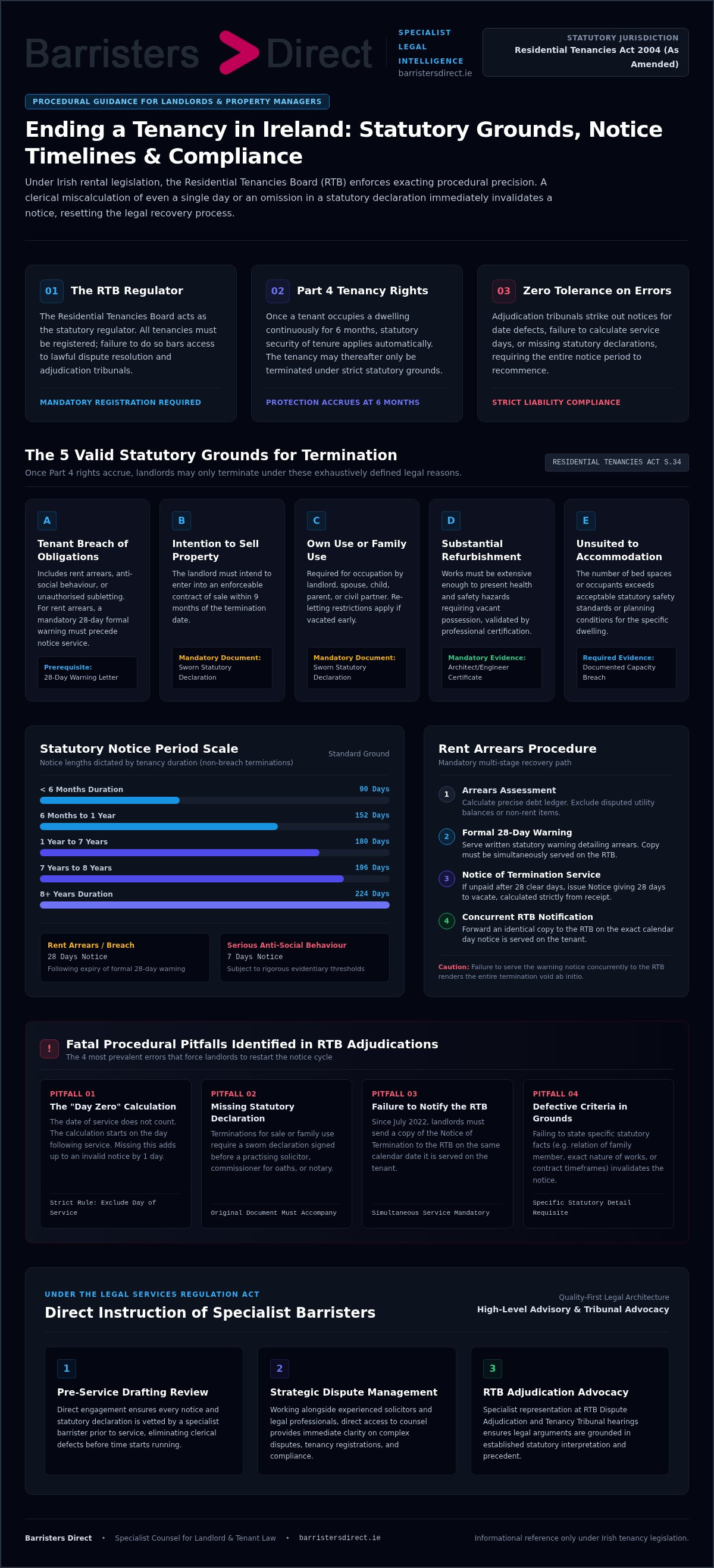
A 'Part 4' tenancy is created once a tenant has been in occupation for at least six months. At this point, they acquire security of tenure. This doesn't mean they can stay indefinitely, but it does mean you can only end the tenancy under specific, legally defined grounds. During this period, tenants maintain their rights to remain in the property whilst the recovery process is underway, provided they continue to meet their obligations. Understanding how to evict a tenant in Ireland requires a clear distinction between these rolling tenancies and fixed-term agreements. If a fixed-term lease is in place, you generally cannot end it early unless there's a specific break clause or a breach of obligations, whereas Part 4 tenancies rely on the statutory grounds set out in the 2004 Act. It may also come as a surprise to many landlords that a tenant occupying under a fixed term tenancy can acquire Part 4 rights after six months' occupation under that fixed term tenancy.
Valid Grounds for Eviction Under Irish Law
Once a tenant acquires Part 4 rights, your ability to recover possession is restricted to specific statutory reasons. If you're researching how to evict a tenant in Ireland, you'll find that the Residential Tenancies Act 2004 provides a finite list of valid reasons and notice requirements for ending a tenancy. Using the wrong ground, or failing to provide the necessary evidence for a valid one, is the most frequent cause of failed adjudications at the RTB.
The primary grounds include:
- Breach of obligations: This most frequently involves rent arrears but can also cover anti-social behaviour or unauthorised sub-letting.
- Property unsuited to needs: Where the number of occupants exceeds the property's capacity.
- Own use or family use: When you or a specific family member, such as a child or parent, requires the dwelling for residence.
- Intention to sell: When you intend to enter into a contract for sale within nine months of the tenancy ending.
- Substantial refurbishment: Where the planned works are so extensive they require vacant possession and are certified by a professional.
Terminating for Rent Arrears: The Mandatory Steps
Recovering a property due to unpaid rent is a multi-stage process. You cannot issue a Notice of Termination immediately. You must first serve a formal 28-day warning letter, and send a copy to the RTB. This document must state the exact amount of arrears and give the tenant 28 days to pay. If they fail to clear the debt, you can then proceed with the termination. Precision is vital. If the tenant pays part of the debt, you must update your records and ensure the final notice reflects the correct figures. Any discrepancy in the arrears amount can lead to an invalid notice.
Selling or Occupying the Property: Evidence Requirements
If you intend to sell or move into the property, the RTB requires more than just your word. For a sale, you must provide a statutory declaration with the Notice of Termination. This declaration confirms your intent to sell within nine months. Landlords often find the logistics of how to evict a tenant in Ireland complex when dealing with the strict evidence required for a property sale. For 'own use' grounds, the definition of family is strictly limited to immediate relatives. If you terminate for this reason and then re-let the property to a new tenant shortly after, you may face significant financial penalties for a 'wrongful termination'.
Securing expert legal advice from a specialist barrister can help you verify your grounds and prepare the necessary documentation to withstand a challenge. It's a strategic investment that ensures your property recovery remains on a sound legal footing.
The Notice of Termination: Precision and Procedural Requirements
If you're determining how to evict a tenant in Ireland, the Notice of Termination is your most critical legal instrument. This document must be in writing, signed by the landlord or an authorised agent, and specify the exact date the tenancy will end. It's a common misconception that a simple letter or email suffices; in reality, the notice must include a statement that the tenant has 28 days to refer any dispute regarding its validity to the RTB. If these specific statutory details are missing, the notice is considered legally void from the outset.
Notice periods are non-negotiable and vary significantly based on the duration of the tenancy. For example, a tenancy of less than six months requires 90 days, whereas a tenancy exceeding eight years requires 224 days. Miscalculating these periods is cited as a primary reason for failure in the RTB guide to adjudication. You must also ensure that the method of service is documented. Whilst hand delivery is permitted, using registered post provides a verifiable paper trail that is essential if the tenant later claims they never received the document.
Statutory Declarations: Why Accuracy is Critical
A Statutory Declaration is a formal statement that must accompany notices served for specific grounds, such as when a landlord intends to sell the property or requires it for family use. This document must be witnessed by a Solicitor, a Commissioner for Oaths, or a Peace Commissioner. If the phrasing does not exactly mirror the requirements set out in the Residential Tenancies Act, the RTB may invalidate the entire termination process. Common errors include failing to state the specific family member who intends to occupy the dwelling or neglecting to mention the timeframe for a proposed sale. Precision here is not just a preference; it is a mandatory requirement to protect your property interests.
Avoiding Common Technical Pitfalls
Many landlords stumble on the '24-hour rule' regarding the date of service. When you calculate the notice period, the day the notice is served does not count as day one. If you serve a notice on a Monday, the countdown begins on Tuesday. If your notice period ends on a Sunday, it's often safer to add an extra day to avoid any ambiguity. Additionally, the notice must be signed by the landlord or their authorised agent. If the property is held in a company name or a trust, the signature must reflect that specific legal entity. Using an outdated template is a frequent mistake that leads to immediate invalidation. Obtaining Landlord & Tenant Legal Advice from a specialist barrister ensures your documentation is current and procedurally robust, preventing the costly delays associated with restarting the termination process.
Navigating RTB Disputes and Adjudication Hearings
If a tenant challenges your Notice of Termination or simply refused to vacate, the matter moves to the Residential Tenancies Board (RTB) dispute resolution service. You'll typically choose between mediation or adjudication. Mediation is a confidential, voluntary process aimed at reaching a mutual agreement. Adjudication is a formal hearing where an independent adjudicator makes a binding decision based on the evidence presented. When learning how to evict a tenant in Ireland, you must accept that the burden of proof rests entirely on the landlord. You must demonstrate that every procedural step, from the initial warning letter to the final notice period, was executed with total accuracy.
A specialist barrister acts as a strategic specialist during these proceedings. They don't just review documents; they organise your evidence into a cohesive legal argument that anticipates the tenant's potential defences. This level of preparation is often the deciding factor in whether a notice is upheld or invalidated. If your evidence is fragmented or your procedural timeline is unclear, the adjudicator may find in favour of the tenant to protect their security of tenure.
The Adjudication Process: From Application to Order
The timeline of an RTB dispute begins with an application, followed by a mandatory period for evidence submission. You have a 'right to reply' to any claims or evidence the tenant provides. Once the hearing concludes, the adjudicator issues a Determination Order. This is a legally binding document. If the adjudicator finds in your favour, the order will specify the date by which the tenant must vacate. If either party fails to comply with this order, the other party can seek enforcement through the District Court, making the Determination Order the foundation of your eventual property recovery.
Enforcement of Possession Orders
If a tenant refuses to vacate after the notice expires or a Determination Order is issued, you must resist the urge to take matters into your own hands. Attempting 'self-help' evictions, such as changing locks or cutting off utilities, constitutes an illegal eviction. This can result in the RTB awarding the tenant thousands of Euros in damages. Instead, you must obtain a Possession Order from the court. If the tenant still refuses to move, you must instruct the Sheriff to execute the order. This is the only legal mechanism for physical repossession in Ireland. Understanding how to evict a tenant in Ireland correctly ensures you don't turn a procedural delay into a significant financial liability.
For expert guidance on preparing your case for a tribunal, you can book a consultation with a specialist barrister to ensure your strategy is legally sound and your evidence is fully prepared.
Strategic Legal Advice: Instructing a Specialist Barrister Directly
The complexity of Irish rental law means that landlords often spend weeks researching how to evict a tenant in Ireland only to find themselves more confused by conflicting online advice. Traditionally, accessing a barrister required a referral from a solicitor, adding layers to the communication process. Today, the 'Direct Access' model allows you to consult with a specialist barrister directly. This provides immediate access to the individuals who actually argue these cases before the RTB and the courts. By engaging a specialist early, you move from a reactive position to a strategic one, ensuring that every notice served is backed by expert insight.
Barristers are the specialists in courtroom advocacy and the interpretation of complex legislation. Their expertise is not just in knowing the law, but in understanding how it is applied by adjudicators and judges. This foresight is invaluable when you are attempting to recover a property whilst ensuring full legal compliance. Using a direct access barrister allows you to get a definitive opinion on your case without unnecessary delays.
Consulting a Specialist: The Barrister-Solicitor Analogy
Think of a barrister as a medical consultant. Whilst a GP provides excellent general care, you seek a consultant for specialist surgery or complex diagnoses. In the legal context, barristers are independent sole practitioners from the Law Library of Ireland who specialise in advocacy. They spend their professional lives in the courtroom and tribunal rooms, giving them a unique perspective on how laws are applied in practice. While a solicitor is still essential for managing the formal litigation process, a barrister provides the high-level strategic advice required to resolve a dispute. This distinction is vital for landlords who need a definitive answer on the validity of their termination grounds.
The Barristers Direct Experience for Landlords
The process of obtaining Landlord & Tenant Legal Advice is designed for efficiency and transparency. We facilitate flat-fee consultations, where a session with a barrister costs €395 + VAT. If you prefer to have both a barrister and a solicitor present, the fee is €595 + VAT. These sessions are conducted online via Zoom or Teams, or over the telephone, fitting easily into a busy schedule.
There are distinct advantages of instructing a barrister directly through our platform. Each consultation includes an automatically generated recording and an AI transcript. These records are shared only with you and your barrister, providing a precise reference point for the advice given. This ensures you have a clear, documented path forward as you manage the recovery of your property. If you're unsure about the next steps in how to evict a tenant in Ireland, booking a specialist review is the most effective way to protect your property interests and ensure full legal compliance.
Securing Your Property Interests with Procedural Precision
Successfully recovering a rental property in the current Irish market requires more than just valid grounds; it demands absolute procedural accuracy. Compliance is the only certainty. The RTB maintains a strict standard of scrutiny, where a single clerical error can invalidate a Notice of Termination and lead to significant delays. Understanding how to evict a tenant in Ireland means recognising that your strongest defence is a well-prepared, legally robust strategy that anticipates potential challenges at adjudication.
By moving away from traditional, fragmented advice and accessing specialist insight directly, you can ensure your property interests remain protected whilst maintaining full legal compliance. Barristers Direct connects you with independent specialist barristers for expert legal advice through a nationwide, online service. With flat-fee transparency starting at €395 + VAT, you gain a clear strategic path forward without the uncertainty of hidden costs. Don't leave your property recovery to chance. Book a consultation with a specialist barrister today to verify your position and proceed with confidence. Professional clarity is the most effective way to navigate complex tenancy disputes and secure a successful outcome.
Frequently Asked Questions
How much notice must I give a tenant to move out in Ireland?
The notice period you must provide depends entirely on the duration of the tenancy. For a tenancy of less than six months, the requirement is 90 days. This increases incrementally, reaching 224 days for tenancies exceeding eight years. If you're unsure how to calculate the period for how to evict a tenant in Ireland, you must refer to the Residential Tenancies Act timelines. Providing even one day less than the statutory requirement will invalidate your notice.
Can I evict a tenant for non-payment of rent during a Part 4 tenancy?
You can terminate a Part 4 tenancy for non-payment of rent, but you must follow a mandatory two-stage process. First, you must serve a formal 28-day warning letter giving the tenant time to clear the arrears. If the debt remains unpaid after this period, you may then issue a Notice of Termination. Precision in documenting these arrears is vital, as any numerical discrepancy can lead to the RTB overturning the eviction at an adjudication hearing.
What makes a Notice of Termination invalid in the eyes of the RTB?
A Notice of Termination is frequently declared invalid due to technical oversights. Common errors include failing to include the mandatory statement regarding the tenant's 28-day right to refer a dispute to the RTB, incorrect date calculations, or a missing signature from the legal owner. If the notice is for a sale or own-use, failing to include a correctly witnessed Statutory Declaration is also a fatal flaw. These procedural requirements are interpreted strictly by the RTB.
Is a Statutory Declaration always necessary when evicting a tenant?
A Statutory Declaration is not required for every eviction, but it is mandatory for specific grounds. If you are ending a tenancy because you intend to sell the property, move in yourself, or carry out substantial refurbishments, the declaration must accompany the notice. It serves as a formal oath of your intentions and must be witnessed by a Solicitor, Peace Commissioner, or Commissioner for Oaths. Omitting this document when required results in an automatic invalidation.
How long does the RTB adjudication process usually take for possession cases?
The timeline for an RTB adjudication varies depending on the current caseload, but landlords should generally expect the process to take several months from the initial application to a final Determination Order. This duration highlights the importance of serving a valid notice the first time. If your notice is found to be invalid after months of waiting, you must restart the entire process, including the full notice period, which can lead to significant financial loss.
Can I evict a tenant if I want to sell my rental property?
You are legally entitled to terminate a tenancy if you intend to sell the rental property within nine months of the termination date. To do this, you must serve a valid Notice of Termination accompanied by a Statutory Declaration confirming your intent. If you're investigating how to evict a tenant in Ireland for this reason, you must ensure the property is actually placed on the market; failing to do so can lead to a wrongful termination claim.
Do I need a solicitor to represent me at an RTB hearing?
You are not legally required to have a solicitor or barrister at an RTB hearing, but many landlords choose to seek expert legal advice to ensure their case is presented effectively. While solicitors handle direct client contact and transactional matters, a specialist barrister can provide strategic insight into the strength of your evidence and procedural compliance. A consultation with a barrister through Barristers Direct can help you organise your arguments before the adjudication begins.
What are the penalties for an illegal eviction in Ireland?
The penalties for an illegal eviction are severe and can include substantial financial awards to the tenant. The RTB has the power to order landlords to pay thousands of Euros in damages for 'self-help' measures such as changing locks, removing belongings, or cutting off essential services. Even if the tenant is in significant rent arrears, you must follow the statutory legal process of eviction to avoid these penalties and protect your professional reputation.
Article by
The Barristers Direct Team
Barristers Direct is a network of independent barristers, who are all highly experienced sole practitioners, and are members of the Law Library.
Disclaimer
_This article does not constitute legal advice. Barristers Direct does not provide legal advice. To obtain legal advice, you should contact a legal practitioner._