

Full article
Published 17/10/2026
What if getting a divorce in Ireland is less about proving why a marriage ended and more about planning what happens next? The process is no-fault, but there are legal requirements to meet, court paperwork to prepare and important decisions about children, finances and property. You generally need to have lived apart for at least two of the previous three years. Living apart can sometimes apply even if you share a home.
If you’re unsure whether you’re eligible, what to expect after applying or which legal professional may be relevant, clear information can help you approach the next step with greater confidence. This guide explains the broad stages of divorce in Ireland, the arrangements the court considers and the information worth preparing before you seek advice. It also outlines how a solicitor, mediator or specialist family-law barrister may fit into your circumstances. Barristers Direct can arrange a paid consultation with a barrister whose expertise matches your issue. Any legal advice is provided by that barrister directly; a solicitor may be needed for formal proceedings and other legal work.
Key Takeaways
- A decree of divorce legally dissolves a marriage. It is different from living separately without a court decree.
- Prepare by reviewing eligibility, gathering relevant information and understanding the court’s directions.
- Arrangements for children, finances and property depend on the family’s circumstances. Avoid assuming there is one standard outcome.
- A solicitor and a barrister have distinct roles. Consider what support you need, including specialist advice on your legal position and possible next steps.
Table of Contents
- What does divorce mean in Ireland, and what does a decree change?
- Who can apply for divorce in Ireland, and what happens next?
- How are children, finances and property considered during divorce?
- Do you need a solicitor for divorce, and how can you prepare?
- How can a family-law barrister consultation clarify your next steps?
What does divorce mean in Ireland, and what does a decree change?
It is understandable to feel uncertain when decisions about a relationship, children and finances overlap. Start by distinguishing the legal change from the practical arrangements that may need attention. In Ireland, a decree of divorce is a court order that formally dissolves a marriage. Until the court grants it, spouses remain legally married, even if they have lived separately for some time or agreed how to manage day-to-day matters.
Divorce is not completed by one form or a private conversation. The court must consider the application and decide whether to grant a decree. The constitutional change that made divorce possible in Ireland followed the Fifteenth Amendment of the Constitution of Ireland. The decree changes the couple’s legal status, while related questions may need separate consideration.
What does a decree of divorce do?
Once granted, the decree ends the marriage in law, allowing a person to marry again. It does not, by itself, mean that every practical or financial issue between former spouses has been settled. Depending on the circumstances and the court’s decisions, orders may also address maintenance, property, pensions or arrangements for children. These matters are distinct from the legal act of dissolving the marriage, and the details can differ from one family to another.
For example, a couple may have reached an understanding about where a child will live but still need to address financial or property matters through the legal process. In another case, several issues may remain unresolved. Avoid assuming that a decree brings one standard package of arrangements. The court considers the case before it and may make relevant orders as part of the proceedings.
Divorce, separation and judicial separation: what is the difference?
Separation describes spouses living apart, but it does not end their marriage. A judicial separation is a distinct court process that formally recognises a separation and can provide for related matters, but it does not dissolve the marriage. A decree of divorce does dissolve it. The distinction matters because the legal status, available orders and next steps depend on which process applies.
If you’re weighing up these options, it may help to understand the different roles legal professionals can play. A solicitor may advise and assist with proceedings and related legal work; a barrister may provide specialist advice or advocacy. Their work can complement one another. The difference between solicitors and barristers is relevant if you’re deciding what kind of support would best address the questions in your case.
As a practical starting point, identify what has already been agreed and what remains uncertain. Note your questions about children, finances, property or pensions, and seek advice on how they relate to the legal process. This helps separate the decision to end the marriage from the arrangements that shape life afterwards.
Who can apply for divorce in Ireland, and what happens next?
Before preparing court papers, establish whether the legal conditions are met and what decisions may need attention alongside the application. Eligibility is a starting point, not a guarantee that the court will grant a decree or that every related issue will be resolved.
What eligibility conditions apply?
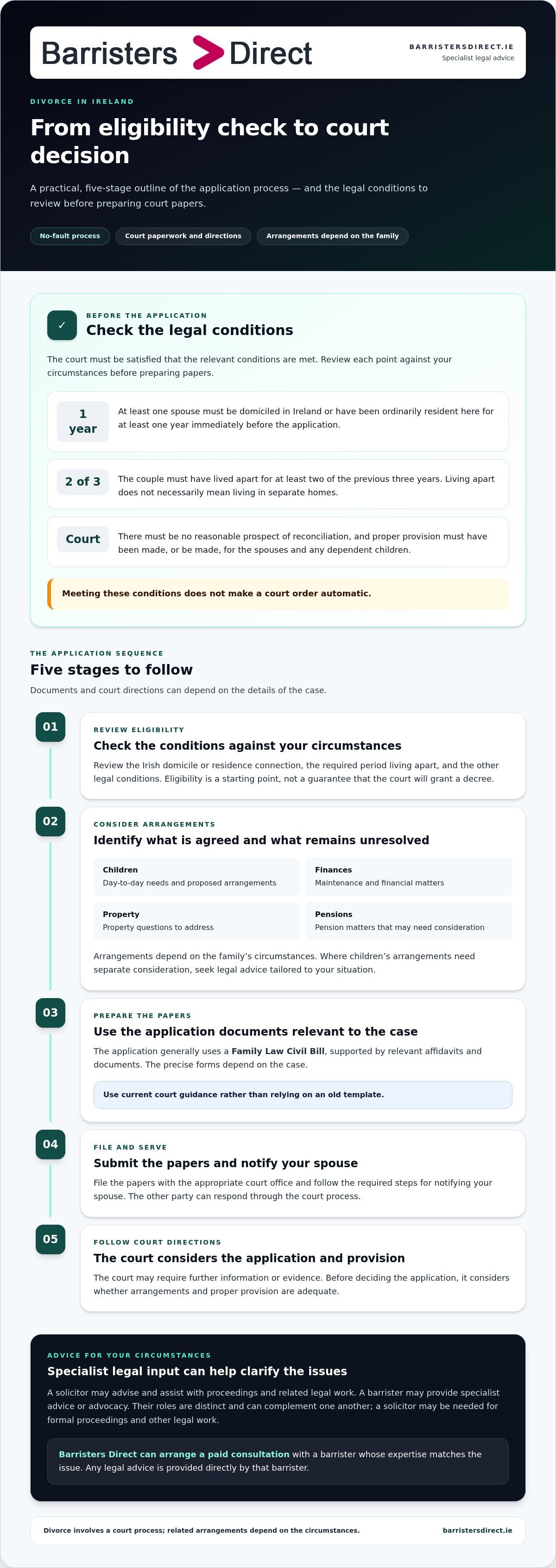
At least one spouse must be domiciled in Ireland or have been ordinarily resident here for at least one year immediately before the application. The couple must have lived apart for at least two of the previous three years. Living apart does not necessarily require separate homes. The court must also be satisfied that there is no reasonable prospect of reconciliation and that proper provision has been made, or will be made, for the spouses and any dependent children.
In brief: an application requires the relevant Irish connection, the required period living apart, no reasonable prospect of reconciliation and proper provision for the family. Meeting these conditions does not make a court order automatic.
What are the main stages?
The process follows a sequence, although the documents and directions depend on the case:
- Review eligibility. Check the residence or domicile connection, separation period and other legal conditions against your circumstances.
- Consider arrangements. Identify what is agreed or unresolved about children, maintenance, property and pensions. Where children’s arrangements need separate consideration, seek advice from a solicitor or barrister tailored to your situation.
- Prepare the papers. The application generally uses a Family Law Civil Bill, supported by relevant affidavits and documents. The precise forms depend on the case, so use current court guidance rather than relying on an old template.
- File and serve the application. File the papers with the appropriate court office and follow the required steps for notifying your spouse. The other party can respond through the court process.
- Follow court directions. The court may require further information or evidence and consider whether arrangements and proper provision are adequate before deciding the application.
For official procedural guidance, the Courts Service explains how to apply for a divorce, including the application and response stages. Check its current forms and instructions before filing. If children are involved, make clear notes about their day-to-day needs and proposed arrangements. Questions about residence, contact and decision-making may require focused legal advice.
A timeline of living arrangements, a list of assets and liabilities, and a record of agreements or disputes can make an initial legal discussion more useful. If you want specialist input on how the requirements relate to your circumstances, Barristers Direct can arrange a consultation with a barrister matched to your family-law issue. Any advice is provided by the barrister directly. A solicitor may also be needed for filing and other legal work.
How are children, finances and property considered during divorce?
Ending a marriage can bring several connected questions into focus, but they are not all the same issue. Arrangements for children concern their care and day-to-day lives. Financial matters concern how each spouse and any dependent children will be provided for, and how assets and liabilities should be addressed. The court may consider relevant arrangements alongside the divorce, but there is no single outcome that fits every family.
How can children’s arrangements be addressed?
Parents may need to plan where a child will live, how time with each parent will work and how important decisions will be handled. Practical details matter: school routines, handovers, holidays and communication can all affect a child’s stability. These arrangements may need attention even if both parents agree to end the marriage. Keep the focus on the child’s needs rather than treating parenting arrangements as part of a financial negotiation.
If parents agree on a workable plan, setting out its practical terms can help make expectations clear. If they disagree, the court may consider the circumstances and relevant information before making an order. Neither agreement nor disagreement guarantees a particular result. A plan should account for the child’s routine and needs, and be realistic for the people who will put it into practice.
What financial matters may need attention?
Consider financial issues separately from parenting arrangements, even though decisions in one area can affect the family’s wider circumstances. Maintenance concerns financial support; property and pensions raise different questions about assets, ownership and future provision. Existing arrangements, such as how bills are paid or who lives in the family home, may help explain the current position. They do not, on their own, establish what the court will decide.
Before seeking advice, prepare a clear picture of the circumstances rather than trying to predict a division. Relevant details may include income, regular outgoings, savings, debts, property, pension arrangements and any existing financial agreements. If a value or document is unavailable, note that rather than guessing. Accurate information helps a legal professional identify what needs clarification and which issues may require more detailed consideration.
Use this checklist to organise the main questions. It is a preparation tool, not a forecast of court orders:
- Children: current care arrangements, routines, proposed time with each parent and any practical concerns affecting stability.
- Income and outgoings: each spouse’s income, regular expenses, debts and existing maintenance arrangements.
- Property and savings: what assets exist, how they are owned and who currently uses or lives in them.
- Pensions: the schemes involved and any available statements or information about benefits.
- Agreements and records: written arrangements, relevant correspondence and documents that help explain the family’s current position.
When considering these matters in a divorce, separate what is already agreed from what remains uncertain. If children’s arrangements are settled but pension or property questions are not, record each point clearly. This gives a solicitor or barrister a more precise starting point for explaining the relevant legal issues and possible next steps.
Do you need a solicitor for divorce, and how can you prepare?
There’s no single answer that suits every case. The support you need depends on how complex the issues are, whether you and your spouse agree, and what practical work remains. A solicitor is not unnecessary simply because you can understand the broad process yourself. If court papers, financial arrangements or disagreements need attention, professional advice can help you understand your position and take informed steps.
What can a solicitor or barrister contribute?
Solicitors commonly provide ongoing, client-facing advice and manage practical legal work, including correspondence and documents. Their role can be central to progressing formal proceedings and coordinating the details of a case. Barristers are independent legal practitioners who can offer specialist analysis of particular issues and, where required, advocacy in court. The professions have distinct skills and may work together; one does not make the other’s contribution less important.
Solicitors often guide the ongoing legal work, while independent barristers bring specialist advice and advocacy. Both professions can play valuable, complementary roles.
If you want an early specialist perspective on a particular question, instructing a barrister directly may be one option. Barristers Direct arranges a paid consultation with a barrister matched to the relevant legal area. The consultation is between you and that barrister, who provides any legal advice. It does not replace a solicitor when you need assistance with formal proceedings or other legal work.
What should you prepare before seeking advice?
A short, factual summary makes a discussion more focused. You don’t need to resolve every issue in advance. Organise what you know, mark anything uncertain and identify the questions that matter most to you. Keep sensitive personal or financial information private; share relevant details directly with the legal professional advising you rather than posting them publicly.
Before a consultation or appointment, consider gathering:
- A timeline: key relationship and separation dates, significant changes in living arrangements, and any court dates or deadlines you already know about.
- Existing arrangements: current agreements about children, finances or use of property, noting whether they are formal or informal.
- Relevant documents: court papers, letters, agreements and financial records related to your questions. Keep copies organised and note where information is missing.
- Points of agreement and dispute: separate what you both accept from issues that remain unresolved, without assuming what a court will decide.
- Your questions: write down what you need to understand, such as which steps require legal help, what information is still needed and what options may be open to you.
Preparation helps a professional use the available information efficiently, but it doesn’t require you to reach legal conclusions on your own. If specialist family-law insight would help you plan your next step, find out about a consultation with a matched barrister. Any advice is provided directly by the barrister, and your circumstances will guide the discussion.
How can a family-law barrister consultation clarify your next steps?
If you’re facing decisions about a divorce, a focused conversation with a family-law barrister can help you identify which questions need attention first. Barristers Direct arranges a paid initial consultation with a barrister matched to the relevant area of law. The discussion can help you explain your circumstances, understand the legal issues and consider possible next steps. It does not promise a particular outcome or replace every form of legal support.
What can an initial family-law consultation help you understand?
A useful discussion starts with the questions that matter most to you. You might want to understand how a point of Irish family law relates to your circumstances, what information is relevant, or what options you could explore before taking formal steps. Prepare a brief summary and bring the documents connected to those questions, then use the meeting to clarify what remains uncertain.
To keep the conversation focused, organise your notes under three headings: what has happened, what is agreed or disputed, and what you need to decide next. For instance, if arrangements for children are broadly settled but a financial issue remains unclear, explain that at the outset. This helps the barrister focus on the issue you want to discuss instead of trying to cover every aspect of family law at once.
Consultations can take place online or by telephone, including through Zoom, Microsoft Teams or Google Meet. Barristers Direct arranges the introduction; it does not itself provide legal advice or guarantee an outcome. Any advice given, and the professional relationship, are between you and the barrister. The barrister can discuss the legal questions raised, but the consultation alone does not determine how a court would decide a matter.
What happens after the consultation?
After the discussion, you can use what you’ve learned to decide what further help may be appropriate. If additional work is proposed, its scope and arrangements are discussed directly with the barrister. You can also consider whether you need a solicitor to manage formal proceedings, prepare or file documents, communicate with the other party or assist with other legal work. A barrister consultation and a solicitor’s involvement can serve different purposes. The right combination depends on the case.
Before the meeting, write down your priorities and any deadlines or court directions already in hand. Keep your questions precise, and note which details you may need to verify. You don’t need to arrive with a complete legal strategy. A specialist can consider the issue and explain relevant options, helping you make a more informed decision about what to do next.
For specialist family-law insight on your options, learn about arranging a family-law consultation with a barrister matched to your legal issue.
Choose a next step that fits your circumstances
You don’t need to resolve every question before moving forward. A useful next step addresses the issue creating the most uncertainty, whether that is understanding a legal point, deciding what information to gather or working out what professional support you need. Keeping that priority in view can make the divorce process feel more manageable.
Before you act, write down the decision you’re trying to make and the information that could affect it. If the issue involves several connected questions, note them separately. This gives you a clearer basis for seeking advice and helps distinguish urgent practical concerns from decisions that can be considered later.
Where specialist input would help you assess your options, explore a family-law consultation. A solicitor may be needed for formal proceedings and related legal work. Take it one decision at a time and choose support that suits your situation.
Frequently Asked Questions
What are the grounds for getting a divorce in Ireland?
Ireland does not require a spouse to prove marital wrongdoing to seek divorce, but the court can grant a decree only if the legal conditions are met. Eligibility and the court’s assessment of related arrangements are separate questions. For example, agreement that the marriage has ended does not itself settle a dispute about financial provision. If a particular fact may affect your case, ask a qualified legal professional to assess it under current law.
How long do you have to be separated before getting divorced in Ireland?
An application depends on meeting the statutory living-apart condition, so establish the relevant dates before deciding whether you can apply. Record when you began living apart and note any later changes in your living arrangements. If dates are disputed or unclear, don’t rely on memory alone. Discuss the chronology and any supporting information with a qualified legal professional, and check current Courts Service guidance before making decisions based on timing.
Can you get divorced in Ireland without a solicitor?
It may be possible to take some steps without retaining a solicitor, but whether that is suitable depends on your circumstances and the work required. A solicitor can manage proceedings and related practical tasks; a barrister can provide specialist advice or advocacy. Barristers Direct arranges a paid consultation with a barrister matched to the legal issue, but does not itself provide legal advice. If court documents or formal representation are needed, discuss solicitor involvement.
What happens after you apply for a divorce in Ireland?
After filing, check the court documents for instructions, any response required from your spouse and dates that apply to your case. The court may request further material or issue directions before a hearing or decision. Keep copies of what you file and receive, and note any actions you need to take. If a document is unclear, seek legal advice promptly rather than assuming no response is required.
What arrangements need to be made for children during a divorce?
Describe arrangements in practical terms rather than simply saying you will share care. For example, clarify regular routines, handovers, school-related responsibilities and how changes will be communicated. If there’s a disagreement, identify the specific issue and its effect on the child. A solicitor, mediator or other appropriate professional can help explore workable options, but a general guide cannot predict what a court would decide in an individual case.
Does divorce automatically divide property and pensions equally in Ireland?
No. Irish divorce law does not mean that every asset or pension is automatically split equally. Financial provision depends on the circumstances, and property, maintenance and pension rights raise distinct questions. For example, understanding a pension may require information about the scheme and its benefits rather than a simple estimate of its current value. Gather relevant records and obtain legal advice before relying on an assumed percentage or informal calculation.
Can a divorce be agreed by both spouses in Ireland?
Yes, spouses can agree on practical matters and proposed terms, which may reduce the number of issues they need to resolve through the process. Agreement alone does not create a decree; the court must still consider the application under the applicable rules. If discussions stall on a particular point, mediation or separate legal advice may help clarify options. Keep proposed terms clear and make sure both parties understand what they are agreeing to.
Disclaimer
_This article does not constitute legal advice. Barristers Direct does not provide legal advice. To obtain legal advice, you should contact a legal practitioner._