

Full article
Published 14/11/2026
A family dispute does not have to begin in court. Dispute resolution without court can give people a way to address disagreements through negotiation, mediation or, where appropriate, arbitration.
It’s understandable to want a clear view of likely costs and what each option involves before deciding how to proceed. Mediation helps parties work towards their own agreement with a mediator’s support; arbitration gives the decision to an arbitrator. The right approach depends on the dispute and whether the parties can reach a workable agreement.
This article explains how these options work for family disputes in Ireland, how their costs compare in general terms and what to consider before choosing a process. It also covers court proceedings, where outcomes can be uncertain and resolving a dispute may take time. You’ll get a clearer understanding of the available routes and when independent legal advice can help you decide what to do next.
Key Takeaways
- Negotiation and mediation can help families work towards an agreement, with a mediator guiding discussion rather than deciding the outcome.
- Arbitration differs from mediation because an arbitrator decides the dispute, and the decision can be binding.
- Settlement discussions can continue at different stages, including after court proceedings have started.
- Costs and timescales depend on the process and the dispute; court proceedings can be time-consuming, costly and uncertain.
- Consider whether urgency, safety, complexity and the need for a binding outcome affect which route is suitable.
Table of Contents
- How Can Family Disputes Be Resolved Without Going to Court?
- Arbitration and binding decisions
- Pre-action requirements and continuing settlement negotiations
- Potential time, costs and uncertainty of court proceedings
- Non-court dispute resolution in family law
- Barristers Direct: Commercial Dispute Resolution
How Can Family Disputes Be Resolved Without Going to Court?
In Ireland, family disagreements about finances or children’s arrangements may be addressed through negotiation, mediation or arbitration. For families considering dispute resolution without court proceedings, the appropriate method depends on the issues and whether both parties can participate.
Mediation with an Independent Mediator
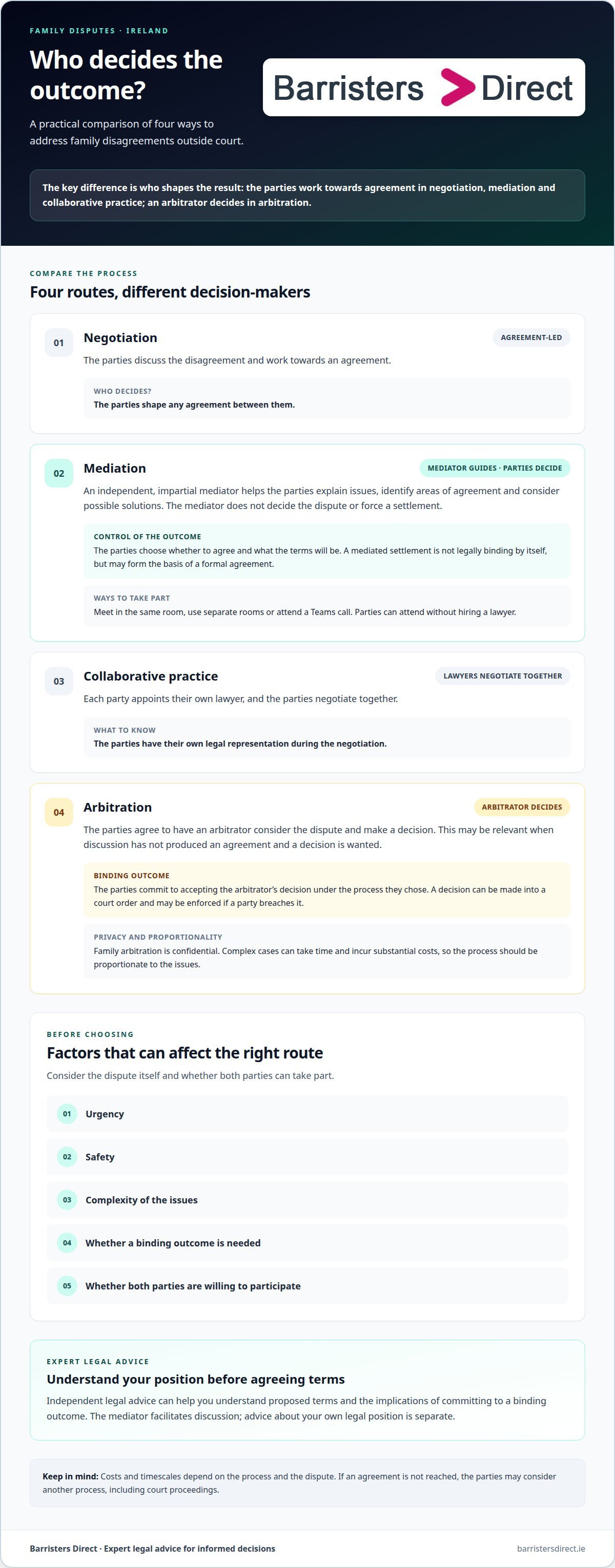
Mediation is a process in which an independent, impartial mediator guides the parties’ discussions but does not decide the dispute. The parties retain control over whether they reach an agreement and what its terms will be.
A mediator helps each person explain the issues, identify areas of agreement and consider possible solutions. They cannot force either party to settle or accept a proposal. Family mediation can take place in the same room, separate rooms or on a Teams call. Parties can attend without hiring a lawyer, although independent legal advice can help them understand proposed terms.
The process can make room for practical arrangements alongside legal issues. For example, parents might discuss a workable schedule for children as well as financial matters. Ireland’s Mediation Act 2017 provides for mediation as an alternative to starting or continuing civil proceedings, according to the Office of the Attorney General.
Finding Dispute Resolution Practitioners
Finding a practitioner means identifying a suitable mediator, arbitrator or collaborative practitioner for the dispute. Their roles differ, so the choice affects who controls the outcome and how discussions proceed.
A mediator facilitates discussion and leaves decisions to the parties. An arbitrator hears the dispute and makes a decision, while collaborative practice involves each party appointing their own lawyer and negotiating together. Consider the dispute’s subject, whether a binding outcome is needed and whether both parties are willing to participate. These factors help identify which method fits the issue.
Impartiality is central to mediation: the mediator helps both sides discuss options without deciding who is right. Legal advice about a party’s own position is separate from the mediator’s facilitation role.
Mediation Steps and Suitable Disputes
In Ireland, mediation involves a trained mediator guiding the parties’ negotiations. The Mediation Act 2017 provides for mediation as an alternative to starting or continuing civil proceedings, according to the Office of the Attorney General.
The process typically begins with the parties agreeing to mediate and identifying the issues they want to resolve. The mediator facilitates discussion, clarifies each side’s concerns and supports the parties as they consider options. The parties decide whether a proposed solution works; the mediator does not impose one.
Family disputes about finances, children’s arrangements or decisions about upbringing may be addressed through non-court processes. Choosing dispute resolution without court proceedings means weighing factors such as urgency, safety, complexity and whether a binding outcome is needed. If the parties cannot reach an agreement, they may consider another process, including court proceedings.
Arbitration and binding decisions
Arbitration differs from mediation because an arbitrator, rather than the parties, decides the dispute. A mediated settlement in Ireland is not legally binding by itself, but may form the basis of a formal agreement.
Family Arbitration and Binding Decisions
Family arbitration is a process in which parties agree to have an arbitrator decide a dispute. It can address financial issues after a relationship ends, as well as disagreements about children’s arrangements and upbringing.
Arbitration may be relevant if discussion has not produced an agreement and the parties want a decision from a neutral decision-maker. The arbitrator considers the facts and issues presented, then gives a decision. By agreeing to arbitration, the parties commit to accepting the arbitrator’s decision under the process they have chosen.
The subject shapes what the arbitrator considers. For example, parties might submit a disagreement about financial arrangements or a child’s upbringing. Arbitration differs from mediation: the arbitrator decides the outcome rather than helping the parties find their own solution. Complex cases can take time and incur substantial costs, so the process should be proportionate to the issues.
Confidentiality and Enforceability
Family arbitration is a confidential process in which an arbitrator makes a binding decision for the parties. It can offer privacy for sensitive financial or child-related discussions, rather than resolving them through a public court hearing.
A family arbitration decision can be made into a court order, which may be enforced if a party breaches it. This gives the outcome a formal route to enforcement, rather than leaving the parties with an informal record of discussions. Because the decision is binding, arbitration is not simply an opportunity to revisit the dispute because one party dislikes the result.
Before choosing arbitration, the parties’ agreement to use the process is central. They should understand what dispute the arbitrator will decide, what material will be considered and how the decision will affect them. Independent legal advice can clarify the implications of committing to a binding outcome. For advice on your legal position, consider speaking with a qualified legal professional before agreeing to arbitration.
Costs also need consideration. In most alternative dispute resolution schemes, each side pays its own costs; in arbitration, the arbitrator can apportion costs if both sides agree. A dispute involving complex evidence or several issues may require more time and expense. The parties’ relationship, the need for privacy and whether a binding decision is required all help determine whether arbitration is appropriate.
Arbitration is not the same as a negotiated settlement. It gives decision-making authority to the arbitrator, while the parties accept the result through their agreement to participate. If they want to retain control over the solution, mediation may be an alternative; if they need a determination, arbitration may better fit that objective.
Pre-action requirements and continuing settlement negotiations
Negotiation is often the first step in resolving a dispute, but the appropriate pre-action requirements depend on the type of dispute. Parties can also continue settlement discussions after proceedings begin.
Informal Negotiation and Without-Prejudice Discussions
Informal negotiation lets the parties discuss the problem and possible outcomes directly, without starting with a formal hearing. It can resolve a disagreement or clarify which issues remain contested.
For example, a clear written proposal can set out the concern, supporting evidence and outcome sought. If discussions stall, a solicitor’s formal letter explaining the issue and requested resolution may help restart them. In family mediation, discussions are without prejudice and cannot be brought to the court’s attention in later proceedings. This can support candid settlement discussions.
Solicitors’ Role in Negotiations
A solicitor can support negotiation by assessing the legal issues, organising relevant evidence and communicating a client’s position. This can help when the parties disagree about the facts, the legal effect of an event or what a fair outcome would involve.
For instance, a solicitor’s letter can identify the disputed issue, explain the requested resolution and invite a response. Independent legal advice can also help a party assess a proposal before accepting it. Solicitors may continue negotiations while preparing a case, so settlement remains possible even if discussions have not resolved every point.
Before taking formal action, the steps to consider depend on the dispute. A contract may set out a process, while another type of claim may require different preparation. The parties’ communications, relevant documents and desired outcome can all shape negotiations. A proportionate exchange of information may help clarify what is agreed and what still needs resolution.
Keep discussions focused on specific issues. If a disagreement concerns an unpaid invoice, for example, the parties might address the amount claimed, the basis for it and any proposed payment arrangement. In a family matter, discussion may instead focus on financial arrangements or children’s needs. The subject determines which evidence and practical options matter.
Direct communication can sometimes resolve a disagreement before solicitors become involved, where appropriate. If the parties cannot communicate productively, legal representatives can help structure negotiations and clarify each side’s position. The process need not end when a claim is issued: negotiations may continue after proceedings start, and settlement can be reached before a final hearing.
Negotiation can narrow a dispute without resolving it completely. If the parties agree on some facts or issues, later steps can focus on their remaining differences. Distinguish proposals from agreed terms and record any resolution clearly, so both parties understand what they have accepted.
Potential time, costs and uncertainty of court proceedings
Mediation uses a mediator to guide negotiation, while an arbitrator decides the dispute. Conciliation is another alternative dispute resolution method, and its process depends on the scheme being used. The distinction matters: mediation leaves the outcome to the parties, while arbitration gives decision-making authority to the arbitrator.
Alternative dispute resolution may be faster and less complex than court proceedings. Commercial disputes taken to court in Ireland can take months or even years. The time required depends on the issues, the evidence, how the parties engage and whether they reach an agreement. A narrow disagreement may require less work than a dispute involving several contested issues.
Costs depend on the process, preparation required and complexity of the dispute. Mediation costs are usually shared between the parties; in most alternative dispute resolution schemes, each side pays its own costs. In arbitration, the arbitrator can apportion costs if both sides agree. Court proceedings can involve legal and court costs, which may increase as the case progresses.
Non-court methods can offer privacy, flexibility and greater control over a settlement. Risks include failing to reach an agreement or accepting terms without understanding their legal effect. A mediator cannot impose a solution. Arbitration gives the decision to an arbitrator, so parties should understand the consequences before agreeing to that process.
Alternative dispute resolution can be considered before court proceedings begin, and negotiations can continue after a claim is issued. A court may ask parties to try mediation before a full hearing. In family disputes, the appropriate process depends on the circumstances and applicable Irish requirements. Urgency, safety, complexity and the need for a binding outcome all help determine whether court is more suitable.
Court proceedings may be preferable when urgent protection is needed, the other party will not participate, or a public decision affecting others is required. A dispute that needs to establish a precedent or affect many people may not suit a confidential process. For highly complex issues, court procedures can allow documents to be examined and people involved to be questioned at an early stage.
Choosing a process means weighing the dispute’s subject, the available evidence and the desired outcome. A family disagreement about arrangements may call for a different approach from a commercial dispute involving contested records. The proportionate option addresses the key issues without adding unnecessary steps.
For a family matter, consider whether the parties can negotiate and whether a binding decision is needed. For a commercial dispute, assess the evidence, the potential impact of delay and whether privacy matters. These factors help determine whether mediation, arbitration or court proceedings best serve the desired outcome.
Costs depend on the process, preparation required and complexity of the dispute. Mediation costs are usually shared between the parties; in most alternative dispute resolution schemes, each side pays its own costs. In arbitration, the arbitrator can apportion costs if both sides agree.
Non-court dispute resolution in family law
For families in Ireland, non-court resolution can provide a structured way to address financial arrangements and children’s matters. The key is to match the process to the dispute, the parties’ ability to communicate and the outcome they need.
The Mediation Act 2017 provides for mediation as an alternative to starting or continuing civil proceedings, according to the Office of the Attorney General. In family mediation, a neutral mediator guides discussions but does not give legal advice or decide the result. The parties retain control over whether to settle and what terms they can accept.
This can matter when parents need to discuss practical arrangements alongside legal issues. They might consider how a proposed arrangement works in everyday life, then identify which details remain unresolved. A mediator can keep discussion focused but cannot require either person to accept a proposal. If communication is unsafe or one party cannot participate freely, mediation may not be appropriate.
Financial disputes after a relationship ends can also be discussed through mediation. For example, parties may need to address assets, liabilities or ongoing financial arrangements. Each proposal should be understood before acceptance: a mediator facilitates the process, while independent legal advice can explain the legal effect and implications of proposed terms.
A mediated discussion is not the same as a formal, legally binding settlement. The parties can record what they have agreed, but the outcome is not legally binding by itself. If they want formal terms, their lawyers can advise how to document the settlement and whether further steps are needed to give it legal effect.
Alternative processes serve different needs. Negotiation leaves the parties responsible for reaching an agreement; mediation adds a neutral facilitator; arbitration gives decision-making authority to an arbitrator. A family may use more than one method at different stages, such as negotiating first and considering mediation if direct discussions stall.
Choose a process based on the circumstances, not simply a wish to avoid a hearing. Urgency, safety, the complexity of financial information, willingness to participate and the need for a binding outcome all matter. If a dispute involves safeguarding concerns, serious conflict or incomplete financial disclosure, a non-court process may not provide the necessary protection or clarity. Court proceedings may then be more suitable.
Before accepting a settlement, consider whether it addresses each issue clearly and whether you understand its legal consequences. Discuss your family law position with a legal professional if you need advice on the options and implications.
Barristers Direct: Commercial Dispute Resolution
Barristers Direct connects businesses with specialist barristers for advice on commercial disputes. If negotiations have stalled, or you are weighing dispute resolution without court proceedings against further legal steps, a barrister can assess the issues and explain the available options.
For a business considering dispute resolution without court, early specialist advice can clarify the strengths of its position and inform its next decision. Barristers Direct arranges a fixed-fee initial consultation with senior or junior counsel. Solicitors remain important when formal legal action is required; direct access offers another route to a barrister’s expertise for an initial consultation.
Contact Barristers Direct to discuss your options for your commercial dispute.
Choose a Clear Next Step
The next step is to define what you need a resolution to achieve. Consider which issues are negotiable, what outcome you could accept and whether you need independent legal advice before making a commitment. Dispute resolution without court is most useful when the process fits the people, risks and decisions involved.
Barristers Direct offers specialist advice through its Commercial Dispute Resolution, Wills and Probate Legal Advice, and Employment Law Consultation services. If your concern falls within one of these areas, expert legal advice can help clarify your position and the options available to you.
Speak with Barristers Direct about your options and take the next step with a clearer view of your legal position.
Frequently Asked Questions
Are there situations where ADR is not a good idea?
Yes. A non-court process may be unsuitable where there is domestic abuse, a safeguarding concern, an urgent need for court action, or serious concern about incomplete financial disclosure. Its suitability also depends on whether both parties can participate freely and share relevant information. For example, if one person fears repercussions for disagreeing, a private meeting alone may not provide enough protection. Safety and fairness should guide the choice of process.
How do you convince the person you disagree with to participate?
You cannot force someone to mediate, but you can explain the process and make a specific, practical proposal. For example, suggest discussing one defined issue with a neutral mediator rather than demanding agreement on every disputed point. Explain that participating does not require accepting a settlement. If direct communication has become difficult, a solicitor can send a measured invitation setting out the issues and proposed next step.
What are the five types of alternative dispute resolution methods?
Five methods are negotiation, mediation, conciliation, arbitration and expert determination. Negotiation is direct discussion between parties; a mediator or conciliator facilitates discussion without deciding the dispute. An arbitrator makes a decision, while expert determination focuses on a specialist issue, such as a valuation. The process and its effect depend on the parties’ agreement and the applicable scheme, so these methods are not interchangeable.
What are the benefits of family law mediation?
Family mediation can give separating partners a private, flexible setting to discuss arrangements and preserve a workable relationship, particularly where they will continue co-parenting. It can also make room for practical proposals, such as a handover arrangement that fits school routines. A mediator does not provide legal advice, so each person may seek independent advice on the implications of proposed terms before deciding whether to formalise them.
What if the other person refuses to settle?
A refusal to settle does not close off every available route. You can clarify which points remain disputed, continue negotiating on issues where agreement is possible, or consider another process if both parties consent. If agreement remains out of reach, court proceedings may be necessary. Keep communications focused on proposals and responses, as the parties’ approach to resolving a dispute can be relevant when a court considers costs.
What methods of non-court dispute resolution are available?
Non-court dispute resolution can include negotiation, mediation, conciliation, neutral evaluation, adjudication, arbitration, expert determination, and relevant ombudsman or regulatory schemes. The best fit depends on whether you need a facilitator, an independent assessment or a decision-maker. For example, an expert may assess a technical valuation issue, while mediation may suit a dispute where the parties want to shape their own practical settlement.
What types of disputes can be settled without court?
Depending on the issue and both parties’ willingness to participate, disputes involving family arrangements, a neighbour, a landlord, a business partner, a bank or a public body may be addressed outside court. A consumer complaint may also fall within an industry or regulatory scheme. The key distinction is whether the matter can be resolved through agreement or an accepted process, rather than requiring an urgent court decision.
What is alternative dispute resolution in Ireland?
Alternative dispute resolution, or ADR, is an umbrella term for processes used to resolve or narrow disputes outside a court hearing. In Ireland, the Mediation Act 2017 provides for mediation as an alternative to starting or continuing civil proceedings, according to the Office of the Attorney General. ADR can involve direct negotiation, a neutral facilitator, an independent assessment or a decision-maker, depending on the chosen method.
Disclaimer
_This article does not constitute legal advice. Barristers Direct does not provide legal advice. To obtain legal advice, you should contact a legal practitioner._