

Full article
Published 08/10/2026
What if a disappointing result after dental treatment does not, by itself, mean negligence? If you are unsure whether your experience raises a legal concern, dental negligence advice Ireland can help you identify the questions that matter and the information that may clarify your position. An adverse outcome and a potential negligence claim are not the same: the circumstances, any harm caused and the available evidence all need careful consideration.
It is understandable to want clear answers, particularly if you are still dealing with pain, further treatment or financial effects. A clear account of what happened, supported by relevant records and details of how your situation has changed, can help a legal professional assess your concerns.
This article explains how an unsuccessful outcome may differ from a potential negligence concern, what information may be useful to organise, and how to seek an informed legal assessment in Ireland. An initial specialist barrister consultation arranged through Barristers Direct can help you explore the issues and possible next steps. It is an opportunity to discuss your position, not a guarantee of a particular conclusion or outcome. Formal legal proceedings may require a solicitor.
Key Takeaways
- Dental negligence advice Ireland can help distinguish dissatisfaction with a result from concerns that may warrant legal assessment.
- Questions about diagnosis, treatment decisions, complications or follow-up may need closer examination, but examples alone do not establish negligence.
- An assessment considers what happened, whether there may have been a shortcoming, and whether it may be connected to harm.
- Organise a dated treatment chronology, relevant correspondence and a clear account of your concerns to explain your situation.
- A specialist barrister consultation can help you understand which questions to ask and what next steps may be available. It can take place online or by telephone.
Table of Contents
- What does dental negligence advice in Ireland help you understand?
- Which dental treatment concerns may warrant closer examination?
- How is a possible dental negligence concern assessed?
- What information can help you prepare for dental negligence advice?
- How can a barrister consultation clarify your next steps?
What does dental negligence advice in Ireland help you understand?
Dental negligence is a legal concern to assess, not a conclusion that follows simply because treatment was painful, disappointing or did not achieve the result you hoped for. Dental procedures can involve known risks, and complications may occur even when care was appropriate. The key question is whether the treatment, considered in its clinical context, may have fallen below the relevant standard and caused harm.
An adverse outcome is not, by itself, evidence of negligence. The treatment, circumstances and resulting harm must be examined before a legal concern can be assessed.
That distinction matters in practice. A filling that needs attention, persistent symptoms after treatment or an unexpected complication may prompt questions, but none proves negligence on its own. An assessment considers what happened, what may have been done inadequately, whether harm followed and whether the alleged shortcoming may have caused it. Dissatisfaction and proof are different things.
When does a dental treatment concern become a legal question?
The circumstances and available evidence matter more than the label attached to an outcome. For example, a complication may be a recognised risk of a procedure. A separate question is whether the risk was considered and managed appropriately in the circumstances. That requires examining the particular treatment and its context, rather than assuming that a poor result establishes inadequate care. An assessment can clarify the issues, but it cannot promise compensation, success or any particular legal result.
Why is dental negligence different from a general complaint?
Dental concerns often turn on clinical details: what symptoms were reported, what diagnosis was reached, which treatment options were considered, how a procedure was carried out, or what follow-up was advised. If you believe a problem was missed or your symptoms worsened after treatment, the sequence of events and relevant records may help explain your concern. The same outcome can have different explanations, so the facts need to be considered individually.
Clinical context may require specialist evidence. A qualified dental expert may need to consider the treatment and explain whether the care appears consistent with the relevant professional standard. The legal assessment must also consider causation: whether any alleged shortcoming led to the injury or loss being claimed. These are separate questions, and an unfavourable result alone answers neither. For a broader explanation of evidence and the steps involved, see this guide to proving medical negligence in Ireland.
Regulatory roles should also be distinguished from a legal assessment. The Medical Council of Ireland regulates medical practitioners, as outlined in this overview of the Medical Council of Ireland); dental professionals are overseen by the Dental Council of Ireland. A regulatory complaint and a claim for compensation address different questions. If you are seeking dental negligence advice Ireland, a specialist legal discussion can help identify which issues may need further evidence and what questions to consider next.
Which dental treatment concerns may warrant closer examination?
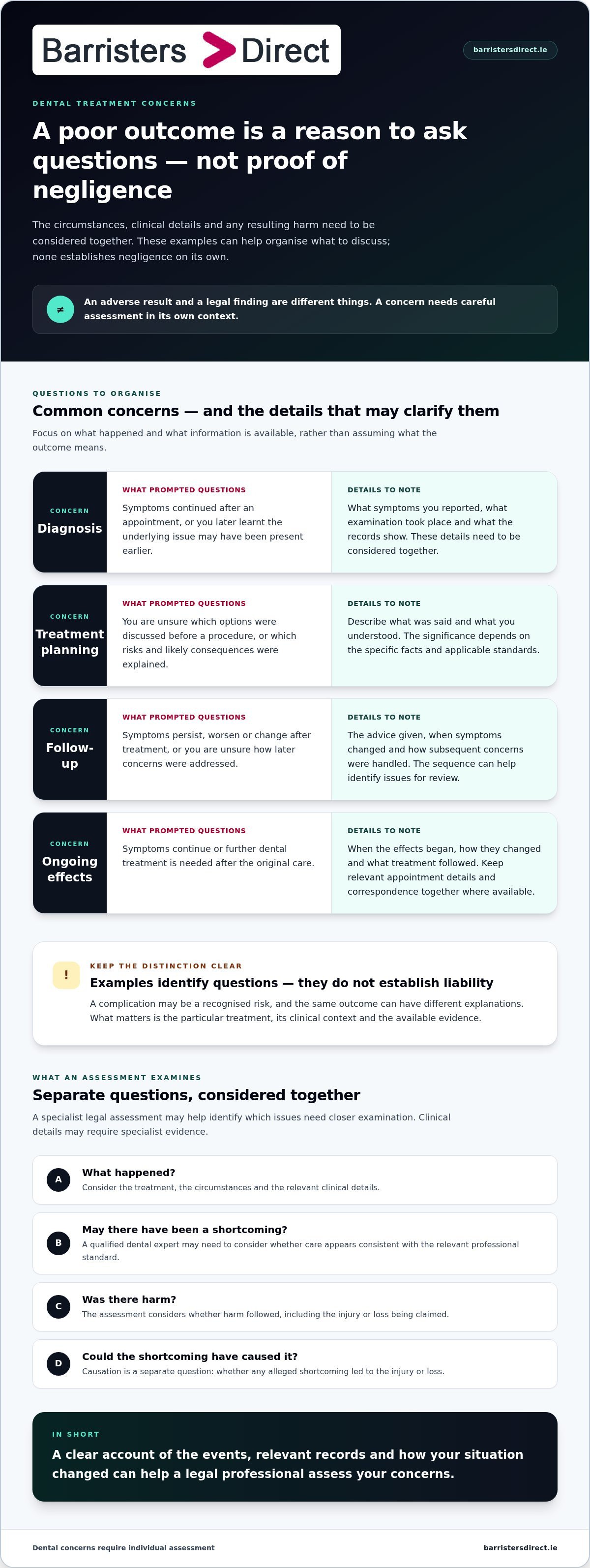
Some experiences prompt questions about how a dental problem was identified, which options were considered or how a complication was handled. They are starting points for discussion, not findings that a dentist acted negligently. The same symptom or result can have different explanations depending on your circumstances, the information available at the time and the treatment provided.
Examples can help identify questions for assessment, but they are not proof of liability.
How can diagnosis, treatment or follow-up raise questions?
Consider a patient whose toothache continues after an appointment and who later learns that the underlying issue may have been present earlier. Relevant questions could include what symptoms were reported, what examination took place and what the records show. Those facts alone do not establish that a diagnosis was missed or delayed. A clinical review would need to consider the situation as a whole.
Treatment planning may also prompt questions. For instance, a patient might be unclear about the options discussed before a procedure, or which risks and likely consequences were explained. The legal significance depends on the specific facts and applicable standards. It is more useful to describe what was said and understood than to assume that a particular consent issue has been established.
Follow-up is another area to examine. If symptoms persist, worsen or change after treatment, you may want to understand what advice was given and how later concerns were addressed. The sequence can help a specialist identify issues for review, but does not determine whether the care was inadequate. The Dental Council of Ireland official website provides information about the regulatory framework for dental professionals. A regulatory concern and a legal claim are separate matters.
What if the concern involves lasting harm or further treatment?
If symptoms continue or further dental treatment is needed, make a clear note of when the effects began, how they have changed and what treatment followed. Keep relevant appointment details and correspondence together where available. This helps explain the impact you report, separately from the expert question of what caused it.
Timing may help an assessment. A problem noticed soon after a procedure may raise different questions from one that appeared later or developed over time, but timing alone does not establish the cause. A dental expert may need to consider the records, treatment and other possible explanations before reaching a view. No example can predict recovery, compensation, settlement or whether court proceedings will be needed.
This is where dental negligence advice Ireland can help you frame your concerns and understand what may need closer review. You can discuss your circumstances with a qualified barrister whose expertise is relevant through a specialist legal consultation.
How is a possible dental negligence concern assessed?
An assessment is a structured review of what happened and its consequences, not a judgement based solely on whether treatment worked as hoped. The aim is to understand the events, identify a possible shortcoming, establish what harm is reported and consider whether the two may be connected. Each part raises a different question, and the answers may depend on clinical records and specialist opinion.
A useful way to organise the issues is to work through them in order:
- The treatment: What care was provided, when did it take place, and what was understood or discussed at the time?
- The possible shortcoming: Which specific part of the care concerns you, such as a decision, explanation or response to a problem?
- The harm: What physical, psychological or financial effects do you report, and when did they begin?
- The connection: Is there information suggesting that the alleged shortcoming may have caused or contributed to those effects?
This is a framework for clarifying a concern, not a checklist that guarantees a claim. An unsatisfactory result alone does not establish negligence. The relevant professional standard and whether an alleged shortcoming caused harm need to be considered in light of the facts and current Irish legal principles. Those questions may call for expert dental evidence. They cannot be settled by assumption or a general description of what usually happens.
What questions may a specialist consider?
A specialist may ask you to explain the treatment chronology and identify the particular decision or event that concerns you. They may also explore what harm you experienced, when it arose, and which records or correspondence could help clarify its timing and possible cause. If clinical issues need further examination, an independent dental opinion may be relevant. The appropriate evidence and next steps depend on the circumstances.
For a clearer discussion, separate what you know from what you suspect. Note, for example, which symptoms you recall reporting, what you were told and what happened afterwards. Then identify what remains uncertain. This helps focus the legal questions without treating a memory, a record entry or an expert view as conclusive on its own.
Why can’t an early discussion guarantee a case outcome?
An initial consultation can help clarify the issues, explain possible routes and identify information that may be needed. It is not a final determination of liability or a promise of compensation. Further review, including examination of records and specialist evidence, may change how the concern is understood. If formal proceedings are considered, they involve additional steps and may require a solicitor.
Barristers Direct arranges a paid consultation with a qualified barrister whose expertise is relevant to the legal issue. The platform arranges the introduction; any advice or further engagement is between you and the barrister. The consultation gives you an opportunity to discuss your questions before deciding whether to pursue further legal work. For tailored dental negligence advice Ireland, bring a concise account of the treatment, your concerns and the harm you report.
What information can help you prepare for dental negligence advice?
You do not need to arrive with a complete file or know which legal terms apply. A clear, honest account gives a barrister a useful starting point and helps identify what remains uncertain. Treat the following as practical preparation, not a formal list of evidence you must provide. Share what you have, and distinguish it from details you are unsure about.
How can you organise the treatment history?
Set out events in date order, using approximate dates if you cannot remember the exact day. Include appointments, treatment, follow-up and when you first noticed any effects. Keep relevant documents together, but do not worry if something is missing. A concise chronology is often easier to discuss than a bundle of unlabelled papers.
- Appointments and treatment: Note the date, the reason for the visit and what you recall taking place.
- Communications: Gather available letters, emails, messages or written advice about the treatment and later concerns.
- Effects and further care: Record when symptoms or other impacts arose, how they changed and any later treatment you received.
- Points to clarify: Mark what is based on a document, what you remember and what is an assumption or unanswered question.
Keep the language neutral. For example, write “pain continued after the appointment” rather than concluding that the treatment caused it. This helps a specialist consider your experience without treating your account as an expert finding about cause.
Which questions should you bring to an initial discussion?
Use your notes to identify what you most need to understand. Questions can focus the discussion and make it easier to leave with a clearer sense of what may need further assessment. You might ask:
- Which parts of my account raise legal or clinical questions, and what remains uncertain?
- What records or other information might help clarify the treatment and its effects?
- Could specialist dental input be relevant, and what would it help assess?
- What possible next steps are open to me, and what would each involve?
These questions do not assume that a claim should be brought or that formal proceedings are necessary. The answers depend on the circumstances and any further information considered. For broader context on medical negligence evidence and next steps, see the linked guide.
Preparing this way can make dental negligence advice Ireland more focused: you can explain what happened, describe the effects you report and ask about gaps in the information. A specialist legal consultation lets you discuss your questions with a qualified barrister whose expertise is relevant.
How can a barrister consultation clarify your next steps?
When the facts are still unclear, a focused discussion with a specialist can help you understand which questions deserve attention and what options may be open to you. Barristers Direct arranges a paid consultation with a qualified barrister whose expertise is relevant to your legal issue. The platform arranges the introduction; advice is provided by the barrister, and any advice or further engagement is between you and that barrister.
The consultation can take place online through Zoom, Microsoft Teams or Google Meet, or by telephone. You can explain your concerns and ask for an informed legal perspective without treating an early discussion as a decision to bring a claim.
What can an initial specialist discussion help clarify?
A barrister can help identify the legal issues raised by your account, distinguish what is known from what remains uncertain, and consider what further information may be useful. You might ask whether your concerns need closer review, what specialist input could help and what different next steps would involve. The discussion can offer direction, but it cannot guarantee that a claim will succeed, result in settlement or lead to compensation.
If formal proceedings are considered, a solicitor may be needed to take them forward. A consultation with a barrister is not full representation, and Barristers Direct does not replace the role of a solicitor.
What happens after the consultation?
After the discussion, you can consider the information and decide how you wish to proceed. There is no obligation to continue with further legal work. If you and the barrister agree to further engagement, the relationship and work are directly between you and the barrister. Barristers Direct arranges access to the relevant specialist; the barrister provides the advice and determines any further work with you.
To make the discussion useful, prepare a brief summary of the treatment, the questions you want answered and any points you are unsure about. You can also ask the barrister to explain unfamiliar legal terms or outline what a suggested next step means in practice. This can give you a clearer understanding of the issues, even if further evidence is needed before your position can be assessed more fully.
If you are considering dental negligence advice Ireland, a specialist consultation offers a way to discuss your situation and possible next steps with a qualified barrister before deciding whether to pursue further legal work. Explore Barristers Direct to learn about arranging a consultation.
Take a considered next step
You do not need to decide immediately whether to pursue a legal claim. A sensible next step is to turn your concerns into clear questions and seek an informed view of what may need closer assessment. Guidance can help you understand your options without assuming that an adverse experience proves negligence or that formal proceedings are the only route.
If you are looking for dental negligence advice Ireland, Barristers Direct can arrange an initial consultation with a qualified barrister whose expertise is relevant to your legal issue. The discussion can take place online or by telephone, giving you a practical way to explore your position and possible next steps. Any advice or further engagement is between you and the barrister, and the consultation does not guarantee a particular outcome.
Arrange an initial specialist barrister consultation to discuss your questions and consider your next steps.
Frequently Asked Questions
Does a poor dental treatment result automatically mean negligence?
No. A disappointing result, ongoing discomfort or the need for additional treatment does not, on its own, establish negligence. The reason for the outcome and the care provided must be considered in context. An unexpected complication, for example, may have more than one possible explanation. A legal assessment may need to examine the treatment details and relevant clinical opinion before a reliable conclusion can be reached.
Can I seek dental negligence advice in Ireland before deciding whether to take legal action?
Yes. An initial discussion can help you understand what questions your experience raises before you decide whether to pursue further work. You could use it to clarify what information may be useful or whether your concern needs additional specialist assessment. Seeking dental negligence advice Ireland does not commit you to bringing a claim or taking a particular next step. The discussion can help you make a more informed decision.
What information should I bring to a dental negligence consultation?
Bring what you have, not a perfect case file. A short chronology, relevant appointment letters or messages, and a note of the questions you want answered can make the discussion more focused. If you have several documents, arrange them by date and label them clearly. You can also note details you are uncertain about. This helps distinguish what records show from what you recall or want clarified.
How is dental negligence different from a dental complaint?
A complaint may express dissatisfaction or seek an explanation about treatment, while a legal assessment considers whether the circumstances raise a potential claim. These have different purposes, and making a complaint does not itself establish legal liability. The applicable legal terminology and route depend on the issue and current Irish law. If you are unsure which description fits, explain what happened and what outcome you are seeking during an initial discussion.
Can a barrister assess a dental negligence concern without a solicitor?
You can have an initial consultation with a relevant barrister without first engaging a solicitor through the Barristers Direct arrangement. The barrister can discuss the legal questions raised by your account and possible next steps. That consultation is not full representation. If formal proceedings are being considered, a solicitor may be needed to manage them, and the appropriate arrangements depend on your circumstances.
What happens during an initial Barristers Direct consultation?
Barristers Direct arranges a paid consultation with a qualified barrister whose expertise is relevant to your legal issue. You can explain your concerns and ask questions about issues that may need further consideration. The discussion can take place online through Zoom, Microsoft Teams or Google Meet, or by telephone. An automatically generated recording and/or synopsis is provided to you and the barrister only. Barristers Direct arranges the introduction; advice and any further engagement are between you and the barrister.
Does seeking an initial consultation guarantee compensation or a successful claim?
No. An initial consultation can provide an informed view of the issues and possible next steps, but it cannot guarantee compensation, success or any other legal result. Further assessment may depend on records, expert opinion and other case-specific information. A consultation is distinct from formal proceedings, which may require additional legal work and a solicitor. You can consider the discussion before deciding whether to pursue further engagement.
Disclaimer
_This article does not constitute legal advice. Barristers Direct does not provide legal advice. To obtain legal advice, you should contact a legal practitioner._