

Full article
Published 11/11/2026
An inheritance dispute can put an estate distribution on hold. An executor should generally avoid distributing assets while a will dispute is ongoing, as doing so may expose them to personal liability. Defending a will against a claim can also involve legal costs that reduce what beneficiaries ultimately receive.
It is understandable to want a clear view of the risks before deciding how to respond. Costs depend on the issues in dispute, the evidence available and whether the parties can resolve the matter without court proceedings. No single figure applies to every case.
This article explains what can affect the cost of a defence, what evidence may support the will’s validity or the estate’s position, and why distribution during a dispute needs careful handling. It also explains how a beneficiary’s role differs from an executor’s, helping you understand possible next steps in an Irish estate dispute.
Key Takeaways
- Defence costs depend on the dispute, the evidence and whether the parties can resolve matters without court proceedings.
- Gather relevant documents early, including correspondence, witness statements, medical reports and earlier wills.
- Providing clear information about the estate’s assets, liabilities and any distributions helps the parties and the court assess the dispute.
- Evidence of the will-maker’s capacity, intentions and the circumstances in which the will was made may be central to a validity challenge.
- Beneficiaries should assess the claim’s merits and act reasonably before deciding how to respond.
Table of Contents
- How much does it cost to defend a contested will?
- Evidence needed to defend an Inheritance Act claim
- Can the estate be distributed during the dispute?
- Evidence of testamentary capacity and intention
- Beneficiaries defending a claim
- Barristers Direct: Wills and Probate Legal Advice
How much does it cost to defend a contested will?
There is no single figure for defending a contested will in Ireland. Costs depend on the grounds raised, the evidence needed, the estate’s complexity and whether the dispute reaches court. Court proceedings can be expensive and take many months, so resolving issues early may limit further expense.
A challenge may concern the will’s validity or a claim for provision from the estate. For example, someone might argue that the deceased lacked testamentary capacity, was pressured into changing the will or did not sign it properly. Each ground calls for different evidence, affecting the work needed to assess and respond to the claim.
Formalities matter. Under the Succession Act 1965, a will must be in writing and signed by the testator, or by another person in the testator’s presence and at their direction. It must also be attested by two witnesses present at the same time. The executor should examine the original will and its signing and witnessing circumstances when assessing a validity challenge.
What is the process for challenging a will in the Irish High Court? The challenger sets out the grounds and supporting case in court proceedings, and the executor or other affected parties respond. The court considers the evidence and decides the dispute. The precise steps depend on the claim and its circumstances.
An executor should first establish the type of claim. If the challenge concerns validity and there is good reason to believe the will is valid, the executor will usually defend it. If the dispute concerns competing beneficiaries’ claims, the personal representative should remain neutral and avoid prejudicing the claim. An executor who is also a beneficiary must act impartially and in the estate’s best interests.
There is no immediate time limit for challenging a will’s validity, but prompt advice is still important. Different claims have different rules and deadlines. For example, a surviving spouse’s legal right share and applications by qualifying cohabitants are subject to time limits. Delay can complicate evidence gathering and estate administration, so identify the claim’s legal basis early.
The Civil Partnership & Certain Rights and Obligations of Co-Habitants Act 2010 provides for qualifying cohabiting partners in Ireland to apply to court for provision from a deceased partner’s estate, according to the Irish Statute Book. A will dispute may therefore involve a claim for provision, rather than an argument that the will itself is invalid. The distinction affects how the executor should respond.
Costs may also depend on who brings or defends proceedings. A court may allow costs in a contested-will case to be paid from the estate if satisfied that the proceedings had reasonable grounds and were conducted bona fide. This is not automatic. The estate’s interests, the parties’ conduct and the basis for the proceedings all matter when costs are considered.
Evidence needed to defend an Inheritance Act claim
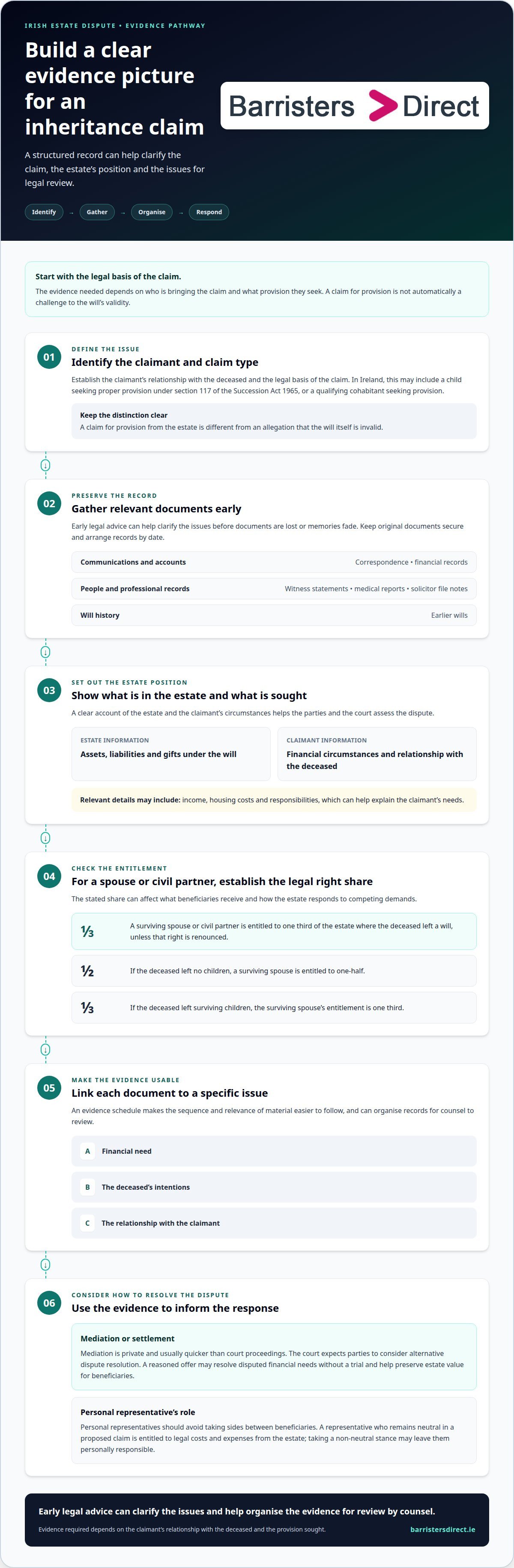
Start by identifying the legal basis of the claim and the person bringing it. In Ireland, a claim concerning a deceased person’s estate may involve a child seeking proper provision under section 117 of the Succession Act 1965, or a qualifying cohabitant seeking provision. The evidence required depends on the claimant’s relationship with the deceased and the provision sought. A claim should not be treated as a challenge to the will’s validity unless that ground is actually raised.
Early legal advice can clarify the issues before documents are lost or memories fade. A solicitor can assess the claim, explain the personal representative’s role and help organise material for counsel to review. Useful evidence may include correspondence between the deceased and claimant, witness statements, financial records, medical reports, solicitor file notes and earlier wills. Keep original documents secure and arrange records by date to make the sequence of events clear.
For a spouse or civil partner, establish the legal right share before assessing a claim. In Ireland, a surviving spouse or civil partner is entitled to one third of the estate where the deceased left a will, unless that right is renounced. If the deceased left no children, a surviving spouse is entitled to one-half, according to the Irish Statute Book. If the deceased left surviving children, the surviving spouse’s entitlement is one-third.
Entitlements can affect what beneficiaries receive and how the estate responds to competing demands. Evidence should therefore set out the estate’s assets and liabilities, gifts under the will and the claimant’s financial circumstances. Records of income, housing costs and responsibilities, for example, may help explain the claimant’s needs. Information about the deceased’s relationship with the claimant can also provide context.
A spouse or civil partner can lose the legal right share if convicted of an offence against the deceased carrying a sentence of more than 2 years. If that issue arises, the relevant conviction and sentence must be established through reliable records. Personal representatives should avoid taking sides between beneficiaries. A representative who remains neutral in a proposed claim is entitled to legal costs and expenses from the estate; taking a non-neutral stance may leave them personally responsible.
Can mediation or settlement resolve a will claim in Ireland? Yes. Mediation is private and usually quicker than court proceedings, and the court expects parties to consider alternative dispute resolution. A reasoned offer may resolve disputed financial needs without a trial and help preserve estate value for beneficiaries.
Keep an evidence schedule linking each document to a specific issue, such as financial need, the deceased’s intentions or the relationship. Early advice on a disputed estate’s legal position can help identify relevant evidence and the appropriate response.
Can the estate be distributed during the dispute?
An executor should not distribute estate assets while a will dispute is ongoing. A distribution may leave too little in the estate to meet a successful claim and could expose the executor to personal liability. The safer course is to preserve the assets until the claim is resolved and the executor can assess the estate’s remaining obligations.
How can an executor or beneficiary defend a will against a claim in Ireland? The executor should provide accurate estate information, preserve relevant records and avoid prejudicing the claim. A beneficiary can respond to the claimant’s case with relevant evidence and a reasoned account of competing interests.
Full disclosure helps everyone assess what is at stake. The personal representative should provide the court and parties with information about:
- the estate’s assets, including property, bank accounts and investments;
- its liabilities, such as debts and administration expenses;
- any distributions already made, with details of the recipient and amount; and
- other information relevant to the claim or the estate’s ability to make provision.
Keep these details current as administration proceeds. If an asset is sold during the dispute, for example, the estate records should show the sale and where the proceeds are held. Accurate records prevent confusion about the estate’s value and support a clear account to the court and parties.
The personal representative should notify beneficiaries and potential defendants about a proposed claim and provide copies of information received in support of it. This allows affected parties to understand the case and prepare a response. A beneficiary’s defence may address the claimant’s evidence, the estate’s circumstances or competing financial needs. The executor, however, should not take a partisan position if that could prejudice the claim.
Preserving assets does not mean neglecting necessary estate administration. The executor should record decisions and avoid transfers that could undermine a potential provision claim. If property needs maintenance, for example, records of the work and payments can explain how the estate was managed while proceedings continued. Consider any proposed distribution in light of the live claim and the estate’s liabilities.
Time limits vary according to the type of claim. A spouse or civil partner’s claim to a legal right share is subject to the Statute of Limitations, while applications under section 194 of the Civil Partnership & Certain Rights and Obligations of Co-Habitants Act 2010 have strict time limits. Those deadlines do not make early distribution safe. The executor should identify the claim’s legal basis and keep the estate intact while the dispute remains unresolved.
Evidence of testamentary capacity and intention
A capacity challenge asks whether the will-maker had the capacity to make the will when it was signed. Evidence should also help establish whether the document reflects the deceased’s intentions.
Gathering and preserving evidence
Build a dated timeline covering the will’s preparation, signing and any later changes. Relevant material may include witness statements, correspondence, solicitor file notes, medical reports and earlier wills. Preserve original documents and keep related records together. A clear chronology helps compare the will-maker’s circumstances with the decisions recorded in the document.
In a capacity challenge, the person disputing the will must prove that the will-maker lacked the relevant capacity when making it. Evidence should relate to that time, rather than relying only on a later account of the deceased’s health. Medical reports and records can provide context, while notes from the will-making process may show how instructions were given and understood.
Undue influence requires positive proof that pressure overpowered the testator’s free will. A claim that someone else had influence or was present is not, by itself, proof. Relevant evidence may include communications about the will, accounts from people who witnessed discussions and the circumstances of any change. Assess each item against the alleged pressure and the timing of the decision.
Documents and financial evidence
Compare the disputed will with earlier wills, correspondence and the solicitor’s file notes. A substantial change may need context, such as a changed relationship or a different explanation of the deceased’s wishes. These documents do not automatically establish intention, but they can help show whether the will’s terms fit the wider evidence.
Financial records can clarify which assets the will covers and the practical effect of its terms. Account statements, property records and records of gifts, for example, may help establish what the deceased owned or transferred. Keep these records distinct from evidence about capacity: the value or ownership of assets does not itself prove whether the will-maker understood the will.
If the wording is ambiguous, identify the exact clause and compare it with the deceased’s recorded instructions. A solicitor’s file note or correspondence may help explain how the wording arose. If the challenge alleges unauthorised changes or forgery, preserve the original document and gather evidence about when and how the alteration appeared.
Organise material by issue: capacity, intention, undue influence, formal execution or an alleged alteration. This helps distinguish evidence supporting validity from evidence about the estate’s assets. A focused bundle also makes gaps and inconsistencies easier to identify before proceedings advance.
Beneficiaries defending a claim
A beneficiary’s position differs from the executor’s. Beneficiaries may protect their own inheritance, but should act reasonably. Their response should address the claimant’s case and the interests of the estate as a whole.
Defending beneficiary interests
A beneficiary defending a proposed claim should obtain legal advice early and identify the precise issue in dispute. For example, if a claimant seeks provision under section 117 of the Succession Act 1965, the response should address the claim’s basis and relevant evidence, rather than treating it as a challenge to the will’s validity.
Set out how the claim may affect each beneficiary’s position. Relevant material may include the will’s terms, the estate’s assets and liabilities, and evidence about competing financial needs. A beneficiary should explain their interests clearly and respond to the claimant’s evidence, rather than rely on personal disagreement or assumptions about the deceased’s intentions.
Reasonable conduct matters throughout negotiations and litigation. A wholly unreasonable or overly aggressive approach may result in a court penalty. Beneficiaries should keep communications measured, provide relevant information and avoid attempts to influence witnesses or the executor. If the executor is also a beneficiary, they must distinguish their personal interest from their duty to act impartially for the estate.
Beneficiaries can consider settlement as well as defending a claim. A sensible, realistic offer made without prejudice may help resolve disputed issues and reduce the risk of paying part of the claimant’s legal costs. Mediation is another option to consider before continuing court proceedings.
Claim risks and possible outcomes
Defending a claim does not guarantee that the will’s terms will remain unchanged. If the claim succeeds, the estate’s distribution may change, reducing what beneficiaries receive. A dispute can also delay an inheritance and reduce estate value through legal costs. Assess the likely effect on the estate alongside the strength of the evidence.
Beneficiaries should not assume their legal costs will be paid from the estate as the claim progresses. The executor’s position is different: a personal representative who remains neutral in a proposed claim is entitled to have their legal costs and expenses paid from the estate. A beneficiary who takes an active position should understand their potential costs exposure.
Before choosing a response, weigh the evidence, the value of the gift at stake and the cost of continued proceedings. A beneficiary with a modest inheritance may face a different practical decision from one whose substantial share is directly challenged. Consider whether defending the claim protects a meaningful interest at proportionate cost.
Early advice can help a beneficiary distinguish a defensible position from an unproductive dispute. Get legal advice on a contested inheritance before responding to a claim or making a settlement offer.
Barristers Direct: Wills and Probate Legal Advice
Barristers Direct arranges fixed-fee consultations with specialist barristers for Wills and Probate matters, including will challenges and inheritance disputes. You can instruct a barrister directly for an initial consultation focused on the claim, available evidence and practical options.
This advice may help if you are an executor assessing a proposed claim or a beneficiary deciding whether to defend your position. A barrister can clarify the legal issues and discuss a considered way forward, including whether negotiation may be appropriate. Solicitors also play an important role in estate administration and can advise on the work they manage.
If you need advice about your situation, contact Barristers Direct.
Choose a clear next step
Before responding to a claim, define the decision you need to make: whether to defend the will, negotiate or seek another resolution. A focused assessment can clarify your legal position and the practical consequences for your interests. If you are a beneficiary, distinguish your personal position from the executor’s responsibilities. If you are an executor, keep the estate’s interests central while seeking advice on your role.
Defending a will against a claim calls for a response grounded in the specific issues and evidence, not assumptions about what other beneficiaries should do. The best course depends on the claim, the parties’ positions and the available material.
For advice on your circumstances, contact Barristers Direct about your claim. A clear understanding of your options can help you take the next step with confidence.
Frequently Asked Questions
Can I defend a Will without a solicitor?
You can obtain initial advice directly from a barrister, but formal court proceedings require a solicitor. Direct access can help you understand the issues and prepare a strategy before deciding how to proceed. A barrister, for example, can advise on the strength of a challenge and the evidence relevant to your position. If court action is needed, a solicitor can manage the proceedings and work with counsel where appropriate.
Can I still receive my inheritance if the Will is being contested?
You may still receive an inheritance, but a dispute can delay payment or change the amount you ultimately receive. An executor may retain estate funds while the parties resolve a claim, rather than distribute a disputed share prematurely. If the claim succeeds, the court may order provision from the estate. The effect on your inheritance depends on the outcome, the estate’s value and its liabilities.
Can anyone challenge a Will?
No. A person needs a recognised basis to bring a claim, and the rules depend on the type of challenge. Someone disputing validity may raise issues such as improper execution, lack of capacity or undue influence. In Ireland, a child may apply under section 117 of the Succession Act 1965 for proper provision, while qualifying cohabitants may seek provision under the 2010 Act. A beneficiary’s disagreement alone does not establish grounds.
How does the court decide on an Inheritance Act claim?
Ireland does not use the Inheritance Act 1975 framework described in some foreign materials. A child’s application for proper provision is considered under section 117 of the Succession Act 1965. The court assesses the evidence and the circumstances relevant to the applicant’s position, including the deceased’s obligations and the provision made for the child. The result depends on the particular claim and evidence, rather than a fixed entitlement for every applicant.
How is property handled in Inheritance Act Claims?
Property forming part of the deceased’s estate may be relevant to a provision claim, while jointly owned property can sometimes pass outside the estate. This distinction can affect which assets are available and how the parties assess a proposed claim. The personal representative should give an accurate account of estate property and liabilities. If a claim succeeds, the court may order a share of the estate to be paid or transferred to the successful claimant.
Is it worth defending a Will?
It depends on the evidence, the legal grounds and what is at stake for you. Compare the claim’s strength with the likely effect on your inheritance and the cost and time involved in continued proceedings. A beneficiary should also consider whether a reasonable settlement could protect their interests more effectively. Early legal advice can help distinguish a strong defence from a response that may add expense without improving your position.
What is the time limit for bringing a will challenge in Ireland?
There is no immediate time limit for challenging a will’s validity in Ireland, but different claims have their own rules and deadlines. Claims by a surviving spouse or qualifying cohabitant are subject to time limits, so identify the claim’s legal basis promptly.
Disclaimer
_This article does not constitute legal advice. Barristers Direct does not provide legal advice. To obtain legal advice, you should contact a legal practitioner._