

Full article
Published 16/09/2026
Table of Contents
A single false statement can dismantle years of professional credibility in minutes, yet the legal path to restoration is often more daunting than the damage itself. If you find your character under fire, the fear of permanent reputational harm is a heavy burden to carry. The landscape of defamation in Ireland is shifting significantly with the Defamation (Amendment) Act 2026, commencing on 1 March 2026. Understanding how these legislative updates affect your ability to clear your name is essential for anyone seeking to protect their standing whilst avoiding the pitfalls of a complex legal system.
You're likely feeling overwhelmed by the prospect of high legal costs and the notorious delays of the Irish court system. This guide provides the clarity you need to navigate these complexities with expert insight into the new statutory defences and strategic advice on safeguarding your professional reputation. We will examine the transition toward judge-led trials, the impact of the 2026 legislative changes, and how accessing specialist barrister advice early can provide a clear, strategic path to resolution. If you require a definitive assessment of your legal position, then understanding the mechanisms of the new Act is your first priority.
Key Takeaways
- Learn how Irish courts apply the 'reasonable person' test to determine if a statement constitutes defamation in both personal and corporate contexts.
- Understand the impact of the Defamation (Amendment) Act 2026, including the shift toward judge-led trials for more consistent and efficient legal outcomes.
- Identify the essential statutory defences, such as Truth and Absolute Privilege, that can be utilised to protect your professional standing.
- Recognise the strict one-year time limit for filing a claim and the specific legal hurdles involved in seeking an extension to two years.
- Discover how a direct access consultation with a specialist barrister provides an objective, expert evaluation of your case merits and strategy.
Table of Contents
What Constitutes Defamation Under Irish Law in 2026?
Defamation in Ireland occurs when a false statement is communicated to at least one third party, resulting in damage to a person’s or corporation’s reputation. The Defamation Act 2009 removed the old distinctions between libel and slander, meaning all claims are now assessed under a single legal standard regardless of whether the statement was written or spoken. This unified approach simplifies the legal framework but places a higher emphasis on the actual impact of the communication on the subject's standing in the community.
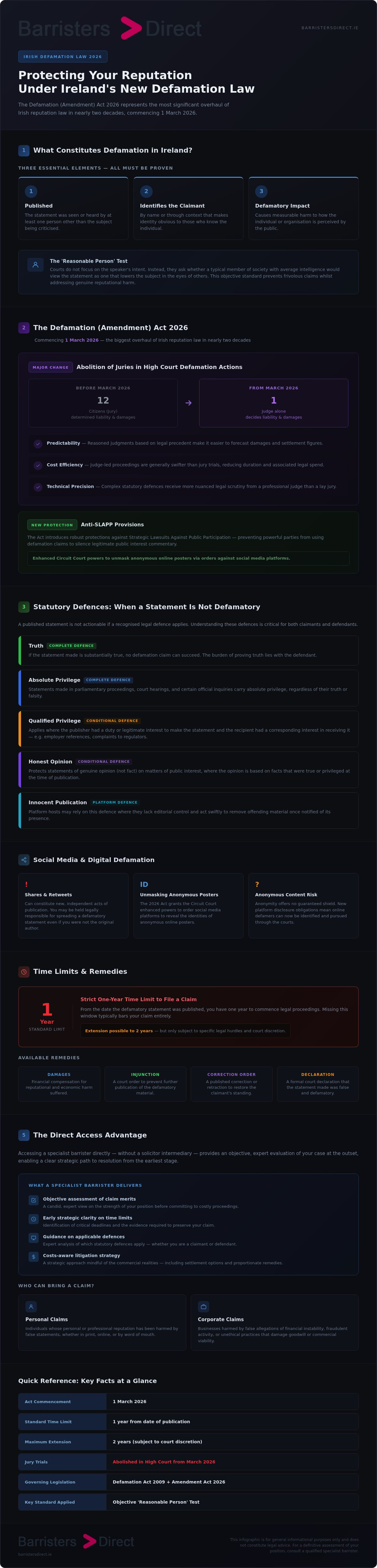
Courts apply an objective 'reasonable person' test to determine liability. They don't focus on what the speaker intended to say, but rather on whether a typical member of society, with average intelligence and knowledge, would view the statement as one that lowers the subject in the eyes of others. This standard prevents overly sensitive individuals from pursuing frivolous claims whilst ensuring that genuine reputational harm is addressed with precision.
For businesses, reputation is often synonymous with goodwill and commercial viability. If a false statement alleges financial instability, fraudulent activity, or unethical practices, it may constitute commercial defamation. In these instances, a company can sue to protect its business interests, provided it can demonstrate that the statement has caused, or is likely to cause, serious harm to its reputation or financial position.
The Three Essential Elements of a Claim
To succeed in a claim, three primary components must be proven. First, the statement must be published, meaning it was seen or heard by someone other than the person being criticised. Second, the statement must identify the claimant, either by name or through specific context that makes their identity obvious to those who know them. Third, the statement must be defamatory in its impact, causing measurable harm to how the individual or organisation is perceived by the public.
Defamation on Social Media and Digital Platforms
The digital landscape presents unique challenges for reputation management, particularly regarding anonymous content. Under the Defamation (Amendment) Act 2026, the Circuit Court possesses enhanced powers to issue orders requiring social media platforms to reveal the identities of anonymous posters. Whilst platform hosts often benefit from an 'innocent publication' defence, this protection typically only applies if they lack editorial control and act swiftly to remove offending material once they're notified of its presence. Digital shares and retweets can constitute new acts of publication, meaning you may be held legally responsible for spreading a defamatory statement even if you weren't the original author.
The Defamation (Amendment) Act 2026: A Shift in Legal Strategy
The Defamation (Amendment) Act 2026, scheduled for commencement on 1 March 2026, represents the most significant overhaul of Irish reputation law in nearly two decades. This legislation isn't merely a set of procedural tweaks; it's a fundamental shift in how claims are handled, prioritising efficiency and predictability over the high-stakes drama of the past. For anyone involved in a dispute, these changes alter the strategic landscape entirely, moving the focus from emotional appeals to rigorous legal analysis. The Act aims to strike a fairer balance between the right to a good name and the right to freedom of expression.
Why the Abolition of Juries Matters
The most striking change is the removal of juries from High Court defamation actions. Previously, twelve citizens determined both liability and the level of damages, often leading to inconsistent awards. From March 2026, these decisions rest solely with a judge. This shift provides several strategic advantages:
- Predictability: Judges must provide reasoned judgments based on legal precedent and established guidelines, making it easier to forecast potential damages and settlement figures.
- Cost Efficiency: Jury trials are notoriously long and expensive. Judge-led proceedings are generally swifter, reducing the duration of High Court proceedings and the associated legal spend.
- Technical Precision: Complex statutory defences are often better suited to a professional judge's scrutiny than a lay jury's interpretation, allowing for more nuanced legal arguments.
Protection Against SLAPPs
The 2026 Act also introduces robust protections against Strategic Lawsuits Against Public Participation, commonly known as SLAPPs. These are abusive proceedings designed not to win a case on its merits, but to silence critics through the threat of ruinous legal costs. Judges now have the power to dismiss such claims at an early stage if they're deemed unfounded or intended to stifle public debate. This mechanism serves as a vital shield for investigative journalists and individuals speaking out on matters of public interest, ensuring the legal system isn't used as a tool for intimidation.
The legislation further mandates that courts encourage Alternative Dispute Resolution (ADR). Parties are now expected to consider mediation or settlement before a case reaches trial, reinforcing the trend toward faster, private resolutions. Additionally, new statutory defences protect retailers from claims arising from routine, good-faith interactions with customers. If you're concerned about how these legislative shifts impact your specific circumstances, seeking an objective assessment from a specialist barrister is a prudent first step. This specialist insight ensures your strategy aligns with the new legal realities of the 2026 Act.
Statutory Defences
Proving that a statement has damaged your reputation is only the first step in a legal dispute. If the defendant can establish a valid statutory defence, your claim for defamation will not succeed, regardless of how much harm was caused. Understanding these protections is essential for both those seeking to clear their name and those defending their right to speak. The law recognises that certain circumstances require the protection of free speech over the protection of individual reputation.
Truth remains the most definitive shield available. If a statement is substantially true, it's not actionable. The defendant doesn't need to prove every minor detail is accurate, provided the 'sting' or the core allegation is proven to be a fact. Absolute privilege provides total protection for statements made in specific official settings, such as during Oireachtas debates, court proceedings, or official inquiries. Qualified privilege is more common in commercial disputes and professional environments. It applies when a person has a legal, social, or moral duty to communicate information to someone with a corresponding interest in receiving it, such as an employer providing a job reference or a person reporting a suspected crime to the Gardaí.
Honest opinion is another vital defence. It protects subjective commentary rather than factual assertions. For this to apply, the opinion must be based on facts that were known (or reasonably believed to be true) at the time the statement was made. If the comment is one that an honest person could have held based on those facts, the defence is likely to stand.
Fair and Reasonable Publication
The Defamation (Amendment) Act 2026 simplifies the existing defence for publications made in the public interest. This updated 'Fair and Reasonable Publication' defence focuses on whether the publisher acted in good faith and whether the conduct was reasonable in the circumstances. Courts measure reasonableness by looking at the steps taken to verify information and the importance of the matter to the public. Seeking a right of reply from the subject before publication is a critical factor in demonstrating reasonableness. If a publisher fails to offer this opportunity, they'll find it significantly harder to rely on this defence in court.
The Role of an Apology
A prompt and sincere apology can be a powerful tool for resolving disputes before they escalate. Under the 2009 Act, making an apology doesn't constitute an admission of liability and can be used to mitigate damages. The statutory 'Offer of Amends' framework allows a defendant to acknowledge an error and offer to pay compensation and costs, which can significantly reduce the final financial impact. An apology must be handled strategically to ensure it doesn't inadvertently compromise a broader legal defence or admit to facts that remain in dispute. Specialist barristers often advise on the exact wording of these communications to protect their client's position whilst seeking a swift resolution.
Navigating the Legal Process: Time Limits and Remedies
The window for initiating a claim is remarkably narrow. Under the Statute of Limitations, you generally have just one year from the date of publication to issue proceedings. Whilst the court has the discretion to extend this to two years, this is reserved for truly exceptional circumstances. If you miss this deadline, your right to seek a remedy is likely lost forever. This strict timeline makes early intervention by a specialist barrister essential to ensure your claim is both valid and timely.
Proving Damage to Reputation
Courts assess harm by examining how a statement has impacted your professional or business standing. General damages compensate for the emotional distress and the loss of reputation itself, whilst special damages cover quantifiable financial losses, such as a lost contract or a drop in business revenue. For companies, proving special damages requires precise evidence of a direct link between the defamatory statement and the financial decline. You can find more detailed guidance on handling these high-stakes conflicts in our article on Commercial Dispute Resolution in Ireland.
The Injunction: Stopping a Defamatory Statement
Preventing a statement from being published in the first place is notoriously difficult. Irish courts are hesitant to grant an interlocutory injunction because it acts as 'prior restraint' on free expression. Under the long-standing 'Rule in Bonnard v Perryman', a court will typically refuse an injunction if the defendant intends to argue that the statement is true. A court will only step in to stop a publication if it's absolutely clear that no valid defence exists and that the damage to your reputation would be irreparable.
Beyond financial compensation, the law offers other remedies such as declaratory orders. These are court statements confirming that a specific allegation was false, which can be more effective for clearing your name than a monetary award alone. However, the cost and duration of a full trial must be weighed against the efficiency of Alternative Dispute Resolution. Mediation often provides a swifter, private path to an apology or a retraction without the public scrutiny of a courtroom. If you're facing a threat to your character, you can arrange a consultation with a specialist barrister to weigh these options and determine the most strategic path forward.
The Direct Access Advantage: Specialist Defamation Strategy
Achieving a successful resolution in a defamation dispute requires a high degree of strategic precision. Whilst the traditional legal route often involves multiple layers of communication, the Direct Access model allows you to engage with a specialist barrister at the earliest possible stage. This direct engagement ensures that you receive a definitive, objective assessment of your case merits before you commit to the financial and emotional demands of a full High Court action. If you require an expert opinion on whether a statement is legally actionable, then consulting an independent advocate is the most logical first step.
Why Consult a Barrister First?
Barristers operate as independent sole practitioners within the Law Library of Ireland, providing an unbiased specialist opinion on the strengths and weaknesses of a claim. You should view the barrister as the 'specialist consultant' of the legal world. Just as a GP refers a patient to a medical consultant for a specific diagnosis, a barrister provides the expert advocacy view required to navigate complex litigation. This objective perspective is critical in reputation management, where emotional stakes can often cloud commercial judgment. Understanding the difference between solicitors and barristers helps you choose the right professional for each stage of your legal journey.
What to Expect from Your Consultation
The process is designed for maximum efficiency and transparency. Your consultation is delivered online via Zoom, Teams, or Google Meet, allowing you to access specialist advice regardless of your location. To ensure total clarity, an automatic recording and an AI-generated synopsis of the session are provided exclusively to you and the barrister. This record serves as a precise reference point for the strategic path forward, grounded in over 20 years of expertise in civil litigation. You can contact our team at [[email protected]](/cdn-cgi/l/email-protection) to arrange your session.
Financial transparency is a core component of this service. A strategic assessment with an independent barrister is provided at a fixed fee of €395 + VAT. This allows you to understand your legal position without the uncertainty of an open-ended solicitor retainer. If the barrister's evaluation indicates that formal litigation is necessary, or if the case requires the holding of client monies, a seamless transition to a qualified solicitor can be arranged. This collaborative approach ensures that the quality of the expert advice remains the priority whilst providing a clear, cost-effective route to clearing your name. By identifying the most viable legal strategy early, you can protect your professional standing with confidence and precision.
Securing Your Reputation in a Changing Legal Landscape
The landscape of Irish defamation law is undergoing its most significant transformation in years. With the 2026 Act introducing judge-led trials and robust anti-SLAPP measures, the focus has shifted toward legal precision and strategic efficiency. If you act swiftly within the strict one-year limitation period, then you have the best opportunity to clear your name and secure a declaratory order or financial compensation.
Navigating these complexities requires an objective, expert perspective. You can bypass traditional delays by accessing our nationwide network of over 100 independent senior and junior counsel. For a fixed fee of €395 + VAT, a specialist barrister will provide a comprehensive strategic assessment of your case via a secure online consultation. Book a Fixed-Fee Reputation Consultation with a Specialist Barrister to gain the clarity and confidence needed to protect your professional standing. Your reputation is your most valuable asset; taking the right expert advice today ensures it remains protected for the future.
Frequently Asked Questions
What is the time limit for taking a defamation case in Ireland?
The standard time limit to initiate a claim for defamation in Ireland is exactly one year from the date of publication. Whilst the court has the discretion to extend this period to two years, this is only granted in exceptional circumstances where it's equitable to do so. Missing this strict deadline usually results in the claim being barred. It's therefore vital to seek specialist advice as soon as you become aware of a false statement.
Can I sue for defamation if someone posts a false review on social media?
You can pursue a claim if a social media review contains false statements that damage your reputation. Under the Defamation (Amendment) Act 2026, courts have enhanced powers to identify anonymous posters on digital platforms. For a claim to succeed, the review must be communicated to a third party and identify you or your business specifically. A specialist barrister can help you determine if the specific language used meets the legal threshold for an actionable claim.
How much does a defamation consultation cost through Barristers Direct?
A strategic consultation with an independent barrister through the platform costs €395 plus VAT. If the matter is contentious and requires a solicitor to also attend, the fee is €595 plus VAT. These fixed fees ensure you know the exact cost of receiving expert insight before proceeding further. This transparent model allows you to access a specialist opinion on the merits of your case without the uncertainty of an open-ended solicitor retainer.
What is the difference between libel and slander in modern Irish law?
Modern Irish law no longer distinguishes between libel and slander. The Defamation Act 2009 replaced these separate terms with the single tort of defamation. This means the same legal standards apply whether the false statement was written, spoken, or broadcast digitally. This unified approach focuses on the damage caused to a person's reputation rather than the medium used for the communication. It simplifies the process for individuals and businesses seeking to clear their names.
Do I need a solicitor to talk to a barrister about a defamation claim?
If formal legal proceedings have not yet been issued, you don't need a solicitor to talk to a barrister for an initial strategic consultation. The Legal Services Regulation Act allows the public and businesses to engage a barrister directly for specialist advice. This direct access model is particularly effective for assessing the strength of a potential claim early. If your case requires formal litigation, a seamless transition to a solicitor firm can be arranged following your initial expert session.
What are the chances of winning a defamation case under the 2026 law?
Success depends entirely on the specific facts of your case and the validity of any statutory defences raised. However, the 2026 legislative changes introduce more predictability by moving from jury trials to judge-led proceedings in the High Court. This shift means decisions are based on reasoned legal precedent rather than emotional appeals. A specialist barrister can provide an objective assessment of your case's merits, helping you understand your legal position before incurring significant costs.
What happens during a defamation consultation?
Your consultation takes place online via Zoom, Microsoft Teams, or Google Meet. During the session, a specialist barrister reviews your case and provides a clear strategic path forward. After the meeting, you'll receive an automatically generated recording and an AI synopsis of the advice provided. This process ensures you have a precise record of the expert opinion. There's no further obligation to continue the engagement once the initial consultation is complete.
Can a company be defamed, or is it only for individuals?
A company can be defamed just like an individual if a false statement damages its business reputation or goodwill. For a corporate claim to succeed, the organisation must typically show that the statement has caused or is likely to cause serious harm to its reputation. This often involves demonstrating actual or potential financial loss. Specialist barristers frequently advise businesses on protecting their commercial standing against false allegations regarding financial stability, ethics, or the quality of their services.
Article by
The Barristers Direct Team
Barristers Direct is a network of independent barristers, who are all highly experienced sole practitioners, and are members of the Law Library.
Disclaimer
_This article does not constitute legal advice. Barristers Direct does not provide legal advice. To obtain legal advice, you should contact a legal practitioner._