

Full article
Published 25/10/2026
A construction dispute in Ireland need not begin in court. Contractor dispute resolution in Ireland can involve negotiation, mediation, adjudication or arbitration, depending on the dispute and the contract. The Construction Contracts Act 2013 forms part of the legal framework, according to the Government of Ireland.
It’s understandable to want a clear way forward when a payment, delay or workmanship disagreement puts a project or business relationship under pressure. The right process depends on whether the parties can reach agreement themselves or need an independent decision.
This guide explains how construction contract disputes arise, what each resolution option involves and how arbitration awards are handled. It also covers how mediation differs from adjudication and arbitration, what to consider before choosing a route, and how specialist legal advice can help you assess your position and prepare for the next step.
Key Takeaways
- Identify whether the dispute concerns payment, delay, workmanship or contract terms, then gather the relevant documents and records.
- Choose a resolution route that fits the issue: negotiation and mediation support agreement, while adjudication and arbitration can lead to a decision.
- Use mediation to explore a confidential, voluntary settlement when direct discussions have stalled and preserving the working relationship matters.
- Before arbitration, assess the strength of the claim, the available evidence and the practical value of pursuing an award.
- Understand the contract’s dispute process and seek specialist legal advice to clarify your position and plan the next step.
Table of Contents
- Are Arbitration Awards Easy to Enforce in Ireland?
- What is Construction Contract Dispute Resolution?
- Common causes of construction contract disputes
- Mediation
- Alternative dispute resolution
- Barristers Direct: Commercial Dispute Resolution
Are Arbitration Awards Easy to Enforce in Ireland?
An arbitration award can provide a binding outcome without a court deciding the underlying construction dispute. Ireland’s Arbitration Act 2010 governs arbitration and is based on the UNCITRAL Model Law, according to the Government of Ireland. The parties submit their dispute to an arbitrator, who considers the evidence and makes an award.
Arbitration is the final dispute resolution mechanism in most standard-form construction contracts used in Ireland, including RIAI, Public Works Contract, NEC and FIDIC forms. Check the dispute-resolution clause before starting: it identifies the agreed process and may set out steps that must come first. If arbitration applies, follow the contract’s procedure and prepare the claim around the issues it covers.
An arbitration award is legally binding. If the losing party doesn’t comply, the successful party may apply to court to enforce it. Enforcement is not the same as re-arguing the whole dispute: the court application concerns giving effect to the award. The New York Convention is also identified as a basis for enforcing Irish arbitration decisions internationally.
Choose mediation when both parties are willing to negotiate; choose arbitration when the contract provides for it and a binding determination is needed. Court proceedings may be appropriate where the contract directs the parties there or court involvement is needed to enforce an award. The contract clause, remedy sought and parties’ positions all help determine the route.
The Small Claims procedure applies only to qualifying claims, so first establish whether your contractor dispute meets its eligibility requirements. If it does, follow the procedure’s application process. If the dispute arises from a commercial construction contract or falls outside those requirements, consider the contract’s dispute mechanism or a court route instead.
Build an evidence file before presenting a claim. Match each allegation to a document, date or recorded event, and arrange the material in a clear sequence.
- Contract: the signed agreement, specifications and dispute-resolution clause.
- Payment: invoices, payment records, applications and notices.
- Performance: site records, photographs, inspection notes and relevant correspondence.
- Impact: records showing the practical effect of the delay, defect or disputed work.
Before arbitration, assess the strength of the claim, the quality of the evidence and the realistic value of a possible award. For example, separate proven completion costs from estimates, then identify which contract term supports each amount. A technical expert report may help explain construction issues, but it should be robust enough to withstand cross-examination. This assessment clarifies the case to present and whether arbitration is a proportionate next step.
What is Construction Contract Dispute Resolution?
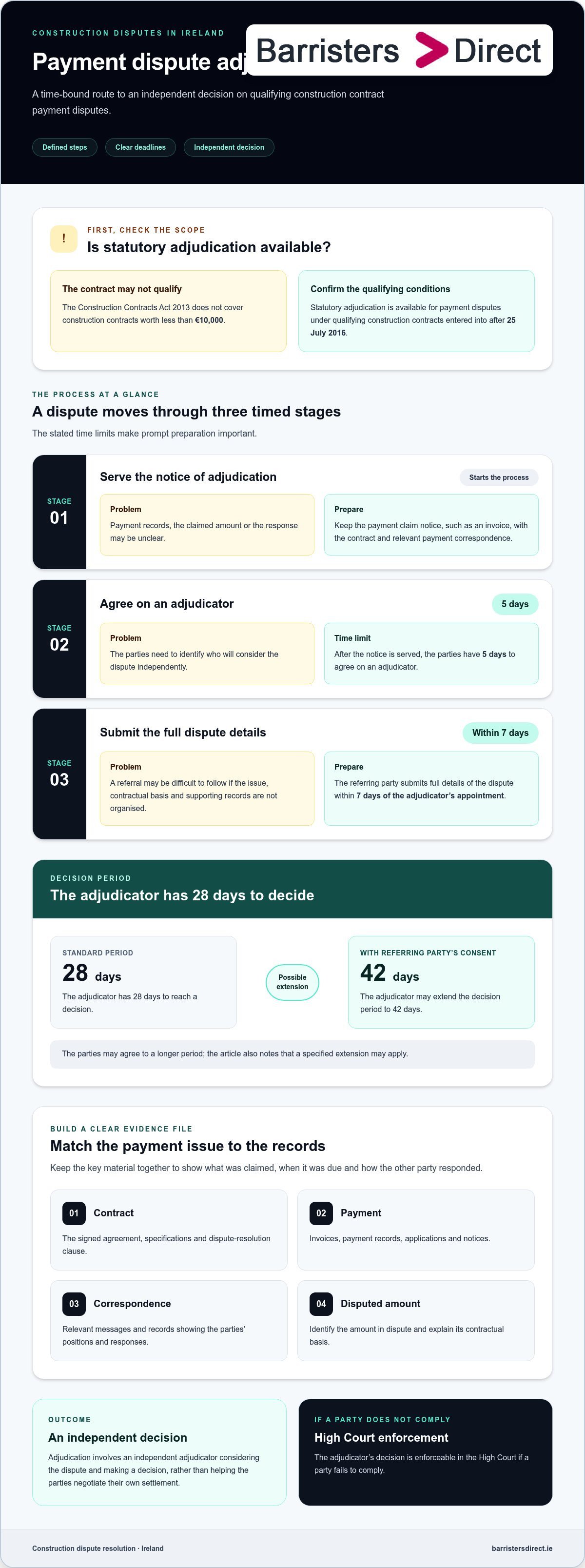
Construction contract dispute resolution is the process for addressing disagreements about work, payment or responsibilities under a building contract. In Ireland, the Construction Contracts Act 2013 forms part of the legal framework, according to the Government of Ireland. The Act’s scope has limits: construction contracts worth less than €10,000 are outside it, according to the Government of Ireland.
Adjudication is provided for in the Construction Contracts Act 2013. An independent adjudicator considers the dispute and makes a decision, rather than helping the parties negotiate their own settlement. If a party fails to comply, the decision is enforceable in the High Court.
For qualifying construction contracts entered into after 25 July 2016, statutory adjudication is available for payment disputes. The process has defined steps. After the notice of adjudication is served, parties have five days to agree on an adjudicator. The referring party then submits full details of the dispute within seven days of the adjudicator’s appointment.
A valid payment claim notice, such as an invoice, starts the strict payment timeline for referring a dispute to adjudication. Keep the notice, contract, payment records and relevant correspondence together. These documents help establish what was claimed, when it was due and how the other party responded.
The adjudicator has 28 days to reach a decision, unless the parties agree to a longer period or the specified extension applies. With the referring party’s consent, the adjudicator may extend the decision period to 42 days. These deadlines make prompt preparation important: identify the disputed amount, explain the contractual basis and organise supporting documents before submitting the referral.
To make a formal complaint against a builder or contractor in Ireland, write to them setting out the work or payment issue, the relevant contract terms and the remedy you seek. Attach supporting records, keep a copy and request a written response. If the complaint does not resolve the dispute, consider the contract’s dispute process.
Adjudication is often suited to payment disputes where a timely decision matters, while negotiation or mediation can support an agreed outcome. The contract, the type of claim and the remedy sought help determine the appropriate route. For a complex claim, specialist legal advice on a construction dispute can help clarify the contractual position and organise the case before referral.
Common causes of construction contract disputes
Construction disputes often begin when the parties interpret the contract differently. A builder may price a defined scope, while the client expects additional work to be included. Disagreements can concern variations, payment, completion dates, workmanship or responsibility for delays. For example, a contractor may attribute late completion to a late design change, while the employer points to inadequate progress on site.
Costs and defects can become linked. A client may withhold payment after finding defective work, while the contractor disputes the alleged defect or proposed repair cost. Separate the issues: identify the contract requirement, record the defect with dated photographs and obtain an itemised repair estimate. Keep invoices and payment records distinct from estimates, so each claimed amount has clear supporting evidence.
Delay claims need a clear chronology. Collect the agreed programme, revised milestones, site diaries, instructions and correspondence about access or design information. Then compare the actual sequence with the contractual dates. A missed milestone alone may not establish responsibility: records can show whether a variation, late information or the contractor’s progress affected completion.
Limitation periods also matter. Most construction disputes in Ireland must be brought within six years from when the issue was discovered. If the contract was executed as a deed, the limitation period may be 12 years. Identify when the relevant issue arose or was discovered and preserve the contract and correspondence, as delay can affect the available route.
For contractor dispute claims, the District Court limit is up to €15,000, and the Circuit Court limit is up to €75,000. The High Court has unlimited jurisdiction. The amount claimed is therefore one factor in identifying the appropriate court; the nature of the dispute and remedy sought also matter.
Recovering repair costs or compensation requires evidence linking the alleged breach to the loss claimed. Set out the work needed, the cost calculation and the supporting records, such as an invoice or expert assessment. Legal costs are separate from repair costs or compensation and should not be treated as automatically recoverable.
Before selecting a route, organise the evidence by issue: contract terms, payment, variations, delay and defects. A dated schedule linking each allegation to a document helps clarify what is agreed and what remains contested. For instance, match a disputed variation to the instruction, the contractor’s price and the related invoice, rather than combining it with unrelated workmanship concerns.
Mediation
Mediation gives construction parties a structured opportunity to reach their own settlement with help from an independent neutral. It can be useful when direct negotiation has stalled but both sides remain willing to discuss a practical outcome, such as agreeing a repair plan or settling a disputed payment.
Unlike an arbitrator, a mediator does not decide who wins. Mediation is voluntary and produces no decision unless both parties agree to one. If they reach an agreement, they can record the settlement terms. If they do not, the underlying dispute remains unresolved and the parties can consider another route.
The Mediation Act 2017 requires legal advisers in Ireland to inform clients about mediation before they head to court. That makes mediation a relevant option to consider when assessing how to resolve a construction dispute. It does not mean both parties must settle: participation and any agreement remain voluntary.
Preparation affects how useful mediation can be. Before the meeting, identify the disputed issues and the outcome you could accept. For a payment disagreement, assemble the contract, invoices, payment records and correspondence. For a workmanship dispute, organise the relevant specifications, dated photographs, inspection notes and proposed remedial work. A concise chronology helps everyone focus on the same events.
A mediator may help the parties clarify what separates their positions and explore possible terms. For example, a contractor and client might discuss a staged payment alongside an agreed schedule for outstanding work. The mediator facilitates the discussion; the parties decide whether the proposal works for them. This can support a negotiated settlement and help protect a business relationship that might otherwise be strained by continued conflict.
Mediation discussions are confidential and cannot be used against a party later in court. This allows the parties to explore settlement proposals without treating every suggestion as an admission in subsequent proceedings. When preparing, distinguish settlement discussions from the underlying records supporting the claim, such as the contract and site correspondence.
Mediation cases last on average 1-2 days. The time required for a particular construction dispute depends on the number of issues and the parties’ preparation. Set out the key points in advance, appoint people with authority to consider settlement, and bring the documents needed to explain each position.
Mediation is less suitable if a party refuses to engage or needs an imposed decision. In that case, adjudication or arbitration may better fit the dispute and contract. If both sides are willing to negotiate, mediation can test whether a workable agreement is possible before the matter proceeds further.
Alternative dispute resolution
For contractor dispute resolution in Ireland, the first decision is whether the parties can agree an outcome or need a third party to decide. The main options are negotiation, mediation, conciliation, adjudication and arbitration. Negotiation starts with direct discussions; the other processes involve a neutral who may facilitate agreement, recommend terms or issue a decision.
Begin with a written list of issues. Separate payment, delay, defects and variations rather than presenting one broad complaint. For each point, identify the contract clause, the response sought and the supporting record. This helps the parties assess whether a focused agreement is possible, such as paying an undisputed invoice while discussing a disputed variation separately.
Negotiation is useful where both sides can exchange proposals directly. Mediation can add structure if discussions stall: a neutral helps the parties explore settlement but does not choose the result. Conciliation also aims for agreement and can include a recommendation. In Irish public-contract conciliation, that recommendation becomes binding unless either party rejects it in writing.
The contract can determine which process comes next. Most Irish public works contracts valued over €10 million require conciliation. A Dispute Review Board may also be established at the start of a major infrastructure or public works project, providing guidance or early decisions as issues arise. Read the dispute clause alongside any project procedure before sending a formal referral.
Adjudication or arbitration may suit a dispute requiring a third-party determination. Adjudication is used for construction payment disputes, while arbitration can produce a binding award under the contract. Arbitration is described as the most expensive and time-consuming available process, so assess the claim, evidence and realistic remedy before committing to it.
Court proceedings are another route, but take place in public and follow a timetable set by the court. ADR is typically faster than court litigation and can help preserve business relationships. These advantages depend on the parties engaging with the chosen process and preparing their positions clearly.
Compare the options using practical criteria: whether the contract prescribes a route, whether an urgent decision is needed, whether both parties will negotiate, and whether a binding outcome is essential. For contractor dispute resolution in Ireland, match the process to the dispute’s purpose, not simply to the first available procedure.
Before proceeding, prepare a short case plan stating the issue, the outcome sought, the relevant contract term and the records that support your position. Then identify any procedural step required by the contract and organise the evidence around it. Seek legal guidance on a construction dispute to assess the contract’s process and plan a focused approach.
Barristers Direct: Commercial Dispute Resolution
Barristers Direct provides Commercial Dispute Resolution for businesses facing construction contract disputes. It enables individuals and companies in Ireland to instruct senior or junior counsel directly, with a specialist barrister matched to the area of law. At an initial meeting, counsel can assess the contract, disputed work, payment records and correspondence, then explain the legal position and practical options.
Consider specialist advice if you need to evaluate a proposed settlement, prepare for mediation or understand an arbitration clause. A barrister’s assessment can help identify the strengths and risks of your position and establish a clear path forward. Solicitors remain important for legal advice and representation; direct access to counsel provides another way to obtain focused specialist advice.
To discuss your dispute, visit Barristers Direct.
Move forward with a clear case strategy
The next step is to turn the facts of your dispute into a focused legal position. Before a consultation, consider the outcome that matters most to your business, the decisions that need to be made and any project obligations still in progress. This helps counsel focus advice on the commercial issue, not just the disagreement itself.
For contractor dispute resolution in Ireland, specialist advice can help you understand your contractual position and weigh the available options. Barristers Direct offers Commercial Dispute Resolution, alongside Wills and Probate Legal Advice and Employment Law Consultation. Its direct-access service matches individuals and companies with a barrister whose expertise fits the area of law, helping you discuss the matter and understand a practical path forward.
If you’re ready to discuss your position, contact Barristers Direct. A clear strategy can help you approach the next stage with purpose and confidence.
Frequently Asked Questions
How Does Adjudication Work Under the Construction Contracts Act 2013?
Adjudication gives either party to a qualifying construction contract a route to refer a dispute for an independent decision. After the adjudicator is appointed, the referring party submits the full dispute details within seven days. The adjudicator’s decision is due within 28 days, unless an extension applies. For example, organise the payment claim, response and contract clause so the referral identifies exactly what decision is sought.
How Does Arbitration Differ from Other Methods?
Arbitration results in a binding award made by an arbitrator, whereas mediation helps parties negotiate their own settlement. Adjudication also results in a decision, following the statutory construction-payment process where applicable. Conciliation seeks agreement and may include a neutral recommendation. For example, seeking a final determination under a contract’s arbitration clause involves a different process from trying to agree revised work terms through mediation.
Is Mediation Legally Safe and Confidential?
Mediation is voluntary in Ireland, and the mediator does not impose an outcome. Discussions are confidential and cannot be used against a party later in court. This allows the parties to explore settlement proposals, such as a revised completion plan, without treating an offer as an admission in later proceedings. Keep the contract and project records organised separately, so you can distinguish evidence supporting your position from settlement discussions.
What Are Dispute Review Boards and Are They Common in Ireland?
Dispute Review Boards can be established at the start of major infrastructure or public works projects. They provide guidance or early decisions when disputes arise during the project. Their use is associated with major projects, but there is no stated frequency establishing how common they are across Irish construction. If a project has a board, identify its role and procedure in the contract before referring an issue to it.
What Causes Construction Disputes in Ireland?
Disputes commonly concern payment, variations, delay, defects or differing interpretations of the contract. For example, one party may treat additional work as an agreed variation while the other says it fell within the original scope. Compare the contract wording with instructions, invoices and site records. Separating each issue helps show whether the dispute concerns entitlement, the amount claimed, responsibility for delay or the quality of work.
Can the Irish Construction Contracts Act 2013 Help Resolve a Payment Dispute?
Yes, statutory adjudication can address payment disputes under qualifying construction contracts. Contracts worth less than €10,000 are outside the Act’s scope. A valid payment claim notice, such as an invoice, starts the relevant payment timeline for referring a dispute. Preserve proof of when the notice was sent and received, alongside the contract and payment response, to establish the sequence if the amount remains contested.
How Does Adjudication Work for Construction Disputes in Ireland, and What Does It Cost?
Either party may refer a construction dispute to adjudication, and the adjudicator considers the submitted material before issuing a decision. The adjudicator may extend the decision period to 42 days with the referring party’s consent. The overall expense depends on the dispute’s complexity, the volume of records and any technical evidence required. Prepare a focused claim and supporting documents to avoid adding unnecessary material to the process.
What Deadlines and Limitation Periods Apply to Contractor Claims in Ireland?
Most construction disputes in Ireland must be brought within six years from when the issue was discovered. If the contract was executed as a deed, the limitation period is 12 years. Adjudication also has shorter procedural deadlines, including the referral details due within seven days of the adjudicator’s appointment. Record when the issue came to light and keep a dated chronology, as the relevant dates affect which deadline applies.
Disclaimer
_This article does not constitute legal advice. Barristers Direct does not provide legal advice. To obtain legal advice, you should contact a legal practitioner._