

Full article
Published 13/10/2026
Resigning may feel like the only way to end an intolerable situation, but leaving is not enough on its own to establish a constructive dismissal claim. If you’re weighing up your options, constructive dismissal claim advice Ireland should start with a central question: could you show that your employer’s conduct left you with no reasonable choice but to resign?
That uncertainty is understandable. The legal threshold is demanding, and the employee must prove the case. What happened at work matters, as do the steps you took before resigning. If you leave without raising concerns or using an appropriate grievance procedure, it may be harder to show that your employer had a fair opportunity to address the problem.
This guide explains the legal test, the evidence that may support your account and practical steps to consider while you’re still employed. It also covers preparing a complaint to the Workplace Relations Commission (WRC), including the usual six-month time limit from the date of resignation. Understanding your position before you act can help you make a more informed decision and seek specialist input on the facts of your situation.
Key Takeaways
- Build a dated chronology connecting workplace events, your employer’s responses and the steps you took before resigning.
- Keep relevant records together, including your contract, workplace policies, emails, messages and meeting notes.
- Consider whether an applicable grievance process could give your employer a chance to address the problem before you decide what to do.
- For constructive dismissal claim advice Ireland, focus on evidence explaining why resignation was justified in the circumstances.
- A specialist barrister consultation can help you examine the facts, records and potential legal issues. Barristers Direct arranges the consultation, and the barrister provides any advice.
Table of Contents
- What is constructive dismissal in Ireland, and what must an employee show?
- What evidence can help explain why you felt compelled to resign?
- Should you raise a grievance before resigning over workplace conduct?
- What happens after resignation: preparing a constructive dismissal complaint
- How specialist barrister input can help clarify your next steps
What is constructive dismissal in Ireland, and what must an employee show?
Deciding whether workplace conduct makes resignation a realistic option is difficult, especially if events have built up over time or your employer has not addressed a serious concern. Under Irish employment law, constructive dismissal is an employee’s resignation in circumstances that may legally be treated as a dismissal. The employee leaves, but argues that the employer’s conduct left no reasonable alternative.
There are two broad routes. An employee may rely on a serious breach of an essential term of the employment contract, or argue that the employer’s conduct was so unreasonable that it was not reasonable to expect them to stay. A difficult atmosphere, disagreement or upsetting incident does not, by itself, establish either route. The circumstances and the response to them matter.
The contractual and reasonableness tests
For the contractual route, the issue is whether the employer breached a fundamental part of the employment relationship, rather than whether a minor disagreement occurred. Under the reasonableness route, conduct is considered in context, including its seriousness, whether it continued and how the employer responded. A colleague’s behaviour may be relevant if the employer knew about it and failed to take appropriate steps to address it.
Context can change how an incident is understood. A management decision may seem less serious in isolation but form part of a repeated pattern alongside ignored complaints or other conduct. Conversely, an employer’s timely response to a concern may be relevant to whether the employee could reasonably have stayed. The legal assessment depends on evidence and context, not solely on how distressing the situation felt.
Why the burden of proof matters
In a constructive dismissal claim, the employee must establish that the resignation was justified under the applicable test. It is not enough to show that work became difficult or that leaving felt necessary at the time. The evidence must support the connection between the employer’s conduct and the decision to resign. This differs from an ordinary unfair dismissal case, where the employer has issued the dismissal and its fairness is in issue.
In practical terms, constructive dismissal claim advice Ireland should help you assess both the conduct you rely on and the steps surrounding your departure. The question is not simply, “Was my workplace unfair?” It is whether the facts can show that the employer’s breach or conduct justified resignation in law.
Constructive dismissal is also discussed in wider employment-law contexts, but a general overview of UK law does not determine how an Irish claim will be assessed. The Irish legal framework and the facts of the particular employment relationship need to be considered. This is distinct from construction claims, which concern a separate area of dispute resolution.
What evidence can help explain why you felt compelled to resign?
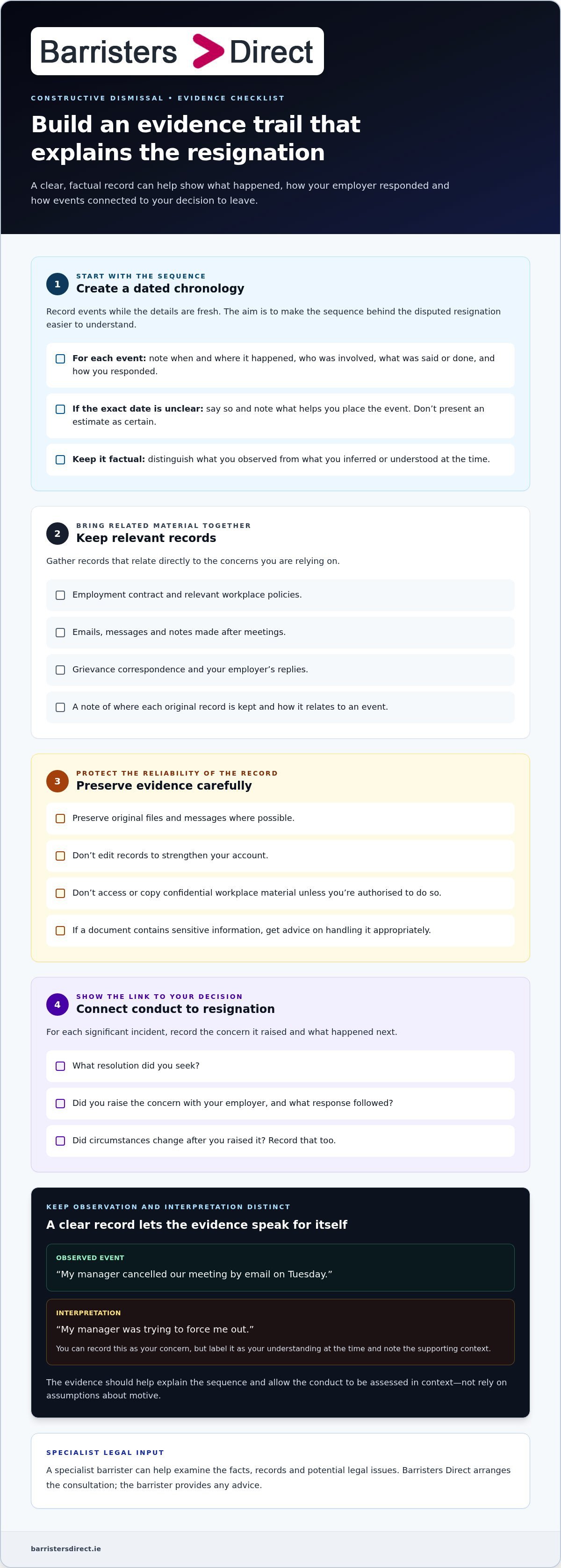
A clear account of events can show how workplace conduct developed and why it led to resignation. Start a dated chronology while details are fresh. For each incident, record when and where it happened, who was involved, what was said or done, and how you responded. If you can’t remember the exact date, say so and note what helps you place the event, rather than presenting an estimate as certain.
A chronology makes it easier to examine the sequence of events behind a disputed resignation.
Building a clear record of events
Bring together records that relate directly to your concerns: your employment contract and relevant policies, emails or messages, notes made after meetings, and any grievance correspondence and employer replies. Preserve original files and messages where possible. Don’t edit records to strengthen your account, and don’t access or copy confidential workplace material unless you’re authorised to do so. If a document contains sensitive information, get advice on handling it appropriately.
Keep the record factual and separate what you observed from what you inferred. For example, “My manager cancelled our meeting by email on Tuesday” describes an event. “My manager was trying to force me out” is an interpretation that may need supporting context. You can record your concern, but label it as your understanding at the time. This helps the reader assess the evidence without confusing an allegation with an established fact.
- For each event: note the date, people present, what happened and any immediate response.
- For related records: note where the original is kept and how it connects to the event.
- For gaps or uncertainty: identify what you can’t recall clearly rather than filling in details later.
Connecting conduct to the decision to resign
Evidence is most useful when it helps explain the effect of events on the employment relationship. For each significant incident, note what concern it raised, what resolution you sought, whether you raised it with your employer and what response followed. If circumstances changed after a complaint, record that too. The aim is not to prove motive through assumption, but to show the sequence and allow the conduct to be assessed in context.
For example, a message may establish that an instruction was given, while later correspondence may show that you asked for it to be reconsidered. Neither item alone necessarily explains why you resigned. Together with a dated note of the impact and the employer’s response, they may clarify your account. Keep relevant material organised so that a specialist reviewing your _constructive dismissal claim advice Ireland_ can identify supporting evidence and points that may need explanation.
Evidence can help assess a claim, but it can’t guarantee a particular finding or outcome. If you want informed input on how your records relate to an employment dispute, find out about specialist barrister consultations through Barristers Direct. Barristers Direct arranges the consultation; any advice is provided by the barrister.
Should you raise a grievance before resigning over workplace conduct?
If you’re still employed, raising a concern through the applicable workplace procedure may give your employer an opportunity to respond or resolve the problem. It can also establish what you asked for, when you raised it and how the employer handled it. Those facts may matter when the events leading to resignation are assessed.
A grievance does not guarantee a successful claim, and it doesn’t automatically make resignation safe. Nor should it be treated as an absolute legal requirement in every situation. The appropriate step depends on the facts, the procedure available and whether using it is realistic. If the issue is urgent or the process does not appear suitable, get advice on your options before taking an irreversible step.
How to raise a workplace concern clearly
Keep your submission measured and specific. Describe the conduct, its impact on your work and the practical outcome you’re seeking. Follow your employer’s applicable procedure where appropriate, and retain copies of what you send and the response you receive. A factual account is more useful than unsupported allegations or legal conclusions.
- Identify the issue: set out what happened and when, using specific examples where possible.
- Explain the effect: describe how the conduct affected your work or the employment relationship.
- State a reasonable outcome: make clear what action or resolution you’re asking the employer to consider.
- Keep a record: retain relevant correspondence and note any meetings or follow-up discussions.
A grievance can contribute to a clear chronology, but it does not prove that the employer acted unlawfully or that resignation is justified. Consider the submission, the employer’s handling of it and the wider circumstances together.
When the problem remains unresolved
If the employer’s response doesn’t address the concern, record what remains unresolved and why. Consider whether there is an appeal or another appropriate internal step, and whether continuing the process is practical in your circumstances. A disappointing response may form part of the overall picture, but it doesn’t decide the claim by itself.
Before resigning, weigh the consequences of leaving against the options still open to you. If a negotiated departure is possible, carefully consider the terms and implications of an exit arrangement. An agreement doesn’t automatically resolve every employment-law issue. If redundancy is genuinely being discussed, assess whether that is the real explanation for the situation rather than assuming the issue is constructive dismissal.
For constructive dismissal claim advice Ireland, consider how your actions and the employer’s response fit the facts as a whole. A grievance may help demonstrate that you tried to resolve matters, but it can’t guarantee an outcome or remove the need to assess the risks of resignation in your circumstances.
What happens after resignation: preparing a constructive dismissal complaint
After resigning, focus on presenting a clear account of why you left and what supports it. A complaint to the Workplace Relations Commission (WRC) requires evidence that your resignation was justified in the circumstances. An organised submission can make the issues easier to understand, but the outcome depends on the facts and the applicable law.
Work through your preparation in a deliberate order:
- Organise the records. Gather relevant employment documents and correspondence, then group them by topic or date so you can locate each item easily.
- Identify the key events. Focus on the conduct you rely on, the employer’s response and the events leading to your resignation. Avoid letting less relevant workplace difficulties obscure the central issue.
- Review steps taken before leaving. Note concerns raised, any procedure followed and what happened in response. Explain any significant step you could not take, if relevant.
- Check current WRC guidance. Confirm the current complaint procedure, forms and applicable deadlines through authoritative, up-to-date WRC information before filing.
Preparing a focused account of the complaint
Set out the employment relationship, the conduct you say made continued employment untenable, your efforts to address it and why you resigned when you did. Link each important factual point to a relevant document, witness or note where available. Keep facts distinct from interpretation: identify what you directly observed, what you recall and what remains disputed. A focused account is more persuasive than one that treats every disagreement as equally important.
Check that the records support the dates and sequence in your account. If a detail is uncertain, describe it as uncertain rather than presenting it as established. Include material that may complicate your position as well as evidence that supports it. This helps you and any adviser reviewing the matter assess its strengths and gaps realistically.
Understanding the WRC route and its limits
The WRC is the body identified for employment complaints. Its procedures and filing requirements can change, so don’t rely on an old form, deadline or third-party summary without checking current official guidance. Verify the applicable time limit promptly; preparing documents should not delay confirming when a complaint must be made. A legal assessment is fact-specific, and neither submitting a complaint nor having supporting records guarantees a particular result.
If you want to discuss how your evidence and account relate to the legal issues, a specialist employment law consultation may help you understand the options. Barristers Direct arranges a paid consultation with a qualified barrister; any advice is provided by that barrister. For input on your circumstances, learn about arranging a consultation through Barristers Direct.
How specialist barrister input can help clarify your next steps
Constructive dismissal disputes turn on their particular facts: what happened, how the employer responded, what steps you took and why you resigned. A specialist barrister may discuss those details with you, review relevant records and explain the legal issues that could affect your position. This can help you identify what is clear, what needs further support and which questions to address next.
Barristers Direct arranges a paid consultation with a qualified barrister in the relevant area of law. The consultation can take place online or by telephone. Barristers Direct arranges the introduction; any advice or further engagement is between you and the barrister. The consultation provides an opportunity for focused legal input, not a promise of a particular finding or outcome.
What to prepare for a specialist consultation
Preparation helps make the discussion more focused. Bring a concise chronology, your employment documents and relevant grievance correspondence or employer responses. You don’t need to provide every workplace record: prioritise material relating directly to the events behind your resignation. Note the questions you want answered, such as whether a particular response, delay or contractual term may affect how your circumstances are assessed.
- Set out the key sequence: highlight the events and decisions that led to your resignation.
- Identify the evidence: indicate which document or correspondence relates to each important point.
- List your questions: distinguish immediate concerns from issues you may need to consider later.
An automatically generated recording and/or synopsis is provided only to you and the barrister. It can help you revisit the discussion, and your own notes of practical next steps may also be useful.
A clear route to focused employment law input
Specialist employment law input can help you explore how the facts and records relate to the issues in your case. If you need representation or other assistance beyond the consultation, that is a separate matter and may involve a solicitor. The consultation itself does not create an ongoing engagement unless you and the barrister agree one.
For _constructive dismissal claim advice Ireland_, prepare your key documents and questions before deciding what to do next. A focused discussion can help you understand the issues to consider, while the decision remains yours and any advice comes from the barrister.
Explore a specialist barrister consultation to discuss your circumstances and consider an informed next step.
Make your next decision with clarity
Before taking another step, consider what you need to decide now and what information would help. A constructive dismissal claim can have lasting consequences, so seek an informed view of your particular circumstances rather than relying on assumptions or general guidance alone.
Constructive dismissal claim advice Ireland can help you understand the legal issues raised by your situation and identify questions that still need attention. Barristers Direct arranges consultations with a qualified barrister matched to the relevant area of law, online or by telephone. Any advice or further engagement is between you and the barrister.
If you’re ready to discuss your circumstances with a specialist, explore a specialist barrister consultation. A clearer understanding of your options can help you choose your next step with greater confidence.
Frequently Asked Questions
Can I bring a constructive dismissal claim if I have not resigned?
Generally, no. A constructive dismissal claim is based on an employee resigning in circumstances they say should legally be treated as a dismissal. If you remain employed, you have not yet taken the step on which this type of claim depends. Don’t resign simply to create a claim. Consider the employment situation, available workplace options and possible consequences first, and obtain advice on your specific circumstances before making a decision you can’t easily reverse.
Is constructive dismissal difficult to prove in Ireland?
It can be challenging because the employee must establish that the circumstances justified resigning, rather than relying only on the fact that work felt intolerable. The decision-maker will assess the evidence and context, including what happened before resignation and how the employer responded. A barrister with relevant employment law experience can assess the strengths and gaps in your account. Specialist constructive dismissal claim advice Ireland may help you understand the issues, but cannot assure a finding.
Can workplace bullying support a constructive dismissal claim?
It may support a claim, depending on the behaviour, its seriousness and the surrounding circumstances. For example, repeated conduct may be relevant if it affected your ability to continue working and the employer knew about it but did not address your concerns. Keep a record of specific incidents and any steps taken to report them. The label “bullying” alone doesn’t establish constructive dismissal; the facts and their effect on the employment relationship need assessment.
How long do I have to bring a constructive dismissal claim in Ireland?
You generally have six months from the date of resignation to bring a claim to the Workplace Relations Commission (WRC). The period may be extended to a maximum of 12 months only if the WRC accepts that reasonable cause explains the delay, and this is applied strictly. Check current WRC guidance promptly and get advice about the deadline for your circumstances. Don’t assume that ongoing discussions with your employer stop or extend the time limit.
Can I resign after raising a grievance and still make a claim?
Yes. Raising a grievance doesn’t prevent you from resigning later or bringing a claim, but it doesn’t prove that resignation was justified either. The timing and substance of the grievance, the employer’s response and what remained unresolved may all be relevant. If the employer offers a solution, consider whether it addresses the underlying concern before deciding what to do. If it doesn’t, record why the issue remains unresolved and seek advice before resigning.
What evidence should I keep if I am considering a constructive dismissal claim?
Keep a private, dated record of key conversations, including who was present and what was said, and note promptly when your recollection may be incomplete. Preserve relevant correspondence in its original form and note where each item came from. You may also identify colleagues who witnessed events, without pressuring them to support your account. Keep only material you’re entitled to retain, and don’t access confidential systems or files without authorisation.
Does an employer have to prove that I was fairly dismissed in a constructive dismissal case?
No, not in the same way as an ordinary unfair dismissal case. In constructive dismissal, the employee resigned, so the employee must establish that the resignation amounted to a dismissal in law and was justified by the circumstances. The employer may still provide its own evidence and challenge your account, but you shouldn’t assume the employer carries the burden of proving a fair dismissal. A decision will depend on the evidence and the applicable legal test.
Disclaimer
_This article does not constitute legal advice. Barristers Direct does not provide legal advice. To obtain legal advice, you should contact a legal practitioner._