
Full article
Published 23/10/2026
Construction disputes are often shaped by decisions made before work begins. A construction lawyer can advise on project arrangements, contract terms, securities and development agreements, and help resolve disputes if they arise. In Ireland, timely advice can clarify responsibilities and risks before they affect project delivery.
Construction projects involve commercial decisions as well as technical work, so contract language or a developing disagreement can be difficult to assess. This article explains how legal advice can support a project from planning and contract review through to dispute resolution, including the role of securities and development agreements.
You’ll learn what a construction lawyer can help with, when to seek advice and how early attention to contractual issues can clarify your options. The aim is to make the legal steps easier to understand, so you can approach a project or dispute with a clearer grasp of the decisions involved.
Key Takeaways
- Understand how legal advice can support a construction project from early planning through to delivery, including the relevance of Ireland’s 2022 building works legislation.
- Learn which contract terms and professional appointments can clarify responsibilities, scope, payment and how changes are handled.
- See how early attention to emerging issues and the Construction Contracts Act 2013 can inform dispute resolution, including adjudication.
- Identify the practical purpose of bonds, guarantees and other securities, and the risks their wording can allocate between parties.
- Explore how development and collaboration agreements can set out shared responsibilities, decision-making and how parties respond when plans change.
Table of Contents
- Construction and infrastructure project experience
- Construction contracts and professional appointments
- Construction dispute avoidance and resolution
- Bonds, guarantees and securities
- Development and collaboration agreements
- Barristers Direct: Commercial Dispute Resolution
Construction and infrastructure project experience
Construction and infrastructure work spans office developments, housing, energy assets and public-sector programmes. A construction lawyer can help parties assess project documents, responsibilities and commercial risks in context. Relevant experience should match the project’s structure, scale and contractual issues, not just its general subject.
Recent Irish developments illustrate that range. Navigation Square in Cork City comprises four buildings and 310,000 sq ft of office space designed to Gold LEED standards. Penrose Dock, also in Cork, had a stated value of €125 million and includes 250,000 sq ft of office space. These projects involve different stakeholders and practical considerations from a public housing scheme or an energy development.
Public and private sector projects can involve different decision-making arrangements. A public project may require coordination among a public body, design team and delivery partners. A private office development may centre on the developer, funder, contractor and future occupiers. In either setting, map the parties, their responsibilities and the documents governing key decisions before work progresses.
Ireland’s Regulation of Providers of Building Works and Miscellaneous Provisions Act is dated 2022, according to the Irish Statute Book. For a project team, the Act’s title is a useful pointer when identifying the regulatory framework relevant to building works. Legal advice can then be focused on the project’s actual structure and documents.
Construction and engineering projects also include infrastructure and energy assets. HitecVision and Reinova Partners received advice on acquiring six operational onshore wind assets from Greencoat Renewables plc. This example shows why project analysis can extend beyond physical construction to acquisition documents, operational arrangements and relationships between asset owners and counterparties.
Project insurance and administration need attention alongside contract planning. Identify the relevant policies, who must maintain them and how evidence of cover is recorded. Set out clear procedures for notices, approvals, variations and record keeping. If an instruction changes the design or timetable, dated correspondence and agreed records help establish what was requested and accepted.
How much does a construction lawyer cost in Ireland? The price depends on the case and is given after a quote request; factors include the project’s complexity, documents to review and advice required.
When should I hire a construction solicitor in Ireland? Seek advice before signing key project documents, or when responsibilities, delays, payment or insurance arrangements become unclear. An early review gives you time to understand the contractual position before decisions narrow your options.
How do I find a specialist construction lawyer near me in Ireland? Look for a legal professional with experience relevant to your project, such as office development, public works, or construction and engineering disputes. Explain the project type, documents and issue so the advice can be matched to the work involved.
Construction contracts and professional appointments
A construction contract turns a project plan into agreed responsibilities, payment terms and procedures. A construction lawyer can help draft or negotiate those terms before they shape delivery. For example, a contractor’s scope should describe the work, required information and process for approving changes. Clear drafting helps each party understand what it must provide and when.
Professional appointments serve a different but related purpose. An appointment between a client and an architect, engineer or project manager should identify the services, deliverables and reporting arrangements. If the engineering design changes, the documents should explain how instructions are issued and how the change affects scope, timing or fees. Distinguishing an appointment from the main building contract matters when responsibilities overlap.
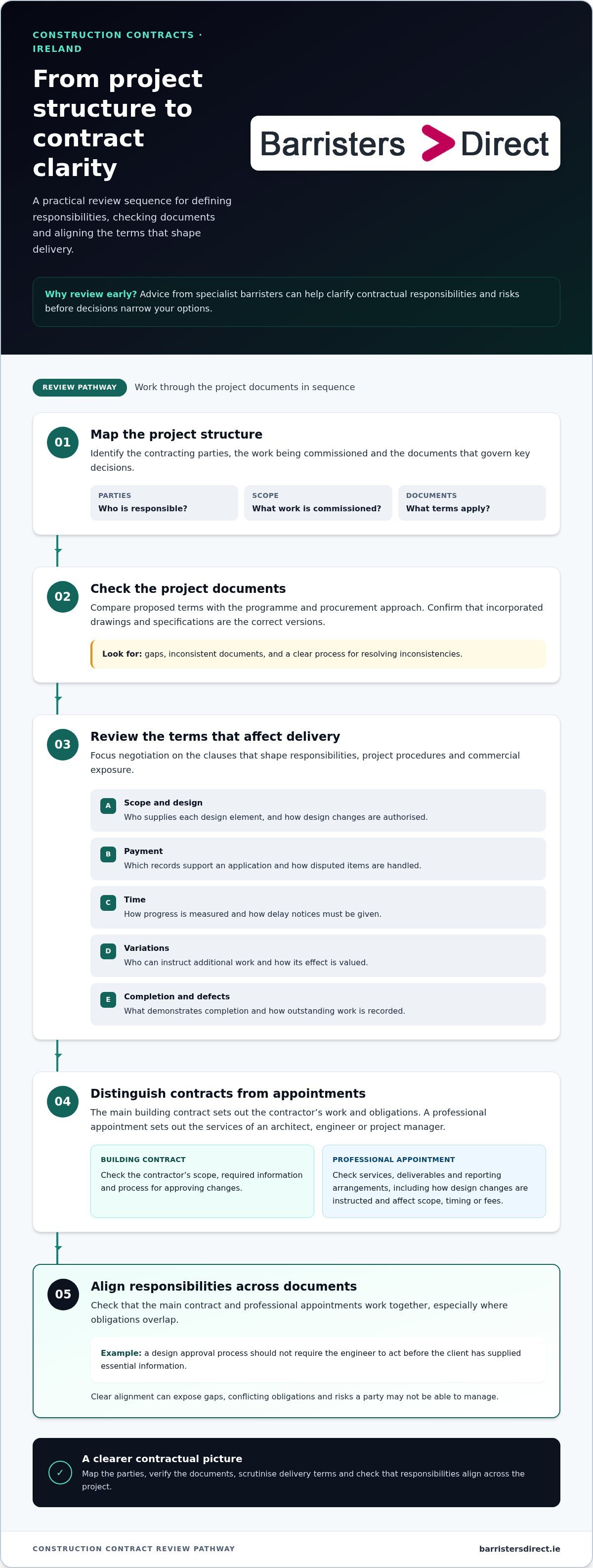
Start by mapping the project structure. Identify the contracting parties, the work being commissioned and any documents incorporated by reference. Then compare the proposed terms with the project programme and procurement approach. If the contract refers to drawings or specifications, check that the correct versions are attached and that inconsistencies have a clear resolution process.
Negotiation should focus on clauses that affect delivery and exposure, not wording alone. Review how the contract deals with:
- Scope and design: who supplies each design element, and how design changes are authorised.
- Payment: what records support an application, and how disputed items are handled.
- Time: how progress is measured and how delay notices must be given.
- Variations: who can instruct additional work and how its effect is valued.
- Completion and defects: what evidence demonstrates completion and how outstanding work is recorded.
These points should align across the main contract and each professional appointment. For example, a design approval process should not require the engineer to act before the client has supplied essential information. A document review can identify gaps, conflicting obligations and provisions that leave a party carrying risks it cannot manage.
What laws and regulations govern construction contracts in Ireland? Contract terms operate alongside applicable Irish law and project-specific requirements. The Irish Statute Book identifies the Construction Contracts Act 2013 as relevant to adjudication in Ireland.
What risks should I consider before signing a construction contract in Ireland? Check the scope, payment process, delay provisions, variation mechanism and responsibility for design information. Compare the contract with professional appointments too, so notice periods and approval duties do not conflict.
Before signing, mark up unclear clauses and record proposed wording for each change. A focused review of the contract, specifications and appointments can show whether the documents describe one workable process or impose separate obligations that pull the project in different directions.
Related hiring also reflects the range of work around construction projects. A Dublin construction and engineering lawyer vacancy is listed for candidates with 4+ years of post-qualification experience. A construction contracts manager vacancy is listed in County Waterford, Ireland. These roles sit on different sides of project delivery, but both call for attention to contractual responsibilities, coordination and the practical handling of project obligations. Clear documents can support that work by making authority, communication and accountability easier to identify throughout delivery.
Construction dispute avoidance and resolution
A disagreement over design changes, delayed information or payment can disrupt a construction project before formal proceedings begin. In Ireland, managing the issue starts with the contract, project records and a clear account of what each party did. Early risk analysis can identify problems while practical options remain.
For example, if a contractor disputes an instructed variation, gather the instruction, relevant drawings, correspondence and valuation records. Compare them with the contract’s process for approving and pricing changes. Dated records of the work and its effect on progress help distinguish the actual disagreement from assumptions or incomplete project updates.
The Irish Statute Book identifies the Construction Contracts Act 2013 as relevant to adjudication in Ireland. Adjudication is one route for addressing a construction dispute, including a payment disagreement. The applicable contract and legal framework inform the procedure, so identify the relevant terms before preparing a referral or response.
Construction dispute management can follow a practical sequence:
- Define the issue: identify the disputed instruction, payment, delay or alleged defect.
- Collect the record: organise the contract, notices, site records, correspondence and supporting calculations.
- Check the procedure: find the contract clauses governing notices, escalation and dispute resolution.
- Assess the options: consider direct negotiation, mediation, adjudication or another route provided for.
- Set the objective: decide whether the priority is payment, revised work, a time adjustment or a final resolution.
A construction specialist focuses on how project contracts, technical records and commercial duties interact. A general solicitor can provide legal advice and manage broader matters, while a dispute-resolution specialist may focus on procedure and settlement. The right expertise depends on the issue, evidence and route under consideration.
What are the steps and deadlines for pursuing a construction claim in Ireland? Identify the claim, preserve supporting records, review the contract’s notice and dispute clauses, then prepare the required notice or submission. Deadlines depend on the applicable procedure and contract terms, so check them at the outset and act promptly.
How are construction payment disputes resolved in Ireland, including adjudication? Parties can use the dispute process set out in their contract, which may include negotiation, mediation or adjudication. The Irish Statute Book identifies the Construction Contracts Act 2013 as relevant to adjudication; payment records, notices and contract terms are central to presenting the issue.
Dispute avoidance continues throughout project delivery. At each meeting, record outstanding decisions, assign responsibility and note the agreed next step. If a design approval or payment issue remains unresolved, a written escalation under the contract can clarify the position before it affects further work.
The construction team advises on disputes and has represented clients in all forums of dispute resolution. It also advises on risk analysis and the early identification of issues relevant to its clients.
When considering a route, use the contract and project record to clarify what remains contested, what outcome is sought and which procedural steps apply. Keeping the assessment focused can help ensure discussions address the live issue and available resolution options.
Bonds, guarantees and securities
Security documents allocate financial risk if a construction obligation is not met. A performance bond, parent company guarantee and advance payment bond each work differently. Their purpose, trigger and expiry depend on the wording. Review each instrument alongside the building contract, rather than treating it as a standalone form.
For example, a public hospital project might require a performance bond to address specified contractor defaults. The project team should identify who provides it, who benefits, what events permit a demand and what supporting documents are required. If the bond’s trigger does not match the contract’s obligations, the parties may disagree about whether it can be called.
A parent company guarantee involves a different relationship. It may support a subsidiary’s contractual commitments, so review the guarantor’s identity and the obligations covered. Check whether the wording addresses performance, payment or both. Examine when the guarantee starts and ends, and whether amendments to the underlying contract affect its scope.
An advance payment bond may be relevant when an employer pays funds before receiving corresponding work or materials. Review which payment it secures and how the secured amount changes as work progresses. The contract and bond should explain what evidence shows that the advance has been earned or repaid. A mismatch can leave uncertainty about the remaining security.
Before signing, compare each instrument with the project’s commercial framework. Focus on these points:
- Parties: confirm the employer, contractor, guarantor and beneficiary are correctly identified.
- Trigger: establish which event allows a demand, and whether notice or evidence is required.
- Scope: check which obligations are secured, including any defined performance or payment duties.
- Duration: align expiry and release provisions with the relevant project milestones.
- Changes: determine how variations, extensions or contract amendments affect the security.
Administration matters after execution. Keep the signed instrument with the contract record, note its expiry date and assign responsibility for required notices. If a hospital centre project changes contractor or delivery arrangements, review whether the existing security still reflects the revised obligations. Record each amendment and obtain the necessary agreement before relying on it.
Security can sit alongside insurance, retention or other contractual protections. These mechanisms are not interchangeable: insurance responds according to its policy terms, while a bond or guarantee follows its own wording. Map each protection to the risk it addresses, then identify any uncovered gap or duplicated requirement.
Legal review is most useful before execution or before a proposed amendment takes effect. A focused review can explain the demand process, clarify the parties’ exposure and align the instrument with the project contract. This gives decision-makers a clearer basis for accepting, negotiating or administering the security.
Development and collaboration agreements
A development agreement sets out how parties will deliver a project together. A collaboration agreement can define shared decisions, contributions and responsibilities. For a site such as Kilkenny’s 16-acre Abbey Quarter, the agreement may need to coordinate land interests, development work and future use. Its terms should reflect the actual project structure, not rely on broad statements of intent.
Start by identifying each party’s role and contribution. One party may provide land, another funding and another development expertise. The agreement should explain how contributions are valued and recorded, who controls project decisions and what approvals are needed before work proceeds. If a developer is responsible for delivery, define the milestones and information other parties need to assess progress.
Decision-making deserves particular attention when a project has several partners. Set out which matters require joint agreement, who may approve routine actions and how unresolved decisions are escalated. For example, the parties can establish a meeting for named representatives, a written decision record and a route to mediation if negotiations stall. Clear steps can prevent an operational disagreement from becoming a wider project dispute.
A practical review can test whether the draft answers these questions:
- Funding: who contributes funds, when contributions fall due, and how cost changes are handled.
- Land and access: which site rights each party contributes and what access the project requires.
- Programme: how milestones, delays and revised delivery plans are recorded.
- Changes: who can approve design or scope changes and how their effects are assessed.
- Exit and default: what happens if a partner cannot meet its commitments or wishes to leave.
Public-sector arrangements add another layer of coordination. An affordable purchase housing scheme valued at €40 million illustrates the scale of public development activity. An agreement for a public project should clearly allocate responsibilities between the relevant body, development partners and delivery team. It should also specify how decisions, reporting and changes are documented.
National projects may bring together parties with different commercial priorities. Align the development agreement with related land, funding and construction documents. If a construction contract requires an approval, the collaboration agreement should identify who obtains it and who provides supporting information. Comparing the documents can expose a gap before it affects delivery.
Before signing, prepare a responsibility schedule and compare it with the agreement’s decision and change procedures. If a disagreement has already emerged over a commercial project, seek expert advice on resolving the dispute and understanding the contractual options.
Barristers Direct: Commercial Dispute Resolution
Barristers Direct offers Commercial Dispute Resolution for individuals and companies facing a construction-related commercial disagreement. You can instruct specialist counsel directly for a fixed-fee initial consultation, without needing a solicitor for that meeting. Counsel can assess the contract, project records and dispute issues, then explain the legal position and possible next steps.
Consider seeking advice if a payment dispute, disputed variation or breakdown in a development arrangement is affecting your decisions. Bring the relevant agreement, correspondence and key project records to the consultation. This gives counsel material to assess the specific issue and provide focused advice. Solicitors continue to play an important role in legal matters, including where their services are appropriate to the work required.
If you’d like expert advice on a commercial dispute, contact Barristers Direct.
Choose your next step with clarity
The next decision is not simply whether to challenge a position. Consider the outcome your business needs, the commercial relationship that matters and the route best suited to those priorities. A construction lawyer can help assess the legal issues against those practical aims, so your response is deliberate rather than reactive.
Before seeking advice, write down the decision you need to make and the result you want to achieve. This focus can make a discussion with specialist counsel more useful, whether you are considering a proposed agreement or responding to a disagreement. Barristers Direct offers a fixed-fee initial consultation for commercial dispute resolution.
If you are ready to discuss your situation, explore how Barristers Direct can help. A clear understanding of your options is a constructive place to begin.
Frequently Asked Questions
What does a construction lawyer do in Ireland?
A construction lawyer advises on legal issues arising from building and infrastructure projects. This can include reviewing a proposed contract, explaining responsibilities under professional appointments, assessing a disagreement over defective work or advising on a development agreement. For example, if a contractor disputes whether extra work was authorised, a lawyer can assess the relevant documents and explain your legal position and available options.
How can I resolve a dispute with a builder or contractor in Ireland?
Start by setting out the issue clearly in writing and gathering relevant records, such as the quotation, agreed specifications, invoices and messages about changes. Explain the outcome you are seeking, such as completion of agreed work or correction of a specific defect. Keep copies of responses and proposed resolutions. If direct discussions do not settle the matter, seek legal advice on the contract and appropriate dispute-resolution route.
Disclaimer
_This article does not constitute legal advice. Barristers Direct does not provide legal advice. To obtain legal advice, you should contact a legal practitioner._