

Full article
Published 20/09/2026
If a company faces insolvency, the assumption that the corporate veil provides absolute protection for your personal savings and property is a dangerous misconception. Under the Companies Act 2014, the boundary between corporate debt and personal liability can dissolve rapidly if fiduciary duties are neglected. Directors often seek specialist company law advice for directors to navigate these complex statutory requirements, particularly whilst managing the daily pressures of a business in transition.
Mastering the intricacies of your role is the only way to protect your professional standing and your assets with precision. This article provides the expert legal insights needed to understand your fiduciary duties, avoid the pitfalls of reckless trading, and secure a strategic path forward.
Key Takeaways
- Learn the eight codified fiduciary duties under the Companies Act 2014 to ensure your boardroom decisions remain legally compliant.
- Identify the specific statutory triggers that can pierce the corporate veil and expose your personal assets to company creditors.
- Discover how to navigate the complexities of near-insolvency by securing specialist company law advice for directors to mitigate risks of reckless trading.
- Understand the critical distinction between de jure, de facto, and shadow directors to clarify your personal exposure and legal responsibilities.
- Gain a strategic advantage by accessing direct consultations with specialist barristers for an objective, fixed-fee assessment of your legal position.
Understanding Director Duties under the Companies Act 2014
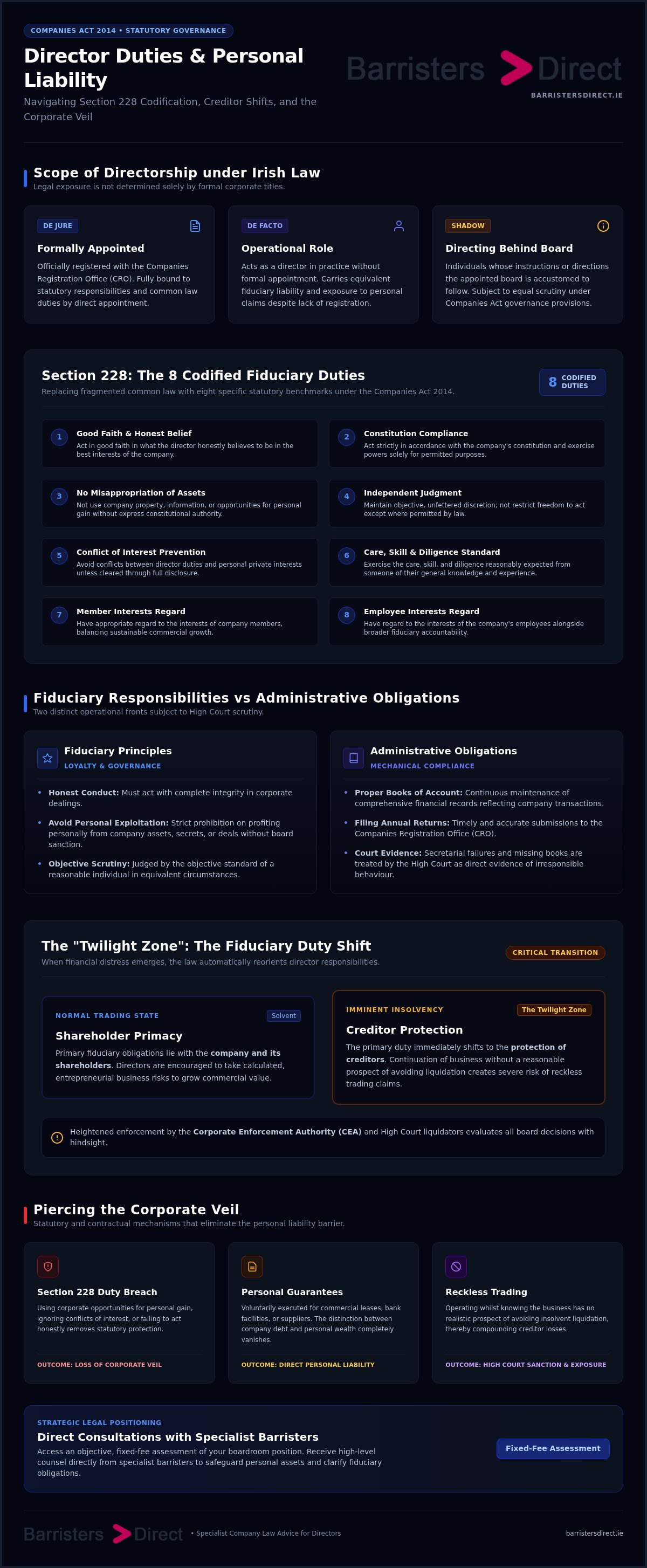
The Companies Act 2014 serves as the primary pillar for Irish corporate governance. It replaced a fragmented system of common law with a clear statutory code that governs how every director must behave. If you hold a board position, you aren't just an employee; you're a fiduciary with significant legal exposure. This exposure isn't limited to "de jure" directors formally registered with the Companies Registration Office. It extends to "de facto" directors who perform the role without a formal appointment and "shadow" directors whose instructions the board typically follows.
The Eight General Duties of a Director
Under Section 228 of the Act, common law principles are now codified into eight distinct statutory duties. You must act in good faith and in what you honestly believe to be the best interests of the company. This requires exercising a level of care, skill, and diligence that a reasonable person would expect from someone with your specific knowledge and experience. Avoiding conflicts of interest is equally paramount.
Fiduciary Responsibilities vs Administrative Obligations
While fiduciary duties focus on your loyalty to the company, administrative obligations are the mechanical requirements for staying on the right side of the law. You're personally responsible for the maintenance of proper books of account and the timely filing of annual returns. When a business enters a period of financial distress, your duty shift is significant. If insolvency is likely, your primary fiduciary obligation moves from the shareholders to the creditors.
Personal Liability and the Corporate Veil
In Irish law, the principle of separate legal personality ensures that a company is a distinct entity from its directors. This corporate veil usually protects your personal wealth from the business's creditors. However, this protection is conditional. If you breach your fiduciary duties under Section 228, that shield can be removed.
Piercing the Corporate Veil in Ireland
The courts are generally reluctant to ignore the company's separate identity, but they'll do so if the corporate structure is used to conceal fraud or evade existing legal obligations. If you fail to maintain clear boundaries between personal and business finances, a liquidator may argue that the company is a mere sham.
Statutory Breaches Leading to Personal Liability
Statutes create specific pathways for personal liability that bypass the corporate veil entirely. For instance, directors can be held personally responsible for unpaid taxes or PRSI contributions if the failure to pay was due to a deliberate act or omission.
Navigating Insolvency: Reckless and Fraudulent Trading
When a company's financial health deteriorates, your legal priorities must shift. Insolvency in Ireland is determined by two distinct tests. The cash flow test asks if the company can pay its debts as they fall due. The balance sheet test examines whether total liabilities exceed the value of the company's assets.
Reckless trading under Section 610 occurs if you're knowingly a party to carrying on business in a way that creates a substantial risk of serious loss to a creditor. Fraudulent trading is even more severe. It constitutes a Category 1 offence, potentially carrying up to 10 years’ imprisonment and fines of up to €500,000.
Defending Reckless Trading Allegations
To defend an allegation of reckless trading, you must demonstrate that you acted honestly and responsibly. This involves proving that you had a reasonable expectation that the company could survive its difficulties. Engaging a barrister to provide a specialist opinion on the "reasonableness" of your actions can be a decisive factor.
Restriction and Disqualification Orders
If a company fails whilst insolvent, the High Court must restrict a director unless they prove they acted responsibly. A Section 819 restriction lasts for five years. A Section 842 disqualification is far more severe, often resulting from persistent defaults or fraud and prevents the individual from acting as a director or secretary of any Irish company for a specified period.
When to Seek Specialist Company Law Advice for Directors
Recognising the exact moment when routine business challenges transition into personal legal risks is a critical skill for any board member. Seeking specialist company law advice for directors at this stage allows you to address board disputes or shareholder disagreements before they escalate into destructive litigation.
Five Steps for Directors Facing Legal Challenges
- Step 1: Review the company constitution and shareholder agreements to clarify your specific powers and limitations.
- Step 2: Document all board decisions and professional advice received to create a clear audit trail of your conduct.
- Step 3: Assess the company’s solvency position with financial experts to ensure you are meeting your duties to creditors.
- Step 4: Engage a specialist barrister for a strategic consultation to gain an objective, high-level view of the legal landscape.
- Step 5: Formulate a clear path forward that prioritises the protection of your personal assets and reputation whilst fulfilling your fiduciary duties.
The Direct Access Advantage for Irish Directors
The Barristers Direct platform enables the direct instruction of independent barristers for an initial consultation. This direct access ensures that you receive high-level company law advice for directors at the moment it is most needed.
Fixed-Fee Strategic Consultations
The Barristers Direct model provides clear, fixed-fee structures for initial consultations. For a barrister-only consultation, the fee is set at €395 plus VAT. If the matter is particularly contentious or requires a broader perspective, a €595 plus VAT model is available, where both a barrister and a solicitor attend the session.
Frequently Asked Questions
Can I be held personally liable for my company’s debts in Ireland?
You can be held personally liable for company debts if you breach your fiduciary duties or engage in reckless or fraudulent trading.
What is the difference between reckless and fraudulent trading?
Reckless trading involves carrying on a business whilst knowingly taking risks that a reasonable person wouldn't take. Fraudulent trading is more severe as it requires a specific intent to defraud creditors or other parties.
Do I need a solicitor to speak with a barrister about company law?
If formal legal proceedings have not yet been commenced, you don't need a solicitor to arrange an initial consultation with a barrister.
What happens if I am issued a director restriction order?
A director restriction order under Section 819 prevents you from acting as a director or secretary of any company for five years, with exceptions for companies meeting specific paid-up share capital requirements.
How much does a consultation with a specialist barrister cost?
A consultation with a specialist barrister through our platform costs €395 plus VAT for a barrister-only session, or €595 plus VAT if a solicitor is also present.
Can a barrister help resolve a shareholder dispute without going to court?
Yes, a barrister can be instrumental in resolving shareholder disputes before they reach the courtroom by providing an independent and objective evaluation of the legal merits.
What duties do I owe to company creditors when the business is insolvent?
When a company becomes insolvent, your fiduciary duties shift from the shareholders to the creditors; you must protect their interests and avoid reckless trading.
How does Barristers Direct ensure the confidentiality of my consultation?
Confidentiality is maintained through a secure consultation process where meeting recordings and synopses are shared exclusively with the client and the barrister.
Disclaimer
_This article does not constitute legal advice. Barristers Direct does not provide legal advice. To obtain legal advice, you should contact a legal practitioner._