

Full article
Published 22/10/2026
You may be able to reject a proposed settlement, but how a company dispute is resolved can depend on what the parties agreed in advance. In Ireland, a shareholders’ agreement may require disputes to go to arbitration. Mediation is different: a mediator helps the parties communicate but cannot impose a decision.
It’s understandable to want a clear answer about whether you must take part in alternative dispute resolution (ADR). The key distinction is between a process the parties have agreed to use and a settlement they choose to accept. This article explains how negotiation, mediation, conciliation and arbitration work, and what each can mean for a commercial or contract dispute.
You’ll also learn how to prevent shareholder disputes, which options may help when disagreements arise, and when court proceedings may become relevant. The aim is to clarify your choices and help you understand the next steps before a disagreement puts further strain on the business or its relationships.
Key Takeaways
- Read the dispute-resolution terms in your contracts and shareholders’ agreement to understand which processes the parties have agreed to use.
- Compare negotiation, mediation, conciliation and arbitration before deciding how to approach a commercial disagreement.
- Clear articles of association and a well-drafted shareholders’ agreement can help prevent disputes and set out how disagreements should be handled.
- Keep relevant contracts, correspondence and business records organised so you can explain your position clearly if a dispute arises.
- Specialist legal advice can help you assess your options and decide on a proportionate next step.
Table of Contents
- What is alternative dispute resolution for businesses?
- How to Avoid Shareholder Disputes?
- Alternative dispute resolution
- What are commercial disputes?
- Transaction and contract-related disputes
- Barristers Direct: Commercial Dispute Resolution
What is alternative dispute resolution for businesses?
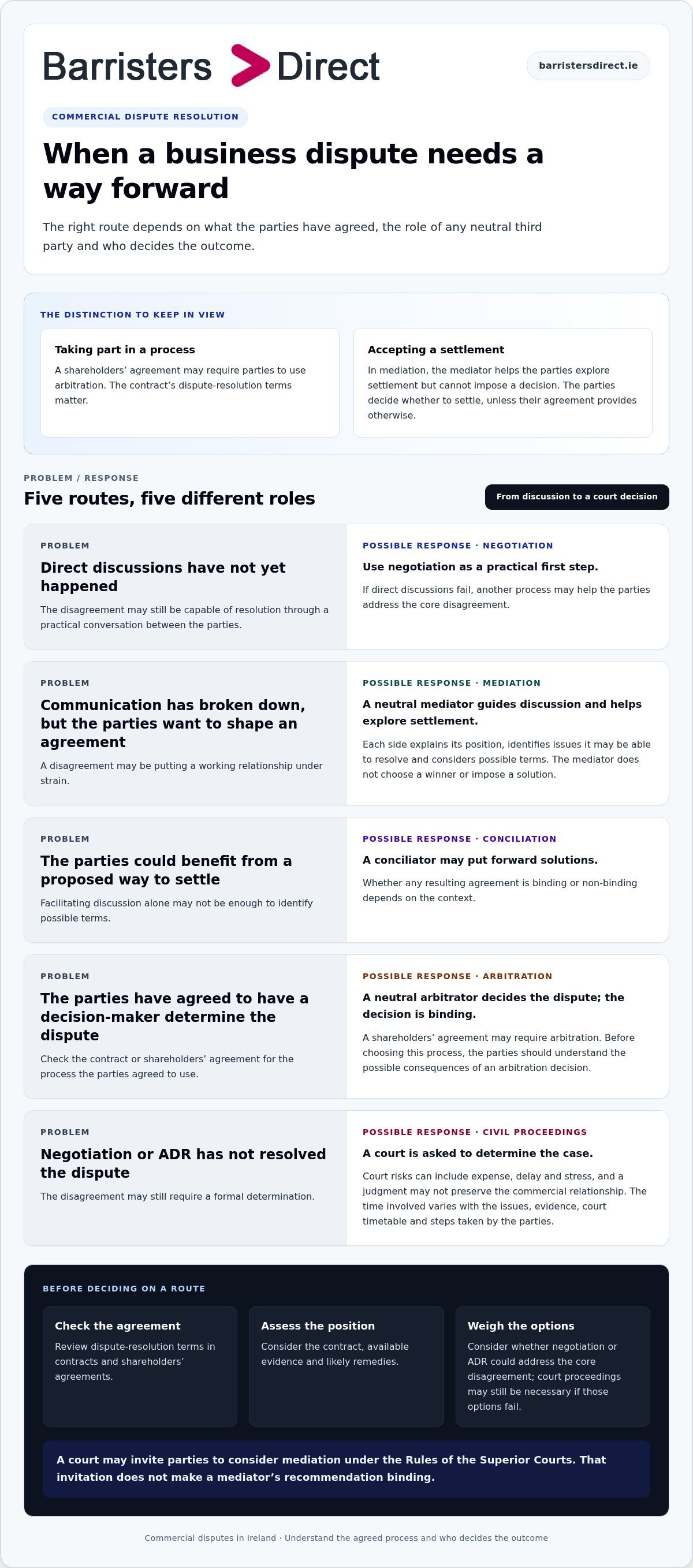
Alternative dispute resolution (ADR) gives businesses ways to address disagreements without asking a court to decide the case. Mediation, arbitration and conciliation involve an independent third party, but each has a different role and outcome.
Mediation and Arbitration
Mediation uses a neutral mediator to help parties communicate and explore settlement. Arbitration gives a neutral arbitrator authority to decide the dispute. The distinction matters: a mediator may suggest a solution but cannot impose one, while an arbitration decision is binding. A clause in a shareholders’ agreement may require parties to arbitrate a shareholder disagreement. Without such a clause, the parties may still agree to mediation or arbitration.
In mediation, each side explains its position, identifies the issues it may be able to resolve, and considers possible terms. The mediator guides the discussion but does not choose a winner. The effect of a settlement can depend on what the parties agree. Conciliation is another ADR option: a conciliator may propose solutions, and any resulting agreement may be binding or non-binding, depending on the context.
ADR Compared with Civil Proceedings
ADR involves third-party assistance to resolve a dispute, while civil proceedings ask a court to determine the case. The process matters because it can affect how much control the parties retain over the outcome. Negotiation is a practical first step. If direct discussions fail, mediation may help preserve a working relationship and shape a settlement around the business’s needs.
Unlike mediation, arbitration gives the arbitrator the job of deciding the dispute rather than facilitating an agreement. The parties should understand the possible consequences of an arbitration decision before choosing that process. The parties may have more control over the process than in court, but they accept that a decision-maker will determine the outcome. Conciliation falls between facilitation and decision-making because the conciliator may put forward a proposal.
ADR is more than an informal conversation. The parties’ agreement, the chosen process and the nature of the dispute all matter. Under the Rules of the Superior Courts, a court may invite parties to consider mediation. That invitation does not make a mediator’s recommendation binding: the parties still decide whether to settle, unless their agreement provides otherwise.
Proceedings Time and Court Risks
There is no single timeline for company dispute proceedings in Ireland. The issues, evidence, court timetable and steps taken by the parties all affect how long a case takes. Early assessment is important, particularly if an ongoing disagreement is disrupting business decisions or relationships.
Court risks include expense, delay, stress and a judgment that may not preserve the parties’ commercial relationship. In a shareholder dispute, litigation costs can consume the value of a small company. Before proceedings begin, assess the contract, available evidence, likely remedies and whether negotiation or ADR could address the core disagreement. If those options fail, court proceedings may still be necessary.
How to Avoid Shareholder Disputes?
Clear governance documents set expectations before shareholders disagree about a decision. In Ireland, a shareholders’ agreement and the company’s articles of association can define responsibilities and establish a process for handling conflict.
Disagreements over Company Decisions
A shareholder disagreement arises when members differ over decisions, access to information or how the company is managed. Clear procedures matter: excluding a member or diverting customers may undermine the position of the person responsible.
A shareholders’ agreement can regulate the relationship between shareholders and record how decisions should be made. It can cover voting, share transfers, access to company information and procedures for resolving deadlock. The articles of association set out the company’s rules, so consistent wording across both documents helps avoid uncertainty.
For example, an agreement can specify what happens if shareholders cannot agree on a major business decision. It can also set out a way to raise concerns before a disagreement escalates. Clear, unambiguous articles and agreements help members understand their rights and reduce the risk of conflicting interpretations.
Conduct matters as much as wording. Locking another shareholder out of accounts, diverting customers or arranging ambush meetings can weaken the responsible party’s position. Keep communications factual, follow the company’s agreed decision-making process and give every involved shareholder a fair opportunity to participate.
Evidence and Dispute Documents
Evidence in a company dispute includes documents and records showing what was agreed, decided and done. Organising these materials helps establish a timeline and clarify which issues are contested.
Gather the current articles of association, shareholders’ agreement, share records, meeting notices and minutes, relevant emails, and records of key decisions. Preserve digital and electronic documents in their original form where possible. If customer or employee information is involved, handle it with data protection in mind and keep the collection focused on relevant records.
A useful first step is to prepare a dated chronology that links each disputed decision to its supporting record. For instance, compare meeting minutes with emails about a shareholder’s access to accounts. Note separately what is documented and what remains disputed. This helps an independent adviser assess the evidence without confusing allegations with facts.
Section 212 of Ireland’s Companies Act 2014 provides a remedy where a company’s affairs or directors’ powers are exercised oppressively or in disregard of a member’s interests, according to the Irish Statute Book. An oppression claim may arise where a member alleges unfair treatment within the company. Irish courts may order a majority shareholder to buy a minority shareholder’s shares at fair value as a remedy.
Most Irish shareholder disputes occur in companies with fewer than five members. In a closely held business, a breakdown in trust can affect daily decisions as well as ownership. Keep governance documents current, record decisions accurately and address concerns through the agreed process. If the evidence raises questions about rights or remedies, independent legal advice on commercial disputes can help clarify the available options before court proceedings are considered.
Alternative dispute resolution
In Ireland, parties can try direct discussions, negotiation or alternative dispute resolution before asking a court to decide a business disagreement. The right route depends on the agreement, the evidence and the outcome each party seeks.
Direct Resolution and ADR Options
Direct resolution means raising the issue with the other party and seeking an agreed solution before formal proceedings. Identify the disputed point, collect relevant documents and make a practical proposal. If negotiation stalls, mediation can help the parties discuss settlement. Arbitration provides a binding decision if they have agreed to that process. Court remains an option if other routes fail.
When a company dispute involves officers, the officers themselves are responsible for resolving it. A director involved can keep communications factual, follow the company’s decision-making process and retain records. Under the Rules of the Superior Courts, a judge may invite the parties to consider mediation before the dispute is heard in court.
Consumers can use ADR schemes for disputes with traders based elsewhere in the EU. Ireland’s EU Alternative Dispute Resolution for Consumer Disputes Regulations 2015 brought the EU ADR Directive into Irish law as SI 343/2015. This consumer route differs from resolving a business-to-business contract disagreement. Authorised ADR bodies must handle complaints effectively, fairly, independently and transparently.
If a company dispute involves a trader in another EU country, first establish whether the complainant is acting as a consumer or as a business. That distinction helps determine whether a consumer ADR scheme is relevant. Keep the contract, order details and communications together so you can present the complaint clearly.
Costs of Resolving a Company Dispute
The cost of resolving a company dispute depends on the process, the issues and the work needed to present each side’s case. Direct negotiation may require less formal preparation than arbitration or court proceedings. Extensive records, contested facts and expert evidence can add work. Consider these factors when comparing options, not just the initial process.
For example, parties considering mediation can assess whether a focused discussion might settle a defined issue. If their contract requires arbitration, they should account for the work involved in preparing documents and submissions. Court proceedings can be expensive, time-consuming and stressful, and litigation costs can consume the value of a small company. Early assessment of the claim, evidence and desired outcome helps shape a proportionate approach.
There is no single cost for resolving a company dispute. The amount depends on the case, including its complexity, the volume of documents, the number of contested points and whether a hearing is needed. While addressing the disagreement, directors should act in the company’s interests and maintain accurate records. Independent legal advice can help assess the issues and available routes.
What are commercial disputes?
Commercial disputes arise from business dealings, company relationships or obligations between businesses. They can range from an unpaid invoice to disagreements about a contract’s meaning or performance.
Types of Commercial and Business Disputes
A commercial dispute is a disagreement connected with trading, business operations or company affairs. Identifying its source matters because the relevant contract, records and remedy depend on the issue. For example, a supplier may allege that a customer failed to pay, while the customer disputes the quality or delivery of the goods.
Other examples include disagreements over service standards, contract terms, shareholder decisions and intellectual property. If a business suspects infringement, it should identify the alleged infringer and gather evidence, such as relevant correspondence or digital records. Possible responses include filing a lawsuit or negotiating a settlement.
Commercial and corporate disputes can overlap. A disagreement between shareholders may affect company decisions, while a contract dispute can disrupt a trading relationship. Separate the issues by identifying who is involved, which obligation or right is disputed, and what outcome would address the business problem. This helps focus discussions and any later proceedings.
Commercial Debt and Customer Disputes
A commercial debt is money a business owes to a person or another party. An unpaid supplier invoice is one example, but a dispute may concern whether the amount is due, whether the work was completed, or whether the invoice reflects the agreed terms.
In a customer dispute, compare the order, contract, delivery record, invoice and relevant communications. Keep customer terms and conditions robust, protect your interests and update them to comply with Irish and EU laws. Clear terms can show what each party agreed, but transaction records remain important evidence.
Before escalating an unpaid account, set out the amount claimed, the basis for it and any response received. If the customer raises a genuine concern about performance, address that issue directly rather than treating every delayed payment the same way. The steps taken can affect both the business relationship and the prospects of resolution.
Commercial Litigation
Commercial litigation is the process of asking a court to decide a business dispute. It may become relevant when negotiation or another resolution route fails, or when a party needs a court determination. The issues, evidence and remedy sought shape how the case is presented.
Before filing a lawsuit, assess whether there is a valid claim and whether litigation is the best option. Gather contracts, invoices, meeting records and digital communications that support your position. A clear evidence trail helps distinguish documented facts from disputed accounts and gives the parties a firmer basis for assessing the likely outcome.
Court action can affect a business beyond the immediate claim. It may take staff time, put pressure on a commercial relationship and bring sensitive business information into the proceedings. Consider these consequences alongside the claim, the other party’s position and the practical value of the remedy sought.
Transaction and contract-related disputes
A transaction dispute can arise when parties disagree about an agreement’s terms, performance or effect. Review the contract alongside the transaction records to identify what each party says went wrong.
Contractual Disputes
A contractual dispute is a disagreement about the meaning, performance or consequences of an agreement. The wording and surrounding records can shape each party’s position. For example, a buyer and supplier may disagree about delivery dates, product specifications or payment terms.
Start by identifying the specific clause in dispute, then compare it with the order, invoices, delivery records and correspondence. If the parties agreed to a change, emails or signed variation documents may help establish what they agreed. A clear timeline can show whether the disagreement concerns the original terms or a later instruction.
Transactions can also lead to disputes after completion. In a business sale, for example, parties may disagree about a contractual representation or an obligation that continues after the sale. The agreement’s definitions, notice requirements and dispute-resolution wording can affect how the issue should be raised. Base your interpretation on the text and evidence, not assumptions about what either party intended.
Contract Breaches
A contract breach occurs when a party fails to perform an agreed obligation. Identify the specific promise and alleged failure: a general claim of unfair treatment may not explain the contractual issue.
For example, if a service provider misses an agreed milestone, compare the relevant clause with project updates, delivery records and any agreed changes. If a customer withholds payment, check the invoice against the payment terms and evidence of completed work. These steps help distinguish a failure to perform from a disagreement about the standard or timing of performance.
Employment agreements can also lead to contractual disagreements, such as disputes about notice provisions or obligations after employment ends. The agreement, relevant communications and records of what happened help define the issue. A shareholder dispute may likewise involve obligations in a shareholders’ agreement, but it can also concern company governance or how a member has been treated.
Before taking further action, parties can state the obligation they rely on, describe the alleged breach and explain the outcome they seek. A focused written account gives the other party a clear issue to respond to and may support resolution without proceedings. If the issue remains unresolved, specialist legal advice can help assess the contract, evidence and available route. Discuss a commercial contract dispute with a legal professional to understand how those details may affect your position.
Barristers Direct: Commercial Dispute Resolution
Barristers Direct offers Commercial Dispute Resolution for businesses assessing a contract, shareholder or other commercial disagreement. You can instruct senior or junior counsel directly for an initial consultation, without a solicitor for that first meeting. A specialist barrister is matched to the area of law, so the consultation can address the issues, evidence and potential next steps.
Consider an initial consultation when you need an informed assessment of your position, want to understand whether negotiation or another resolution route may suit, or need clarity before proceedings. The fixed-fee meeting provides specialist advice and a clear path forward, with no further fee for that initial consultation. If the dispute concerns an unpaid business debt, Debt Recovery Legal Advice may also be relevant.
For advice on a commercial disagreement, contact Barristers Direct or visit barristersdirect.ie.
Choose a clear next step
A company dispute can put pressure on decisions, working relationships and the time available to run the business. A practical next step is to review the agreement, key records and the outcome you want to achieve. This gives you a clearer basis for deciding whether to negotiate, pursue another resolution process or consider court proceedings.
Specialist legal advice can help you understand the strengths and limits of your position before choosing a course of action. Barristers Direct offers Commercial Dispute Resolution, alongside Wills and Probate Legal Advice and Employment Law Consultation. For a business disagreement, the advice should be guided by the issues involved and the evidence available.
If you want to discuss the options for your situation, contact Barristers Direct for guidance. A clear assessment can help you move forward with greater confidence and make decisions that serve your business.
Frequently Asked Questions
Do the parties have to participate in ADR?
Not automatically: participation may depend on the contract or shareholders’ agreement. If the agreement requires disputes to go to arbitration, its wording may require that route. Mediation is different because the parties can discuss settlement without a mediator imposing an outcome. A court may invite the parties to consider mediation, but that invitation is not itself a settlement. Review the relevant clause before declining a proposed process.
Frozen Out - or Held Hostage?
If a shareholder is excluded from decisions or access to company information, focus first on the conduct and its effect. Keep dated records of requests, responses, meeting notices and decisions, then compare them with the company’s governing documents. Avoid retaliation, such as restricting another member’s access or diverting customers. Independent legal advice can help assess the evidence and identify a proportionate response before positions harden.
What are the benefits of using ADR?
ADR can give parties more influence over the process and the terms they discuss than asking a court to decide the dispute. For example, mediation may let a supplier and customer address a disputed delivery while preserving their ability to trade. Parties can also focus on a particular issue rather than every disagreement between them. Arbitration provides a decision if agreement cannot be reached, but that decision is binding.
What are the common types of company disputes in Ireland?
Common examples include disagreements over contract performance, unpaid business debts, customer terms and shareholder decisions. A buyer might challenge an invoice after a delayed delivery, or a shareholder might contest how a company decision was made. Employment-related disagreements can also affect a business. Since the documents and people involved vary, identify the specific obligation, decision or conduct at issue.
What steps should a company take when a dispute arises?
Start by preserving relevant records, including contracts, emails, invoices and meeting notes. Next, write a concise chronology and identify the outcome the business needs, such as payment, corrected performance or a decision on governance. Review the agreement for any notice or dispute-resolution terms, then raise the issue clearly with the other party. Obtain independent legal advice before committing to a formal process or filing a claim.
Disclaimer
_This article does not constitute legal advice. Barristers Direct does not provide legal advice. To obtain legal advice, you should contact a legal practitioner._