

Full article
Published 24/10/2026
Competition-law compliance starts with reviewing how your business sets prices, works with competitors and structures commercial agreements. A commercial lawyer can assess these practices against the rules that apply in Ireland, identify potential risks and advise on practical steps to address them. A written policy helps, but it should reflect how your business actually operates.
It is understandable to view competition law as a specialist concern, especially when an ordinary business decision could raise legal questions. Clear advice can help you assess the issue before it affects negotiations, contracts or business plans.
This article explains how legal support can help with competition-law compliance, commercial contracts, shareholder agreements, disputes and transactions in Ireland. It also outlines what to consider when seeking advice, so you can understand your options and decide which steps fit your business.
Key Takeaways
- Identify the commercial terms your contract needs to address, including responsibilities, payment, delivery and what happens if either party does not perform.
- Use a shareholder agreement to set out how decisions, ownership changes and disagreements will be handled.
- Consider discussions, negotiation, mediation or court proceedings when choosing a route for resolving a business dispute.
- Plan transactions by clarifying the commercial objectives, reviewing key agreements and addressing risks before completion.
- Specialist barrister advice can help you assess a commercial dispute and understand practical next steps.
Table of Contents
- What are the legal requirements for drafting a commercial contract?
- Shareholder agreements
- What are the options for resolving commercial disputes?
- Transaction planning and implementation
- Barristers Direct: Commercial Dispute Resolution
What are the legal requirements for drafting a commercial contract?
In Ireland, a commercial contract should clearly record the parties’ agreement, responsibilities and key risks. The terms depend on the transaction, the sectors involved and whether the contract concerns private business or public procurement.
Contract structuring and negotiation
Start by identifying the parties, the goods or services involved, the pricing method and each party’s performance obligations. Then address delivery, payment dates, quality standards, confidentiality, intellectual property, termination and dispute resolution. A commercial lawyer can help shape the terms around the transaction rather than rely on generic wording.
During negotiations, compare each proposed change with the business objective. For example, a supplier and customer may need to clarify who is responsible for delayed delivery or defective goods. Record agreed changes in the final draft, check that defined terms are used consistently and ensure that schedules match the main contract.
Fees depend on the case and are provided after a quote request. Factors include the contract’s complexity, the work required and the level of negotiation involved.
Online templates may omit terms that matter to a particular transaction, use definitions that do not fit the parties or leave conflicting clauses unresolved. Handling a contract without legal advice can also mean overlooking risks in liability, termination or dispute provisions. A solicitor or barrister can review the deal and explain proposed wording before you sign.
Marketing and media agreements
Marketing, advertising and media contracts should specify campaign deliverables, the approval process, timetable and payment arrangements. For example, an agreement for a series of social media advertisements should describe the content to be produced and how revisions will be handled. Clarify who owns or may use photographs, copy, designs and other campaign materials.
Check how the agreement deals with brand guidelines, confidential information, cancellation and third-party materials. If an agency relies on a photographer or production company, clarify how that work fits into the main agreement. Clear responsibilities make it easier to address a missed deadline or disagreement about whether the campaign meets the agreed brief.
Public sector contracts require particular attention to the tender documents and proposed contract. Before submitting a bid, compare the requested services, evaluation criteria, delivery requirements and draft terms with your business’s capacity to perform. Ensure the bid aligns with the final contract, especially where the tender response describes service levels, staffing or delivery milestones.
Bribery risks may also matter when a contract involves agents, intermediaries or public-facing dealings. The Criminal Justice (Corruption Offences) Act 2018 is relevant to bribery and corruption investigations in Ireland, according to the Irish Statute Book. Businesses can assess relevant relationships and contract controls, including approval processes and clear records of authorised work.
For contracts covering goods or services, define what must be supplied, when it is due and how acceptance will be assessed. A dispute may arise if a customer says delivered goods are defective or a supplier says the customer has not paid for completed work. Clear specifications, inspection procedures and written records help establish what each party agreed to do.
Shareholder agreements
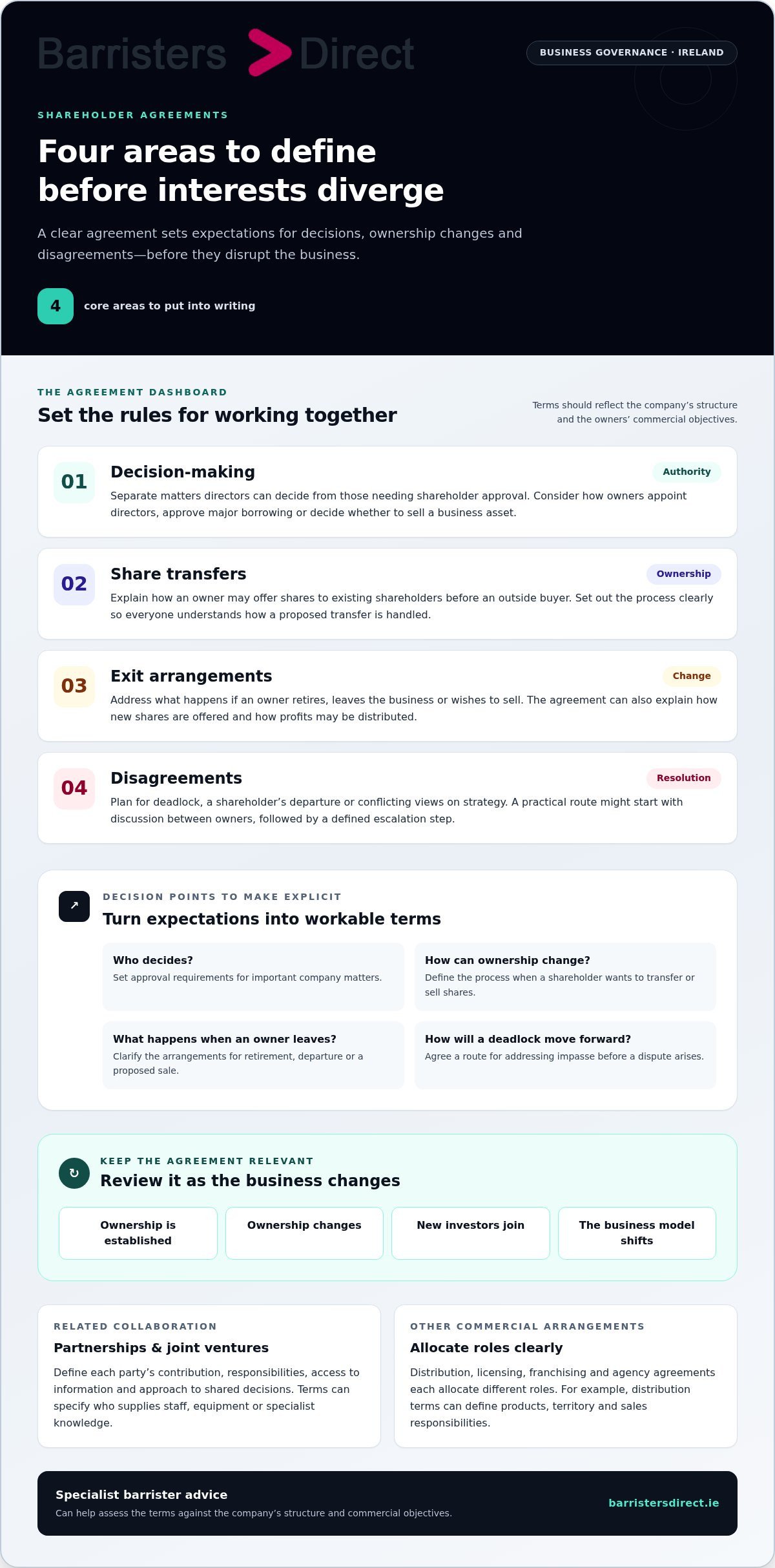
A shareholder agreement records how owners will work together and what happens when their interests differ. For an Irish company, it can clarify decision-making, share transfers, financial arrangements and ways to resolve disagreements. Prepare it when ownership is established or changed, and review it when new investors join or the business model shifts.
Start by identifying the shareholders and the decisions that need special approval. For example, the agreement can set out how owners appoint directors, approve major borrowing or decide whether to sell a business asset. It can also explain how profits may be distributed, how new shares are offered and what happens if an owner wants to leave. The right terms depend on the company’s structure and the parties’ commercial objectives.
Pay particular attention to events that could disrupt the business. Consider how the agreement addresses a deadlock, a proposed share transfer, a shareholder’s departure or a dispute over strategy. A clear process might require an initial discussion between owners, followed by a defined escalation step. Specific wording helps each party understand the process before a disagreement arises.
- Decision-making: Identify which matters directors can decide and which require shareholder approval.
- Share transfers: Set out how an owner may offer shares to existing shareholders before an outside buyer.
- Exit arrangements: Explain what happens if an owner retires, leaves the business or wishes to sell.
- Disagreements: Establish a practical route for addressing deadlock or conflicting views.
Other agreements support a company’s business relationships. A partnership or joint venture agreement can define each party’s contribution, responsibilities, access to information and approach to shared decisions. For example, two businesses collaborating on a project can specify who supplies staff, equipment or specialist knowledge. Clear terms help prevent differing assumptions from turning into a commercial dispute.
Distribution, licensing, franchising and agency agreements allocate different roles. A distribution agreement can define the products, territory and sales responsibilities; a licence can specify permitted uses of intellectual property. A franchise agreement can document operating standards and each party’s obligations, while an agency agreement can explain the agent’s authority and reporting arrangements. Match the terms to the actual business relationship.
Technology licences and services agreements also need precise drafting. Identify the software or service, permitted users, support responsibilities, implementation tasks and any agreed service levels. If a provider handles updates or holds customer data, state each party’s responsibilities clearly. Your IT department can describe practical requirements, while legal advice can help turn them into workable contract terms.
Before signing, compare the agreement with related documents, including investment terms, service contracts and any existing collaboration arrangements. Check that names, defined terms, responsibilities and approval processes align. If a shareholder disagreement has already become a commercial dispute, specialist legal advice can help clarify the issues and possible next steps.
Commercial terms should also be considered in light of the rules governing business operations and conduct. Regulatory bodies and agencies oversee commercial entities, including in areas such as safety, privacy, food and drugs. For agreements to supply goods or services, clearly recording the parties’ responsibilities can help frame the relationship if a contractual dispute arises. Product-related arrangements may also require careful liability terms, particularly where responsibility for a claim is disputed.
The firm handles contractual disputes concerning the supply of goods and services, as well as product liability claims.
What are the options for resolving commercial disputes?
Businesses in Ireland can address a commercial dispute through discussion, negotiation, mediation or court proceedings. The appropriate route depends on the disagreement, available evidence, the relationship between the parties and the outcome each business needs. A dispute over unpaid invoices, for example, calls for a different approach from a disagreement about an ongoing supply arrangement.
Start by defining the issue and gathering relevant records. Collect the contract, invoices, delivery notes and project correspondence, then prepare a clear timeline. Identify what the other party has done, what the agreement required and what remedy your business seeks. A focused review helps solicitors and counsel assess each position and assist with a practical response.
Direct discussions may resolve a dispute if both parties are willing to engage. Set out the concern in writing, refer to the relevant agreement and propose a specific next step, such as correcting work or agreeing on a payment schedule. Negotiation allows the parties to shape a solution themselves. Keep a record of proposals and agreed actions, especially if the business relationship may continue.
Mediation brings in an independent mediator to help the parties explore a settlement. The mediator supports the discussion but does not decide the outcome. This approach may suit a dispute where the parties need structured conversations, such as a disagreement between a customer and supplier over service performance. Before mediation, prepare a concise summary, supporting documents and a realistic view of acceptable settlement terms.
Court proceedings may be considered when direct engagement has failed, the dispute needs a formal determination or a party requires a legal remedy. Litigation involves presenting the claim and supporting evidence through the court process. A legal adviser can explain the issues, assess relevant documents and help prepare the case. The decision requires careful consideration of the disputed facts and the result sought.
- Discussion: Set out the issue and propose a practical resolution directly.
- Negotiation: Exchange settlement proposals and record any agreed terms.
- Mediation: Use a mediator to structure discussions and explore settlement.
- Court proceedings: Seek a formal decision where the dispute requires it.
Employee-related disputes can concern workplace conduct, contractual terms or the ending of employment. Preserve relevant records, including communications, policies and meeting notes, then identify the decision or action being challenged. A solicitor or barrister can help assess the facts and explain the available options. Clear, early communication may help the parties understand the issue before positions become entrenched.
Taxation disputes require a distinct review of the assessment or decision, supporting accounts and correspondence with Revenue. Identify the precise point in dispute, check figures against source records and organise relevant documents before responding. A tax adviser can address accounting questions, while legal advice can help with the legal aspects of the dispute. Both perspectives may be useful when the disagreement involves records and legal interpretation.
The evidence and business objective should guide the choice of approach. Strong records make it easier to explain your position, assess settlement proposals and prepare for formal proceedings. If the matter concerns a business dispute, specialist legal advice can clarify the issues and help determine a proportionate next step.
Transaction planning and implementation
A business transaction needs a clear objective, a defined structure and coordinated implementation. Legal advice can help with commercial contracts, company formation and business sales in Ireland by clarifying the proposed arrangement, reviewing documents and identifying issues that could affect completion.
Begin by setting out what the transaction is meant to achieve. For a business purchase, identify the assets or shares involved, the parties’ responsibilities and the conditions to meet before completion. For a new company, consider its ownership structure, decision-making arrangements and intended activities. This groundwork helps ensure the documents reflect the commercial plan.
Due diligence is an important planning step in a business sale or purchase. Organise relevant company records, contracts, financial information and details of assets or liabilities. Then identify matters that need clarification before the parties proceed. For example, a buyer reviewing a service business may need to understand how the proposed sale affects its customer agreements and supplier arrangements.
Implementation depends on coordinating the transaction documents and the parties’ actions. A completion plan can identify who must sign each document, provide agreed information or make a required payment. If the transaction involves several companies, clear responsibilities and communication can help prevent an outstanding task from disrupting the agreed timetable.
Large commercial arrangements show why planning needs to address long-term performance as well as signing. Ireland’s National Broadband Plan contract covers rollout, operation and maintenance over 25 years. The National Postcode System, Eircode, also involves a contract for design, operation and maintenance. These examples illustrate the need to define ongoing responsibilities, service delivery and how the parties will manage the arrangement over time.
Banking and secured transactions require careful coordination between the borrower, lender and other relevant parties. Review the facility documents alongside the proposed security arrangements, and ensure the business understands its obligations. The documents should describe the borrowing, repayment arrangements and assets connected with the security. If the business is refinancing, compare the new terms with existing commitments before implementation.
For a secured transaction, map each step from signing to completion. Identify which documents relate to the financing, who must provide them and how the transaction depends on their delivery. Keep a record of document versions and agreed changes. This helps the business and its professional advisers track whether the final documents reflect the negotiated terms.
Commercial transactions may also involve multiple entities and connected agreements. A hotel-chain transaction in Ireland involved up to 24 companies, illustrating the coordination such structures can require. Prepare a clear document list, identify each entity’s role and track decisions that require approval. A commercial lawyer can then focus on how the parts fit together, rather than treating each document in isolation.
If negotiations over a transaction develop into a disagreement, seek advice on resolving a commercial dispute before positions become entrenched.
Major public sector projects, such as the contract for the design, operation and maintenance of Ireland’s National Postcode System, Eircode, highlight the critical importance of clearly defined responsibilities and expert legal oversight from a commercial lawyer when managing complex multi-party agreements.
Barristers Direct: Commercial Dispute Resolution
Barristers Direct provides Commercial Dispute Resolution for businesses seeking specialist advice on a commercial disagreement. If a contract dispute, unpaid invoice or breakdown in a business relationship needs legal analysis, the service matches you with a barrister whose expertise fits the issue.
You can instruct senior or junior counsel directly for an initial consultation, without needing a solicitor for that first meeting. The fixed-fee meeting gives you expert advice and a clear path forward, helping you understand the issues and consider practical next steps. Solicitors continue to play an important role in legal matters, and may be involved where the work requires their services.
For advice on a business dispute, contact Barristers Direct or visit barristersdirect.ie.
Make your next business decision with clarity
Before signing, negotiating or responding to a disagreement, identify the decision your business needs to make and the legal issues involved. A commercial lawyer can help assess those issues and explain your options, so you can take a considered next step rather than rely on assumptions.
Barristers Direct provides Commercial Dispute Resolution for businesses facing commercial disagreements. Its Employment Law Consultation can assist with workplace concerns, while Wills and Probate Legal Advice may be relevant to personal planning alongside business responsibilities. Each matter calls for advice suited to its specific legal context.
If you’re ready to discuss a business dispute with specialist counsel, explore your options with Barristers Direct. Clear advice can help you approach the next decision with greater confidence.
Frequently Asked Questions
How can businesses ensure compliance with competition law?
Businesses can reduce competition-law risk by reviewing decisions about pricing, sales territories and dealings with competitors. For example, train staff not to exchange sensitive pricing plans at industry meetings, and document the independent basis for pricing decisions. Review proposed distribution arrangements and joint business initiatives before approving them. If a commercial decision could restrict competition, seek specialist legal advice before committing, and record the reasoning and evidence considered.
How does Commercial Law protect intellectual property rights?
Commercial law helps businesses define and protect intellectual property through clear ownership terms and permissions in agreements. For example, a company commissioning a logo can state who owns the finished design and how it may be used. A software licence can specify who may use the programme, for what purpose and whether copying or adaptation is allowed. Keep signed agreements and records of creation together so the business can identify its rights when negotiating or responding to unauthorised use.
What are the legal obligations for data protection in commercial transactions?
Businesses handling personal data in commercial transactions must comply with the General Data Protection Regulation (GDPR) and the Data Protection Act 2018, according to the Irish Statute Book. In practice, identify what personal information the transaction involves, who will access it and how it will be secured. Address consent where relevant and provide data subject rights. For example, a customer database transfer should prompt a review of the data involved and the parties’ responsibilities.
What is Commercial Law?
Commercial law governs business operations and commercial activities. In Ireland, it can cover company matters, business contracts, employment activities, intellectual property and the sale of goods. A retailer’s supply arrangement, a company’s service contract and a business’s licensing terms each raise different commercial-law questions. The relevant issues depend on the transaction, the parties’ roles and their agreed obligations.
What does a commercial lawyer do in Ireland?
A commercial lawyer advises businesses on legal issues arising from their activities, such as interpreting a contract, assessing a proposed transaction or responding to a dispute. The work may include reviewing documents, explaining risks and advising on available options. The precise role depends on the issue and the professional’s expertise. Barristers Direct connects businesses with a specialist barrister for an initial consultation; solicitors may be involved in other stages of a matter.
How do I find and choose a commercial solicitor in Ireland?
Identify the business issue and look for a solicitor or barrister who can review the transaction and explain the effect of proposed terms. Fees depend on the contract’s complexity, the work required and the level of negotiation involved.
Disclaimer
_This article does not constitute legal advice. Barristers Direct does not provide legal advice. To obtain legal advice, you should contact a legal practitioner._