

Full article
Published 10/11/2026
The court that can hear a civil claim depends on its value and type. For civil litigation advice in Ireland, the key limits are €15,000 for civil matters in the District Court and €75,000 for certain contract, land-title and equity disputes in the Circuit Court. A claim’s value is not the only factor, so the nature of the dispute also matters.
A legal letter with a deadline needs prompt attention. Keep it, note the date for replying and seek legal advice before the deadline passes. A request for a reply within 7 days is one example of a time-limited matter; ignoring it can leave you with less time to understand your position and decide how to respond.
If you’re unsure which court may hear your claim or what to do after receiving a letter, this guide explains civil proceedings in Ireland, the main court limits and practical next steps. It also outlines disputes that may become civil claims, helping you understand the process before deciding how to proceed.
Key Takeaways
- The District Court can hear civil matters valued up to €15,000, while the Circuit Court handles certain contract, land-title and equity disputes valued up to €75,000.
- If a legal letter sets a reply deadline, keep it, note the date and seek legal advice before time runs out.
- Contract disputes concern agreements, while tort claims arise from alleged wrongful acts that cause harm.
- Civil proceedings may be heard in different courts, depending on the dispute and the claim.
- Time limits for bringing a claim depend on its type, so get advice promptly if you think a deadline may apply.
Table of Contents
- District Court and Circuit Court case-value limits
- Responding to legal letters and deadlines
- Contract and tort law
- Civil proceedings in Ireland
- What are the time limits for bringing a civil claim in Ireland?
- Barristers Direct
District Court and Circuit Court case-value limits
The District Court can hear civil matters valued at no more than €15,000. The Circuit Court covers certain contract, land-title and equity disputes valued at no more than €75,000. These limits help identify a possible court, but the dispute’s legal nature also matters. A contract claim, for example, must fall within the relevant category and value limit.
Civil proceedings in Ireland may be heard in the District Court, Circuit Court, High Court or Commercial Court. A claim above a lower court’s financial limit may need to follow a different route, while some disputes are assigned according to their subject. The amount sought is one factor in deciding where a case belongs, not a complete answer by itself.
Small claims are dealt with in the District Court, but not every low-value disagreement qualifies. The type of dispute and the remedy sought still matter. Small claims are excluded from civil legal aid, subject to some exceptions. Before treating a matter as a small claim, establish whether its nature and circumstances fit the procedure.
A solicitor can explain the court process and available options, manage a civil case and represent you in court. Legal fees depend on the work involved, such as preparing documents, advising on evidence or attending a hearing. Before proceeding, ask for a clear explanation of the proposed work and fee arrangements. Representing yourself is different from having a solicitor manage the case.
You may represent yourself in an Irish court. However, court rules, evidence requirements and deadlines still apply, so legal advice can clarify the issues and steps involved. For example, before submitting court papers, a person considering a claim should understand what they must prove and which documents support it.
Appeal routes depend on the decision and the court involved. Judicial review can be used to challenge District Court and Circuit Court decisions, but it is a distinct legal process. A challenge may raise questions about legality or procedure, rather than simply asking another court to reconsider the dispute.
Mediation and arbitration are alternatives to having a court decide a dispute. Mediation involves trying to reach an agreement with a neutral mediator, while arbitration involves a decision by an arbitrator. Whether either option is suitable depends on the dispute, the parties’ positions and any agreement governing how it is resolved.
Losing a civil case can mean paying your own legal expenses and may lead to an order to contribute to the other side’s costs. The amount and consequences depend on the case and the court’s decision. Consider this risk alongside the claim’s value, the available evidence and the practical outcome you seek.
For a company assessing a commercial dispute, the claim’s value and legal category both affect the next steps. In-house counsel guidance may help legal teams consider how a dispute fits within their organisation’s wider legal work.
Responding to legal letters and deadlines
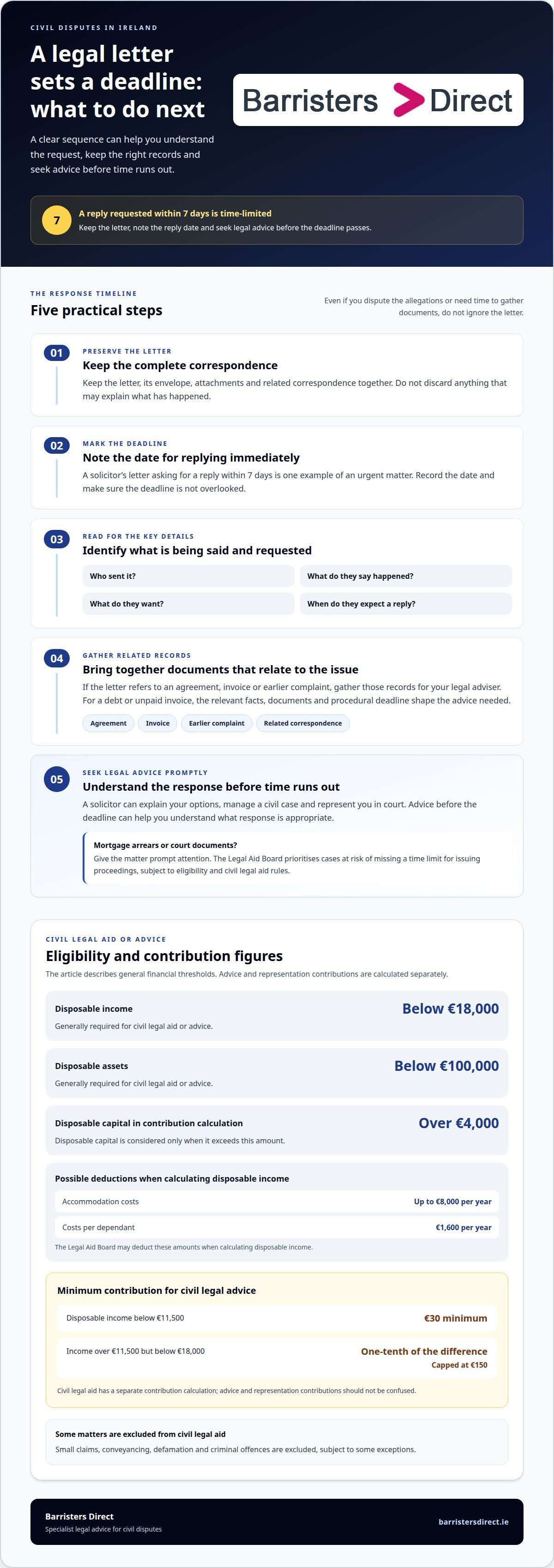
A solicitor’s letter demanding a reply within 7 days is an example of an urgent, time-limited legal matter. Keep the letter and note the deadline immediately. Do not ignore it, even if you dispute the allegations or need time to gather documents. Seek legal advice before the deadline passes, so you can understand what response is appropriate.
Read the letter carefully. Identify who sent it, what they say happened, what they want and when they expect a reply. Keep the envelope, attachments and related correspondence. If it refers to an agreement, invoice or earlier complaint, gather those records for your legal adviser. A solicitor can explain your options, manage a civil case and represent you in court.
Civil legal aid or advice generally requires disposable income below €18,000 and disposable assets below €100,000. Disposable capital is considered in the contribution calculation only when it exceeds €4,000. The Legal Aid Board may deduct accommodation costs of up to €8,000 per year and €1,600 per dependant per year when calculating disposable income.
Contributions depend on the applicant’s disposable income and, where relevant, capital. For civil legal advice, applicants with disposable income below €11,500 pay a minimum contribution of €30. If income is over €11,500 but below €18,000, the minimum contribution is one-tenth of the difference, capped at €150. Civil legal aid has a separate contribution calculation, so advice and representation contributions should not be confused.
Mortgage arrears can lead to a repossession dispute, so give prompt attention to a letter about missed payments or court proceedings. The Legal Aid Board prioritises cases at risk of missing a time limit for issuing proceedings. It may provide legal advice and representation, subject to eligibility and civil legal aid rules. Keep lender correspondence and court documents together, then seek advice promptly.
Civil legal aid excludes small claims, conveyancing, defamation and criminal offences, subject to some exceptions. If your letter concerns a debt, unpaid invoice or recovery proceedings, advice on debt recovery disputes can clarify the issues and possible response. The relevant facts, documents and procedural deadline shape the advice needed.
If you need specialist guidance on a civil dispute, you can explore legal advice options relevant to your matter. Early advice can help you assess the letter’s demands and the next procedural step.
Contract and tort law
Civil litigation in Ireland can involve contract law or tort law. A contract dispute concerns an agreement between parties, such as a business arrangement for services. A tort claim concerns an alleged wrongful act that causes harm. This distinction helps explain what happened, who was involved and what the claimant says should be put right.
For a contract dispute, identify the agreement and the term said to have been broken. A written contract, email exchange, invoice or order may show what the parties agreed. For example, a business might say a supplier failed to provide the goods described in an order. The supplier might dispute the agreed specification, delivery or payment terms.
A tort claim focuses on conduct and its alleged consequences, rather than breach of an agreement. For example, a person might claim that another party’s careless act damaged their property. The facts, records and accounts from people involved can clarify what happened and the alleged loss. The parties may disagree about the events, responsibility or cause of the damage.
Some disputes involve facts relevant to both contract and tort. A service provider’s work could be challenged under an agreement, while the same events may also raise a claim about resulting harm. The legal characterisation matters because it shapes the issues to address and the relevant evidence. A label alone does not establish that a claim will succeed.
Organise the available material into a clear sequence of events. Put the agreement or relevant correspondence alongside records of performance, payment and any complaint. For a property damage claim, include records showing the condition before and after the incident. A dated timeline can help an adviser identify which facts are agreed and which remain contested.
For a business dispute, identify each party’s role, the agreement relied on and the outcome sought. If an unpaid invoice is central, separate the amount claimed from any disagreement about the work or goods supplied. If the complaint concerns damage, record the alleged act and its effects. These distinctions help focus legal advice on the substance of the dispute.
Contract and tort claims can raise different questions, even when they arise from the same events. An adviser can assess the documents, the parties’ accounts and the remedy sought before framing a claim. Clear analysis at this stage helps distinguish a disagreement about contractual performance from an allegation of harm caused by someone’s conduct.
Civil proceedings in Ireland
Civil proceedings are court cases used to resolve disputes between people, businesses or public bodies. In Ireland, the District Court, Circuit Court, High Court and Commercial Court may hear civil claims.
Starting and conducting proceedings
Civil proceedings begin when a claimant brings a dispute before a court for resolution. The court, issues and remedy sought shape the process that follows. Disputes may concern contracts, personal injuries, mortgage repossession, property or injunctions. A claim can also be brought against the State, including An Garda Síochána.
The parties explain their positions through the relevant court process, supported by evidence. Anyone defending a claim must understand what is alleged and what response is required. The Courts Service of Ireland cannot advise or represent parties in court. A qualified legal representative can explain procedure, prepare and submit paperwork, communicate with others involved and speak on a person’s behalf.
Time limits for civil claims
A time limit sets the period within which a claimant must take a required step, such as issuing proceedings. Missing an applicable deadline can affect whether a claim may proceed. The relevant period depends on the type of dispute and the events giving rise to it, so different claims can have different deadlines.
Identify the event behind the claim, when it occurred and any correspondence referring to a deadline. These details help establish which time limit may apply and what action is required. If the dispute involves several events, record each date separately. Prompt legal advice can help assess the applicable limit and the steps needed to protect a claim.
Evidence and supporting documents
Evidence is material that supports or challenges the facts relied on in a civil claim. For a contract dispute, relevant items may include the agreement, emails, invoices and payment records. For property damage, photographs, repair documents and correspondence may help explain what happened. Relevant evidence helps the court assess a clear account of the disputed events.
To make or defend a claim, organise documents by date and link each item to an issue in dispute. Include records that support your account, as well as correspondence that may show a different account. A witness may also have relevant evidence about an event. A complete, ordered file helps a legal representative assess the case and prepare the necessary court material.
Enforcing a court judgment
Enforcement is the process of seeking compliance with a court judgment when the person or organisation required to act does not comply. Obtaining a judgment and achieving its practical effect are separate concerns. The appropriate enforcement step depends on what the judgment requires and the circumstances of the party bound by it.
Review the judgment to identify the obligation, the parties and any directions made by the court. If the other party does not comply, legal advice can clarify the available enforcement route and paperwork. Relevant facts include the type of judgment, what remains outstanding and information about the party required to comply.
What are the time limits for bringing a civil claim in Ireland?
There is no single time limit for every civil claim in Ireland. The applicable period depends on the type of claim and the facts that start the clock. A contract dispute, personal injury claim or property case may involve different rules. Identify the legal basis of the claim before relying on a deadline.
The date of an event may not, by itself, establish when a time limit begins. The starting point can depend on what happened, when the claimant knew relevant facts and the legal category involved. For example, an unpaid invoice dispute raises different issues from an injury claim. Legal advice can help establish which dates matter.
Keep a chronological record of key events. Note when the agreement was made, when the alleged breach occurred, when loss became apparent and when the parties communicated. For an injury claim, record the incident date and relevant medical appointments. These details help an adviser assess the possible deadline without treating every claim as identical.
A deadline to reply to a solicitor’s letter is not necessarily the same as the limitation period for issuing a claim. A letter may set a response date, while separate rules govern how long a claimant has to commence proceedings. Treat each date as a distinct procedural issue. Do not assume discussions or correspondence have stopped a limitation period.
If you are defending a claim, check the documents for dates relating to the alleged event, the claim and any court papers. A response deadline in proceedings may require action even while the underlying facts are disputed. If you intend to bring a counterclaim, its time limit may need separate assessment. An adviser can distinguish these deadlines and explain the required steps.
Claims involving public bodies, contracts, personal injuries or property can raise different limitation questions. The court that may hear a claim does not, by itself, establish its time limit. Nor does the amount sought determine when the relevant period begins. The nature of the claim and sequence of events guide the analysis.
Bring the relevant agreement, correspondence, invoices, medical records or property documents to a legal consultation. A dated timeline helps connect the records to the dispute. If an important date is unclear, identify the event and the evidence that may establish it. Early assessment gives an adviser time to consider the applicable rule and any urgent procedural steps.
For focused guidance on the dates and documents relevant to your dispute, seek specialist legal advice before deciding how to proceed.
Barristers Direct
Barristers Direct connects individuals and businesses in Ireland with specialist barristers for expert legal advice. If you need clarity on a civil claim, a barrister can assess the dispute, explain relevant court procedures and outline practical next steps. You can instruct counsel directly for an initial consultation without first instructing a solicitor for that meeting.
Advice can help you assess a commercial disagreement, employment issue, debt or another civil matter. Barristers Direct offers Commercial Dispute Resolution, Employment Law Consultation and Debt Recovery Legal Advice, alongside other legal advice services. The right starting point depends on the nature of your dispute and the advice you need.
If you’d like to discuss your situation, contact Barristers Direct.
Choose a clear next step
A dispute can be difficult to manage when the facts, deadlines and possible outcomes are unclear. Turn what you know into a focused discussion: identify the issue, gather key documents and decide what you need advice on. Specialist counsel can assess the legal questions and explain practical options, helping you make an informed next move rather than react without a clear plan.
Barristers Direct arranges expert legal advice through specialist barristers, including Commercial Dispute Resolution, Wills and Probate Legal Advice, and Employment Law Consultation. If you need civil litigation advice in Ireland, an initial consultation can clarify the issues relevant to your circumstances and the path forward.
Contact Barristers Direct for advice and take the next step with greater clarity.
Frequently Asked Questions
Need Legal Help?
If a civil dispute or approaching deadline is causing concern, civil litigation advice in Ireland can help you understand the legal issue and possible next steps. Barristers Direct arranges a fixed-fee initial consultation with a barrister specialising in the relevant area. The barrister can assess your legal question and explain your options. If formal legal action is required, you’ll need a solicitor for that work.
What civil matters are covered?
Civil matters include disputes between individuals, businesses and public bodies. Examples include contract disagreements, property disputes, personal injury claims, mortgage repossession cases and injunctions. The legal issues and process depend on the type of dispute. An unpaid business invoice, for instance, raises different questions from a claim alleging harm caused by another person’s actions.
What happens if I need a solicitor to go to court?
If your matter requires formal court action, a solicitor can manage the case and represent you in court. Barristers Direct arranges an initial consultation with a specialist barrister, and you may be referred to a solicitor if further litigation is required. Solicitors and barristers have distinct roles, with counsel providing specialist advice or advocacy when needed.
What should I do first if I get a letter with a deadline?
Keep the letter and attachments, note the response date and seek legal advice promptly. Identify what the sender wants, the allegations made and any documents mentioned. If a letter refers to an invoice, for example, locate it and the related payment records. Don’t assume ongoing discussions change a deadline; ask an adviser what action the letter requires.
What is civil litigation in Ireland?
Civil litigation is the process of resolving a non-criminal dispute through the courts. It can involve a person seeking compensation, a business pursuing a contractual claim or a party asking for an injunction. The claimant sets out the case, and the other party can respond. The court considers the legal issues and evidence before deciding the matter.
How does the civil litigation process work in Ireland, step by step?
The process generally moves from assessing the dispute to preparing and submitting the required court papers, followed by the other party’s response and the court’s consideration of the case. Evidence and legal arguments inform the decision. If the court makes a judgment, the parties must understand what it requires. The exact procedure depends on the court and the nature of the claim.
Which Irish court handles different types and values of civil claims?
The District Court can hear civil matters valued up to €15,000. The Circuit Court covers certain contract, land-title and equity disputes valued up to €75,000. Civil proceedings may also be heard in the High Court or Commercial Court. The claim’s value is only one consideration; the subject matter and remedy sought also affect which court may be appropriate.
Do I need a solicitor or barrister for civil litigation in Ireland?
For civil litigation advice in Ireland, a barrister can provide specialist advice through an initial consultation, while a solicitor can manage proceedings and represent you in court. You can represent yourself, but court procedure and evidence still require careful attention. If formal proceedings are needed, a solicitor remains important for managing the case. The right arrangement depends on the advice and work your dispute requires.
Disclaimer
_This article does not constitute legal advice. Barristers Direct does not provide legal advice. To obtain legal advice, you should contact a legal practitioner._