

Full article
Published 27/10/2026
A missed deadline can amount to a breach, but it doesn’t automatically give you the right to end the agreement. For breach of contract legal advice in Ireland, the key questions are whether a legally enforceable agreement exists, whether a party failed to meet one of its terms and what remedy fits the breach. A claim is generally subject to a six-year time limit from the date the breach occurred under the Statute of Limitations Act 1957.
It’s understandable to focus first on what the other party failed to do. But a claim may also depend on the evidence, the loss caused and whether a defence applies. Contracts can be written, oral or formed through conduct, so the absence of a signed document does not settle the issue by itself.
This article explains common breaches, possible remedies and defences, and when legal advice can help you decide what to do next. It also covers why termination is not automatic and what to consider before making or defending a claim.
Key Takeaways
- A contract may be written, oral or formed through conduct. Identify the agreed terms and the specific failure before assessing a claim.
- Contract claims are generally subject to a six-year limit from the date of breach under the Statute of Limitations Act 1957, so timing matters.
- Damages may compensate for loss, while specific performance or an injunction may be suitable in some cases. The right remedy depends on the breach and the contract.
- Termination is not automatic: a party seeking to end the contract must show a fundamental breach and act promptly.
- Consider possible defences, including duress, illegality, force majeure or frustration. Specialist advice can help assess the evidence and possible next steps.
Table of Contents
- Damages instead of termination
- Specific performance
- In Ireland, what constitutes a breach of contract?
- Do I need a solicitor to make a breach of contract claim?
- Defences to breach of contract
- Barristers Direct: Commercial Dispute Resolution
Damages instead of termination
In Ireland, damages are the most common remedy for a proven breach of contract. They compensate for loss caused by the breach, and a serious breach may also give the innocent party the right to terminate.
Damages for financial loss
Damages for financial loss are money awarded to compensate the wronged party, as far as possible, for loss caused by a breach. For example, a business that pays to correct defective work may include that expense in its claimed loss. The amount sought must be supported by evidence and linked to the other party’s failure. Proving a breach alone does not establish the financial value of a claim.
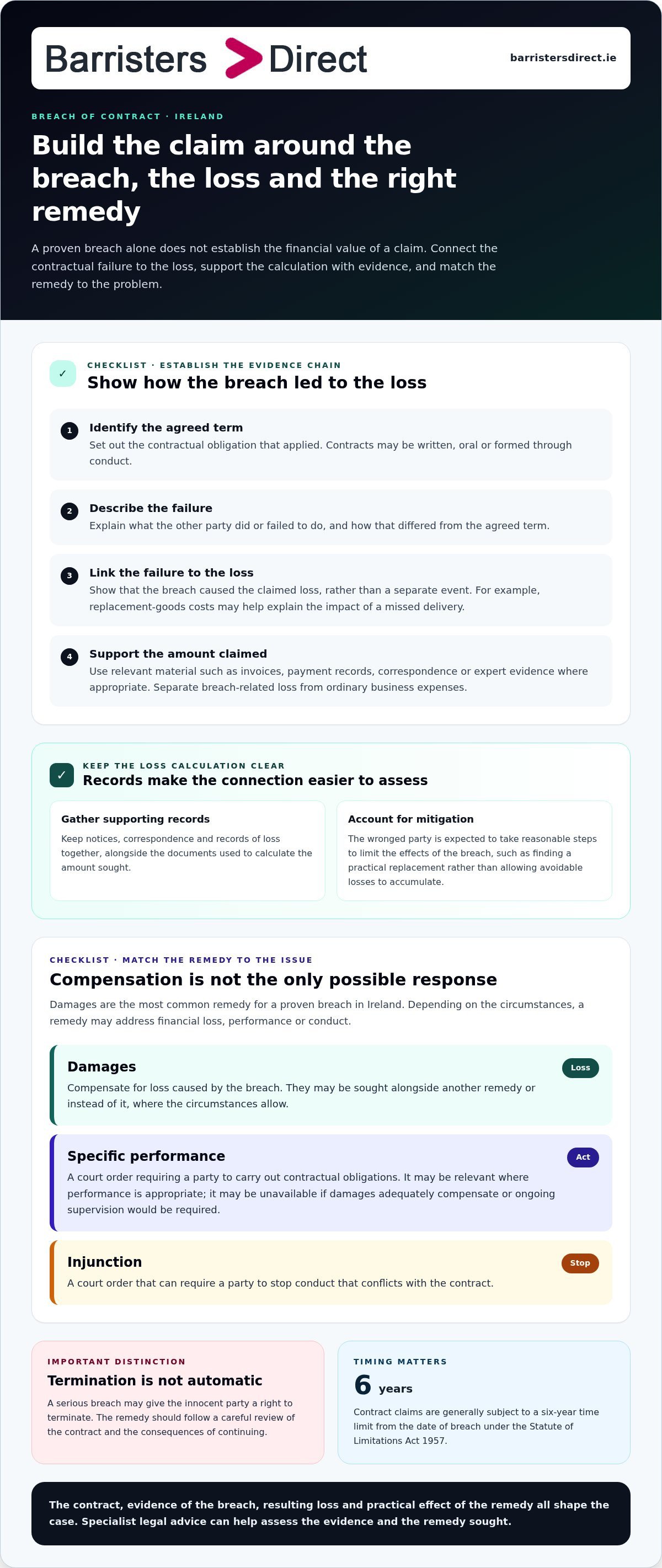
Build the claim around the sequence of events. Identify the contractual term, show how it was breached, and explain the resulting loss. If a supplier misses a delivery date and the buyer incurs extra costs sourcing replacement goods, records of those costs can help show the connection. The court considers causation: whether the breach caused the claimed loss, rather than a separate event.
Then quantify the loss using relevant material, such as invoices, payment records, correspondence or expert evidence where appropriate. A clear calculation separates losses arising from the breach from ordinary business expenses. The duty to mitigate also matters. The wronged party is expected to take reasonable steps to limit the effects, such as finding a practical replacement rather than allowing avoidable losses to accumulate.
Damages alongside other remedies
Damages may be claimed alongside, or instead of, another remedy where the circumstances allow. For example, an innocent party may seek to keep a contract in place while pursuing compensation for loss already caused by defective performance. Ending an agreement is not the only response to a breach. The remedy should address the actual problem and the contract’s continuing role.
A breach does not always have to cause financial damage for the innocent party to obtain a remedy. However, a claim for compensatory damages requires proof of loss resulting from the breach. Depending on the facts, specific performance or an injunction may be relevant instead. These remedies address performance or conduct, rather than simply compensating for financial loss.
If the breach is serious enough to give a right to terminate, the innocent party may choose to waive termination and claim damages if the breach gives rise to them. This can preserve the agreement, but the choice should follow a careful review of the contract and the consequences of continuing. Keep notices, correspondence and records of loss together. They help explain which remedy fits the breach and how the claimed amount was calculated.
Specific performance
Specific performance is a court remedy that requires a party to carry out contractual obligations. In Ireland, it allows the innocent party to seek performance while keeping the contract in place.
This remedy focuses on the promised act, not compensation alone. For example, a buyer under a property contract might seek completion rather than damages for the seller’s failure to complete. The court considers whether ordering the agreed performance is appropriate. The practical question is whether the obligation can be clearly identified and carried out.
Specific performance is not automatic. It may be unavailable where damages would adequately compensate for the breach. A court may also decline to make an order if compliance would require ongoing supervision. An open construction contract involving continuing work can raise that difficulty, because performance may involve repeated decisions and monitoring.
Defective, delayed and complete non-performance each raise different issues. If construction work falls below the agreed standard, the requested order must identify what needs to be corrected. If a contractor is late, the question is whether the promised work can still be completed usefully. If nothing has been done, the court must consider whether ordering performance remains workable.
A specific performance order does not guarantee a flawless result. Even after a successful action, performance may still be defective. This matters when choosing a remedy: an order to complete work may not resolve every quality issue. The contract, evidence of the breach and practical effect of the requested order all shape the case.
Assess an inability to perform against the exact contractual obligation. Identify what the party promised, what prevents performance and whether the obstacle affects all or only part of the work. For example, if a supplier says a particular item cannot be delivered, documents about the item and agreed delivery terms can help clarify the dispute. The claimed inability is relevant to whether performance can realistically be ordered, but it does not by itself determine the proper remedy.
An injunction is different: it orders a party to stop conduct that conflicts with the contract. For example, if an agreement restricts a party from taking a particular action, an injunction could address that conduct. Specific performance instead requires an act to be done. The remedy should match the problem, rather than simply repeat the contract’s wording.
Before seeking either order, set out the term, the breach and the precise outcome needed. A focused review of those issues can help clarify which remedy to pursue. Focused legal advice can help assess the contractual obligation and the practical remedy sought.
In Ireland, what constitutes a breach of contract?
A breach occurs when a party fails to comply materially with a term of a legally binding contract. To bring a claim, the plaintiff must establish that an enforceable agreement existed and that the defendant breached one of its terms. If you need breach of contract legal advice in Ireland, these are the core issues to assess.
A contract does not always need a signed document. In Ireland, parties may form agreements orally or through their conduct. Emails, invoices, meeting notes and performance records can help show what each party agreed to do. For example, if a business accepts an order and begins supplying goods, those actions may help establish the terms and the parties’ agreement.
Common examples include failing to deliver agreed goods or services, missing a deadline and causing financial loss, or providing work below the agreed standard. Disputes can also arise under commercial leases or service contracts. The key is to compare the alleged failure with the actual term. A disappointing result alone does not prove a breach if the agreement did not promise the expected outcome.
A claim should identify the agreement, the relevant term and the act or omission alleged to be a breach. The plaintiff must set out the claim in particulars of claim and prove the facts giving rise to the breach on the balance of probabilities. In other words, the court assesses whether the alleged events are more likely than not. A clear timeline can connect contract documents, performance, notices and resulting loss.
Time limits matter. In Ireland, a breach of contract claim must generally be brought within six years from the date the breach occurred under the Statute of Limitations Act 1957. Identify when the particular failure happened, then consider how that date affects the claim. If an agreement involves several obligations, separate breaches may occur at different times, so a single timeline can help clarify the relevant events.
Bringing a claim also involves practical decisions beyond establishing breach. Consider the available evidence, the remedy sought, any applicable pre-action obligations and whether negotiation or mediation could resolve the dispute. The Mediation Act 2017 is relevant to mediation in Ireland. Depending on the case, discovery or expert evidence may also become important. For instance, a dispute about whether specialist work met an agreed standard may require evidence explaining the work and the contractual requirements.
Before issuing proceedings, organise the contract or evidence of an oral agreement, communications about performance and records supporting the alleged breach. Ensure the particulars explain the claim clearly and identify the remedy sought. Seeking breach of contract legal advice in Ireland can help clarify how the agreement, alleged breach and supporting evidence fit together.
Do I need a solicitor to make a breach of contract claim?
A solicitor is not the only source of legal advice, but consulting one before suing or defending a claim is advisable. Termination requires particular care: in Ireland, a plaintiff seeking to end a contract for breach must show that the breach was fundamental to the agreement.
A fundamental or repudiatory breach is more than a serious inconvenience. It concerns a failure that goes to the contract’s core, assessed against the obligation and the agreement as a whole. For example, if a supplier’s central promise was to deliver essential equipment, complete non-delivery may be more consequential than a short delay in providing a minor item. The precise terms remain critical.
Check the contract first. An express termination clause may specify the events that permit termination and any required notice. The concepts of fundamental or repudiatory breach apply principally where a contract has no relevant express or statutory terms. A solicitor can interpret the wording, compare it with the alleged breach and assess whether termination is available, rather than assuming every failure ends the agreement.
If termination may be justified, act promptly and decisively. Delay can be treated as affirming the contract or waiving the right to terminate. For instance, continuing to demand performance after learning of a serious breach may affect how the parties’ conduct is understood. Keep a dated record of the breach, notices, responses and steps taken under the agreement before deciding how to proceed.
Ending a contract also has practical consequences. Identify the obligations that remain, the performance already received and the remedy sought. If a business terminates after a supplier fails to provide a key service, it should be able to explain which contractual promise failed and why the failure was fundamental. Damages may still be relevant, but termination is a separate decision with its own legal basis.
Legal advice can help before signing, when assessing whether a breach occurred, and before starting or defending proceedings. A solicitor can review the contract, evidence, termination wording and potential remedies. Advice is especially useful where the other party disputes the facts, the contract contains a termination procedure, or ending the agreement could itself lead to a claim.
The cost of legal advice or a contract claim depends on the case, including the contract’s complexity, evidence, work required and whether proceedings follow; a fee is given after a quote request. These factors help explain why the cost of reviewing a short service agreement may differ from a dispute involving extensive records or contested performance.
Before a consultation, gather the agreement, relevant correspondence, a timeline of events and any termination notices. These materials help focus advice on the key questions: what the contract required, whether the breach was fundamental and whether prompt termination remains available.
Defences to breach of contract
A claimed breach does not end the analysis. Possible responses to a breach of contract claim may involve questions about pressure, advice, legality, events affecting performance, or whether performance has become fundamentally different. Each defence raises a different question about how the agreement was made or why performance failed. The response should address the particular allegation, not rely on a general denial.
Undue influence or duress concerns pressure or influence surrounding a party’s agreement. Start by identifying who applied the pressure, what was said or done, and when the agreement was signed. For example, messages exchanged before signing may help explain whether a party gave consent freely. The circumstances matter; simply regretting an agreement does not establish this defence.
Lack of independent advice may be relevant where a party alleges undue influence or pressure. Identify whether advice was available, whether it was sought and what the parties understood when they agreed. The absence of separate advice is not, by itself, a complete answer to every contract claim. Its significance depends on the surrounding facts and the alleged pressure.
Illegality or public policy may be raised where the agreement or its purpose is said to conflict with the law or public policy. The precise term and the activity it concerns need close examination. For instance, a party disputing an obligation should identify the specific contractual promise said to create the problem. A bare assertion of illegality does not explain which part of the agreement is being challenged.
Force majeure depends on the contract’s wording and the event relied upon. Check whether the agreement addresses events that prevent or delay performance, then compare its terms with what occurred. A party relying on this defence should link the event to the particular obligation affected. For example, evidence that an event disrupted one delivery does not automatically explain a separate missed payment.
Frustration concerns circumstances said to make contractual performance impossible or fundamentally different from what the parties agreed. Set out the original obligation, the later event and how that event changed performance. A difficult or more expensive arrangement is not necessarily impossible. The facts and the contract’s provisions must be considered together.
For any defence, organise the agreement, relevant correspondence and a dated account of events. Match each piece of evidence to the issue it supports: pressure before signing, the event affecting performance, or the term said to be unlawful. This helps distinguish a genuine legal defence from a disagreement about performance or loss.
If a claim has been made against you, or you need to assess a proposed defence, seek expert legal advice on your contract dispute. A focused review can examine the relevant terms, evidence and legal basis before you decide how to respond.
Barristers Direct: Commercial Dispute Resolution
Barristers Direct provides Commercial Dispute Resolution for individuals and businesses facing contract disputes. You can instruct specialist senior or junior counsel directly for an initial consultation, without needing a solicitor for that meeting. A barrister can assess the agreement, evidence, possible remedies and any defence, then explain a clear path forward. This can help if you’re weighing a claim, responding to an allegation or considering settlement.
Direct access for an initial consultation is not the same as litigation representation. If your dispute requires legal action, consider getting legal advice about representation and next steps. The consultation can clarify your position, options and next steps, without promising a particular outcome. Contact Barristers Direct to arrange a fixed-fee consultation about your commercial contract dispute.
Choose your next step with clarity
The next decision is not simply whether to pursue a claim. Consider what outcome matters most to you and which practical steps support that objective. A clear legal strategy can help you decide whether to seek resolution, preserve a business relationship or prepare for a contested dispute. For breach of contract legal advice in Ireland, look for advice that considers both your legal position and the commercial consequences of each option.
Barristers Direct provides specialist legal advice through counsel, including Commercial Dispute Resolution. An initial discussion can help you understand the issues that need attention and the possible direction of your matter. If you are ready to discuss your circumstances, contact Barristers Direct for legal advice. A considered next step can help you approach the dispute with greater purpose and confidence.
Frequently Asked Questions
Is it possible to settle a contract disagreement out of court?
Yes, parties can settle a contract disagreement without court proceedings. They might negotiate directly, exchange written proposals or use mediation to work towards agreed terms. For example, a supplier and customer could agree on a revised delivery date and how to address costs already incurred. Record any settlement clearly, including which claims it resolves and what each party must do, so the agreement provides a practical basis for moving forward.
What counts as a breach of contract under Irish law?
A breach occurs when a party fails to meet an obligation in an enforceable agreement. The obligation may be written, agreed orally or shown through conduct. For instance, a customer who accepts a quotation and arranges payment may have entered into an agreement even without signing a formal document. Compare the actual promise with what happened: dissatisfaction alone is not enough if the contract did not require the expected outcome.
What remedies can a party claim for breach of contract in Ireland?
Available remedies include damages, termination where the breach is fundamental, specific performance and an injunction. The remedy should match the problem. Damages address loss caused by non-performance, while specific performance asks for a contractual obligation to be carried out. An injunction may be relevant when a party needs conduct stopped. Identify the result sought before deciding how to frame a claim.
How are damages for breach of contract calculated in Ireland?
Assess damages by connecting the breach to the loss and supporting the calculation with evidence. For example, if a business pays another supplier to complete unfinished work, invoices and payment records can help show the replacement expense. The assessment also considers whether the loss resulted from the breach and whether reasonable steps were taken to limit it. Separate ordinary operating costs from expenses arising directly from the contractual failure.
What steps should I take if someone breaches a contract in Ireland?
Start by preserving the contract and evidence: save relevant emails, messages, invoices and delivery records. Make a dated timeline showing the obligation, what happened and any response from the other party. Then set out the outcome you want, such as completion, compensation or an agreed resolution. Before sending a formal notice or issuing proceedings, get advice on the contract wording and consequences of your proposed response.
What are the time limits for bringing a breach of contract claim in Ireland?
The general time limit is six years from the date the breach occurred under the Statute of Limitations Act 1957. Identify the date of the specific failure, rather than assuming the clock starts when negotiations end or loss becomes clearer. An agreement with separate obligations can involve distinct breach dates. Keep a chronology of relevant events and seek legal advice promptly, so limitation timing is considered alongside the merits.
Which Irish court handles breach of contract claims, and what are the monetary limits?
Irish civil courts hear contract claims, and the appropriate court level depends on the claim’s value and nature. Monetary jurisdiction limits determine which court can hear a particular claim, so the amount sought is a key factor in deciding where proceedings belong. The contract, remedy and complexity also matter. Before issuing a claim, get advice on the correct forum and how the claim should be pleaded.
Can I resolve an Irish contract dispute through mediation or another form of alternative dispute resolution?
Yes, parties can consider mediation or another dispute-resolution process instead of relying solely on court proceedings. Mediation provides a structured setting for discussing proposals and exploring settlement. Arbitration is another route where the parties’ agreement provides for it; the Arbitration Act 2010 is relevant to arbitration in Ireland. Check the contract’s dispute-resolution clause first, since it may set out a process or forum the parties agreed to use.
Disclaimer
_This article does not constitute legal advice. Barristers Direct does not provide legal advice. To obtain legal advice, you should contact a legal practitioner._