

Full article
Published 09/10/2026
Could an early legal conversation help you understand what happened without committing you to a claim? A birth injury legal consultation in Ireland gives families an opportunity to discuss their concerns with a barrister who has relevant legal expertise, particularly when it is difficult to tell whether an injury may involve negligent care.
A difficult birth or unexpected diagnosis does not, by itself, establish negligence. The key questions include whether the care fell below the required standard and whether that failure caused harm. A consultation can help you understand what may need further assessment, which records and details could be useful, and why time limits should be considered promptly.
This guide explains what to prepare for an initial discussion, what a specialist barrister may be able to assess, and how direct access compares with speaking to a solicitor. Barristers Direct arranges paid consultations with qualified barristers. The barrister provides any case-specific legal advice, not the platform. An early consultation is a decision point, not a promise of a claim or litigation. It can help you identify a measured next step, including when a solicitor may be needed if formal proceedings are pursued.
Key Takeaways
- A birth injury concern involves both the harm and the care provided during pregnancy, labour or delivery. The outcome alone does not establish negligence.
- Clinical records and a clear chronology can help a barrister understand the events, but they do not prove negligence by themselves.
- A solicitor and barrister can play complementary roles. A direct birth injury legal consultation in Ireland offers an early discussion with a barrister experienced in the relevant area.
- Prepare a short timeline, any records already available and questions you want answered. You do not need a complete file before seeking advice.
- Barristers Direct arranges a paid consultation with a barrister matched to the relevant area of law. Meetings can take place by telephone or online.
Table of Contents
- Birth injury legal consultation in Ireland: when might early advice help?
- How birth injury concerns are assessed: care, evidence and uncertainty
- Solicitor or barrister? Comparing routes to birth injury legal advice
- How to prepare for a birth injury barrister consultation
- Arranging a birth injury legal consultation in Ireland through Barristers Direct
Birth injury legal consultation in Ireland: when might early advice help?
Questions about an injury around birth can be difficult to raise, especially while a family is focused on medical care, recovery and support. Seeking legal advice does not mean deciding to pursue litigation. An early discussion can help you separate what is known from what remains uncertain and consider whether further assessment may be useful.
A birth injury concern involves both the harm and the care provided during pregnancy, labour or delivery. It may relate to a baby, the mother or both. The general overview of Birth injury describes a range of injuries and causes, but the legal significance of a particular event depends on its circumstances and evidence.
An injury or difficult outcome does not, on its own, establish that negligent care occurred. A legal assessment considers the care provided and whether the available evidence supports a concern that the care fell below the appropriate standard and caused harm. Those questions are specific to each case. The purpose of a birth injury legal consultation in Ireland is to clarify the issues, not to promise a particular result.
What circumstances may prompt a birth injury consultation?
A family may have questions about monitoring during pregnancy or labour, how a reported change in condition was responded to, or events surrounding delivery and an injury identified afterwards. These are examples of concerns to discuss, not evidence that a healthcare professional acted negligently. The timing, clinical context and records may all matter, and an injury can have more than one possible explanation.
If you are unsure whether an event is relevant, describe what you understand happened and what has concerned you since. You do not need to reach a legal conclusion before asking for advice.
What can an initial legal discussion clarify?
A barrister can consider the account and relevant material you present, then identify questions that may need closer examination. These could include which records may help explain the sequence of events, whether the concern raises legal issues, and what further information or specialist assessment may be needed. An initial conversation is not a substitute for a full review of the evidence, and it cannot determine the outcome of a potential claim.
An initial consultation helps clarify the questions and possible next steps; it does not guarantee a result. You can use the discussion to decide whether to gather further information, seek additional advice or take another measured step. Any case-specific legal advice comes from the barrister, not Barristers Direct.
How birth injury concerns are assessed: care, evidence and uncertainty
Assessment is not simply a question of whether an injury occurred. It connects three issues: what happened, what care was provided at the time, and whether the available evidence supports a legal concern. Keeping these questions distinct helps prevent assumptions from taking the place of careful review.
An injury alone does not establish that negligent care caused it. The relevant question is whether the evidence supports both a concern about the care and a link between that care and the harm. A barrister can help identify what needs closer consideration, but a consultation is not a clinical diagnosis or a final determination of a claim.
Which records and details may help explain what happened?
Start with what you already have. Available maternity, birth and follow-up records may help build a picture, but you do not need to collect every document before an initial discussion. A short, neutral chronology can also help: note appointments, significant events, concerns raised, responses received and subsequent care. Mark approximate dates as estimates rather than presenting them as certain.
Keep recollections separate from conclusions. For example, record what you remember being said or observed, then list separately the questions you have about the care. This gives a barrister a clearer account to consider without asking you to interpret clinical decisions or decide whether a professional standard was met.
How might medical and legal questions be considered?
A barrister may identify which legal issues arise from the account and what further evidence could help address them. One issue may be causation: whether the care in question caused or contributed to the injury. That requires case-specific consideration, not an assumption based only on the timing of events or the diagnosis. The barrister can explain what remains uncertain and whether specialist medical assessment may be relevant.
In medical negligence proceedings, independent medical evidence can be important to assessing the care and its relationship to the harm. The legal team may need an independent expert report before proceedings are issued. The expert considers medical questions; the barrister advises on the legal issues. Neither role should be replaced by a family’s interpretation of records.
The Royal College of Physicians of Ireland provides professional information and education for doctors. That context may help explain medical terminology, but it cannot determine whether care in an individual birth injury matter met the relevant standard. A legal assessment must consider the particular records, circumstances and expert evidence.
A birth injury legal consultation in Ireland can help organise these questions and identify what may need further review. To discuss the legal issues raised by your account with a specialist barrister, you can explore a consultation through Barristers Direct. Any case-specific advice comes from the barrister.
Solicitor or barrister? Comparing routes to birth injury legal advice
Families can seek legal advice through a solicitor, arrange an initial discussion with a barrister, or work with both as the matter develops. These routes serve different purposes, and neither is automatically right for every situation. The choice depends on the advice you need now and the support that may be required later.
Solicitor-led contact A solicitor commonly maintains direct contact with the client, explains the wider process and may coordinate records, correspondence and other legal work. If specialist advice or advocacy is useful, the solicitor may engage a barrister.
Direct barrister consultation A direct consultation offers an opportunity to discuss the legal questions with a barrister whose expertise is relevant to the issue. It can help clarify what further information or advice may be needed, but it is not full representation.
Complementary roles A solicitor and barrister may contribute at different stages. The solicitor can manage ongoing client contact and broader work, while the barrister can provide specialist legal advice and, where instructed, advocacy.
What does a solicitor-led route involve?
A solicitor is often the main point of contact for a client and can help organise the overall legal work. In a birth injury matter, this may include considering the records and circumstances, explaining options and coordinating any further steps. If specialist input is needed, the solicitor may instruct a barrister to advise or act as an advocate. Their roles can work together rather than compete.
For a clearer explanation of how the professions differ, see Barristers Direct’s guide to the difference between solicitors and barristers. Understanding those responsibilities can help you decide which kind of discussion would be useful at this stage.
What does direct access to a barrister offer at the advice stage?
A birth injury legal consultation in Ireland arranged directly with a barrister gives you an opportunity to raise questions with a legal specialist. You can explain your concerns and present relevant information; the barrister can then give case-specific advice on the legal issues and possible next steps. Barristers Direct arranges a consultation with a qualified barrister matched to the relevant area of law. The platform arranges the meeting, while any legal advice comes from the barrister.
This route may suit someone seeking an initial specialist view before deciding what broader support is needed. It does not mean a solicitor’s role is unnecessary. If a matter proceeds to formal legal proceedings, a solicitor must be engaged; an initial consultation should not be mistaken for full representation or management of proceedings. A barrister’s advice may help you understand whether further legal support is appropriate, while a solicitor can assist with the wider work involved.
Consider what you want from the first conversation. If your priority is ongoing guidance and coordination, solicitor-led contact may fit. If you want to discuss legal questions directly with a relevant barrister, a consultation may be a useful first step. The routes can complement one another as your needs become clearer.
How to prepare for a birth injury barrister consultation
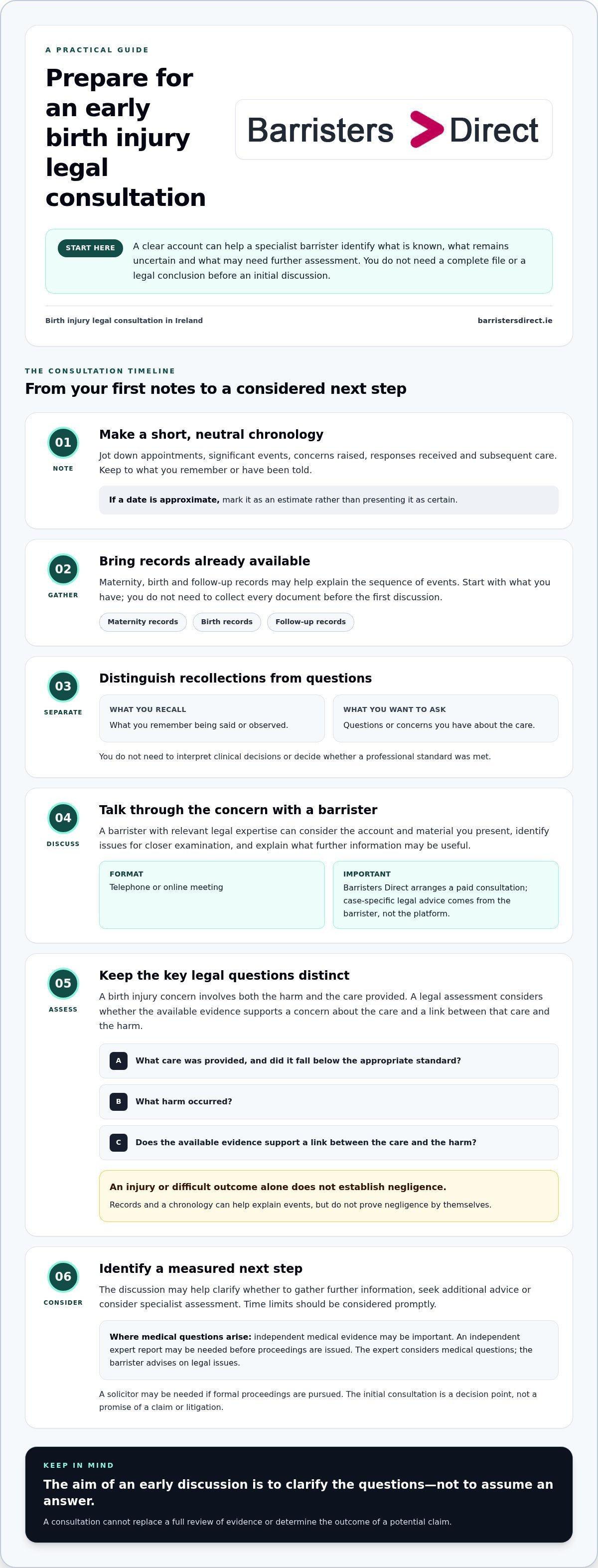
Preparing a little information can help make the discussion focused, but it should not become another burden. Do not delay urgent medical care, practical support or a conversation with your healthcare team while collecting documents. For a birth injury legal consultation in Ireland, start with a short account of what you remember and the questions you need answered. A complete file is not required for an initial discussion.
What information should families organise before the meeting?
Keep preparation simple. Write events in date order where possible, noting appointments, the birth, concerns raised and relevant follow-up care. If you are unsure of a date, mark it as approximate. Gather records or correspondence already available, but do not postpone the meeting to obtain every document. Separately note what you recall, what you have been told and what remains unclear. This helps distinguish the facts as you understand them from questions about the care.
- Chronology: Briefly record key events, dates and people involved, where known.
- Documents: Set aside available maternity, birth and follow-up records, letters or other relevant correspondence.
- Questions: List your main concerns and any practical issues you want to discuss.
What questions can help make the consultation useful?
Use the meeting to understand what needs closer examination, rather than to reach a conclusion in advance. You might ask which legal and factual issues arise from your account, what further records could be relevant, and whether specialist medical input may be needed. The barrister can explain what can be considered from the information available and what remains uncertain. Avoid trying to interpret clinical notes as a medical professional.
- Which parts of the account or records need further clarification?
- Could additional records or an independent medical expert’s opinion be relevant?
- What options and responsibilities may arise if further legal representation is needed?
- What should I consider next, and are there any time-sensitive issues to discuss?
Write a brief timeline, bring what you have and ask what remains to be checked. That sequence keeps preparation manageable and gives the barrister a practical starting point. The discussion can help you understand the legal issues and possible next steps, but it cannot guarantee a particular outcome. Any case-specific legal advice comes from the barrister.
If you are ready to discuss your circumstances with a relevant barrister, you can arrange a barrister consultation through Barristers Direct.
Arranging a birth injury legal consultation in Ireland through Barristers Direct
When you are ready to discuss your concerns, Barristers Direct arranges a consultation with a barrister whose area of expertise is relevant to your legal issue. A birth injury legal consultation in Ireland through the platform is a paid meeting with that barrister. Barristers Direct arranges the introduction; the platform does not provide legal advice or guarantee an outcome.
What happens when a consultation is arranged?
You submit details of the legal issue, and Barristers Direct arranges a consultation with a qualified barrister matched to the relevant area of law. The advertised fee must be paid before the initial consultation is arranged. Meetings can take place by telephone or online through Zoom, Microsoft Teams or Google Meet.
An automatically generated recording and/or synopsis of the consultation is provided only to you and the specific barrister. This explains who receives that material; it should not be read as a wider promise about confidentiality or how other information is handled.
What happens after the initial discussion?
During the consultation, you can explain the circumstances and ask about legal issues raised by your account. The barrister may outline what can be considered from the information shared, what questions remain and possible next steps. The scope of the discussion depends on the material available and the barrister’s advice. No particular assessment or outcome is guaranteed.
Any legal advice, and any agreement for further work, is solely between you and the introduced barrister. Barristers Direct arranges the consultation but is not responsible for that advice, contract or professional relationship. The meeting itself does not provide representation. If formal proceedings are pursued, a solicitor must be engaged; the barrister can explain how that may fit into the next stage.
This distinction helps set a clear expectation: the consultation is an opportunity to obtain specialist advice, not a commitment to litigation or a substitute for every form of legal support. You can use the barrister’s advice to consider whether further records, expert input or assistance with broader legal work may be appropriate. If your needs develop, the barrister can discuss options related to the advice provided and the limits of the initial meeting.
If you are ready to discuss your circumstances with a relevant barrister, you can arrange an initial consultation as a measured next step.
Take the next step at your own pace
You do not need to have reached a conclusion before seeking a clearer view. If uncertainty remains, a birth injury legal consultation in Ireland can be a practical way to discuss the questions that matter and decide what, if anything, to do next. Seeking advice is a step towards understanding your options, not a commitment to litigation.
Choose the next step that feels manageable for your circumstances. You may wish to speak with a specialist barrister and use that advice to consider whether further legal support is appropriate. The decision remains yours, and the purpose of an early discussion is to help you make it with greater clarity.
Arrange an initial consultation with a specialist barrister when you are ready to discuss your options. A considered first step can make a complex situation feel more manageable.
Frequently Asked Questions
Is a birth injury automatically evidence of medical negligence?
No. An injury or unexpected outcome is not, by itself, proof of negligence. A legal assessment considers whether the care fell below the standard expected of a reasonably competent professional and whether that failure caused the harm. A diagnosis after birth, for example, cannot alone establish what caused it. The clinical history and, where appropriate, independent medical evidence need careful review before a legal conclusion can be reached.
Can a parent arrange a legal consultation on behalf of a child in Ireland?
Yes. A parent or guardian can arrange a consultation to discuss concerns about a child’s injury. Explain whether you are seeking advice about the child, your own circumstances, or both, as these may raise distinct questions. A parent or guardian may bring a claim on a child’s behalf before the child turns 18. The barrister can discuss what the consultation can address and explain relevant next steps for the particular situation.
What records should I bring to a birth injury legal consultation?
Bring relevant material you already have, such as letters, discharge information or notes from later appointments, but do not postpone a consultation to assemble a complete file. If possible, organise documents by date and make a note of any missing records or terms you do not understand. That helps the barrister see what information is available and where questions remain, without you needing to interpret clinical documents yourself.
How long do I have to consider a birth injury claim in Ireland?
Time limits depend on who was injured and when the relevant date of knowledge arose. Generally, an adult medical negligence claim must be started within two years of the negligent act or the date of knowledge. For a child injured at birth, the limitation period is paused until age 18, allowing a claim in their own right up to age 20; a parent or guardian may bring one on the child’s behalf before 18. Seek case-specific advice promptly.
Can I speak to a barrister directly about a birth injury concern?
Yes. In Ireland, section 101 of the Legal Services Regulation Act 2015 permits direct instruction of a barrister for advice on non-contentious matters without first engaging a solicitor. This can provide an early discussion with a specialist about the legal questions raised by your circumstances. If the matter proceeds to formal legal proceedings, a solicitor must be engaged. An initial consultation is advice, not full representation in those proceedings.
Is the initial Barristers Direct consultation online or by telephone?
It may take place by telephone or online using Zoom, Microsoft Teams or Google Meet. The advertised fee is provided before payment, and the consultation is arranged once that fee has been paid. Choose the option that best suits how you can discuss your concerns and share relevant information with the barrister.
What happens after an initial birth injury consultation?
The barrister may explain the legal issues raised, what further information could matter and possible next steps, based on the discussion. An automatically generated recording and/or synopsis is provided only to you and the barrister. Any advice or agreement for further work is between you and the barrister, and no outcome is guaranteed. If formal proceedings are pursued, a solicitor must be engaged to support that process.
Disclaimer
_This article does not constitute legal advice. Barristers Direct does not provide legal advice. To obtain legal advice, you should contact a legal practitioner._