

Full article
Published 26/08/2026
Most people believe that hiring a solicitor is the only way to start a legal journey, but understanding the distinction between a barrister and a solicitor in Ireland could save you thousands in legal fees. If you feel the weight of billable hour anxiety or the frustration of not knowing whether you need a generalist or a specialist, you aren’t alone. It’s common to fear being trapped in long-term litigation without a clear strategy or a transparent view of the final cost.
This guide clarifies the fundamental differences between these two roles and introduces the direct access model. This modern approach allows you to secure expert legal opinions without the traditional middleman, ensuring your strategy is sound from day one. We promise to strip away the intimidating layers of the legal system to show you a more efficient, cost-effective way to get results whilst maintaining total clarity. You’ll learn how to navigate the Irish legal hierarchy, bypass unnecessary gatekeepers for initial advice, and establish a clear strategic path for your specific dispute.
Key Takeaways
- Understand why “lawyer” is a broad term in Ireland and how the dual branch system defines the specific duties of solicitors and barristers.
- Distinguish between the solicitor’s role as a legal project manager and the barrister’s function as a specialist consultant for complex legal opinions and advocacy.
- Learn how the direct access model for a barrister vs solicitor ireland allows you to engage expert counsel directly for initial strategy without the need for a middleman.
- Discover how fixed-fee consultations can eliminate billable hour anxiety whilst providing a clear, strategic path forward for your dispute.
- Identify the specific scenarios, such as commercial disputes or employment law, where early intervention from a barrister provides the most value.
Table of Contents
- The Dual Branch System: Understanding the Irish Legal Profession
- Barrister vs Solicitor: Key Differences in Roles and Expertise
- The Direct Access Advantage: Rethinking Legal Costs in Ireland
- When to Choose Which: Guidance for Common Legal Disputes
- How to Instruct a Barrister Directly in Ireland
The Dual Branch System: Understanding the Irish Legal Profession
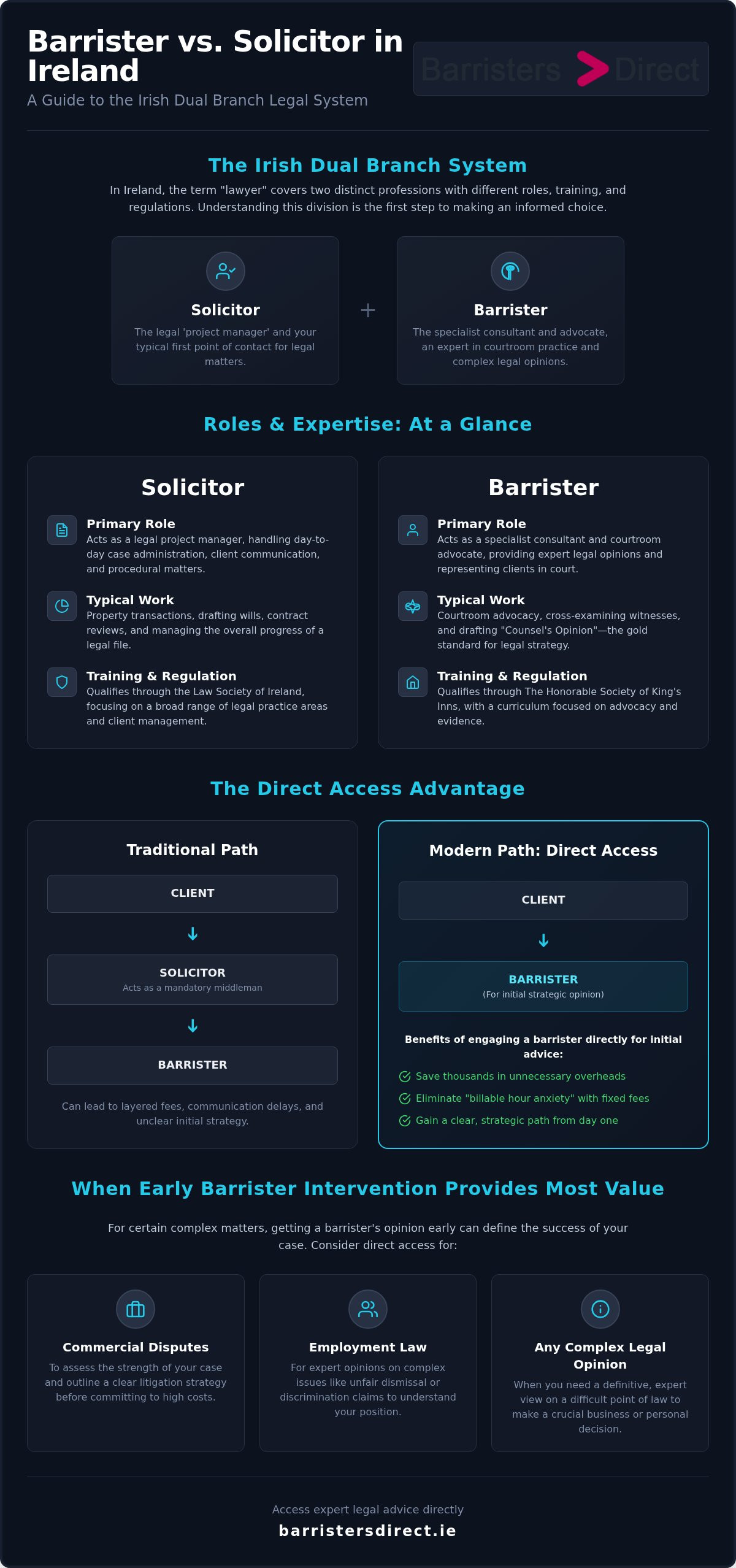
In Ireland, the term "lawyer" functions as a broad umbrella, but it actually describes two distinct professions with different training, regulations, and daily duties. Unlike the unified system seen in American legal dramas like Suits, where one attorney handles every aspect of a case, Ireland maintains a dual branch system. This historical division between solicitors and barristers in Ireland is central to how legal services are delivered and billed. Understanding the barrister vs solicitor in Ireland distinction is vital because it dictates who you hire, when you hire them, and how your strategy is formed.
The two branches are governed by separate regulatory bodies. Solicitors are regulated by the Law Society of Ireland, whilst barristers are members of The Bar of Ireland. This split isn’t just about tradition; it impacts your wallet and your legal strategy. Traditionally, the solicitor acted as a gateway, but modern regulations now allow for more direct paths to specialist advice, which can significantly lower initial costs.
What exactly is a Solicitor?
Think of a solicitor as your legal project manager. They are typically your first port of call and often operate from "High Street" offices. Their role involves managing files, handling client money, and overseeing the general administration of a legal matter. If you need a will drafted, a property transaction completed, or a contract reviewed, a solicitor is the appropriate lead. They manage the day-to-day communication and ensure that all procedural requirements are met throughout the life of your case.
What exactly is a Barrister?
If the solicitor is the project manager, the barrister is the specialist consultant. Often described as the "consultant surgeons" of the legal world, barristers are called in for their specific expertise in advocacy or for providing complex legal opinions. Most work as independent sole practitioners from the Law Library. Within this branch, you’ll find Junior Counsel and Senior Counsel. Senior Counsel, often called "silks," are experienced practitioners recognised for their high level of expertise. Barristers provide the strategic intelligence needed for complex disputes, such as commercial litigation or employment law issues. Through platforms like Barristers Direct, you can now access this specialist knowledge directly for initial consultations, bypassing the need for a middleman during the strategy phase.
Barrister vs Solicitor: Key Differences in Roles and Expertise
The divide between a barrister and solicitor in Ireland begins at the education stage. Solicitors qualify through the Law Society of Ireland at Blackhall Place, focusing on a broad range of legal practice areas and client management. Barristers, conversely, train at the Honorable Society of King’s Inns, where the curriculum emphasises oral advocacy and the technicalities of legal evidence. This divergent training creates a system where solicitors act as generalists managing the overall process, whilst barristers function as specialists providing the final strategic opinion.
Direct Advocacy and the Courtroom
In the Irish court system, the barrister is the primary voice. Whilst solicitors have rights of audience in all courts, they typically lead in the District and Circuit Courts for routine matters. For complex litigation in the High Court or higher, the barrister takes the lead. They are trained to stand up and speak, cross-examine witnesses, and argue points of law before a judge. This specialisation in oral advocacy is what defines the barrister’s role in the public eye.
The solicitor’s role in this environment is vital but distinct. They prepare the "book of evidence" and brief the barrister on the specific facts of the case. Effective litigation usually requires both professionals working in tandem: the solicitor managing the procedural timeline and the barrister focusing on the oral presentation and legal arguments.
Legal Advice and Strategic Opinions
A barrister’s written advice, known as "Counsel’s Opinion," is often considered the gold standard for legal strategy. Solicitors frequently use these opinions to advise their clients on the specific risks of proceeding with a case. If a barrister identifies a significant legal hurdle, it allows the client to pivot before incurring heavy costs. This opinion provides a high-level view of how a judge is likely to interpret the law in your specific circumstances.
The Direct Access Advantage: Rethinking Legal Costs in Ireland
The traditional legal gateway in Ireland is undergoing a significant shift. For decades, the path to legal expertise was strictly linear: you hired a solicitor, who then briefed a barrister. This model often created a financial barrier, as clients were forced to pay for a generalist’s time before ever receiving a specialist’s opinion. When evaluating the cost-efficiency of a barrister vs solicitor in Ireland, the direct access model now provides a more transparent alternative. Since 25 September 2024, the Legal Services Regulation Act 2015 has permitted the public to engage barristers directly for non-contentious matters.
Reducing Legal Fees Through Direct Consultation
Starting a formal file with a solicitor involves administrative costs that can escalate quickly. Hourly billing cycles often lead to anxiety, as the final invoice remains a moving target. In contrast, a direct consultation with a barrister is typically offered on a fixed-fee basis. This provides immediate cost certainty for small businesses and individuals. You pay for a specific strategic outcome rather than a generic administrative process.
The Role of Barristers Direct in Modern Law
Our platform, Barristers Direct, matches you with the appropriate Junior or Senior Counsel from the Law Library immediately. We specialise in making elite legal expertise accessible and straightforward. If your matter is non-contentious, i.e. legal proceedings have not yet been formally issued, or you are seeking advice on a contract or a probate issue, you can speak to a barrister directly.
When to Choose Which: Guidance for Common Legal Disputes
Commercial and Business Disputes
For businesses, time is a significant cost. If you are facing contract breaches or require debt recovery, a barrister’s strategic view can settle a case before it ever reaches a courtroom. They evaluate the strength of your evidence and provide a clear-eyed assessment of your legal position.
Private Client Matters: Wills and Employment
In probate law, the language of a will can be notoriously complex. If you are challenging a will or need to ensure an estate is protected, a barrister’s role in interpreting probate law is indispensable. Similarly, in employment law, navigating workplace conflicts like unfair dismissal requires specialist counsel who understands the nuances of the Workplace Relations Commission (WRC).
How to Instruct a Barrister Directly in Ireland
Instructing a barrister directly is a streamlined process designed to provide immediate strategic clarity without the traditional administrative delays. The process begins with a clear submission of your case details through a professional platform. This allows for an initial assessment to determine if your matter is suitable for direct instruction under the current Legal Services Regulatory Authority (LSRA) guidelines.
The Consultation Process Simplified
A key advantage of this model is the ability to match your specific dispute to the expertise of either a Junior or Senior Counsel. If your case involves a standard employment dispute or debt recovery, a Junior Counsel provides expert specialist advice at a proportional cost. For high-value commercial litigation or complex probate issues, a Senior Counsel offers the depth of experience required for high-stakes decision-making.
Your Path Forward with Barristers Direct
If your legal matter evolves and requires formal court proceedings, the transition to a solicitor is managed seamlessly. Under Irish law, once a case becomes contentious, a solicitor must be engaged to manage the litigation process and hold client funds. Starting with Barristers Direct ensures that the expert who provides your initial strategy is the same professional who would ultimately argue your case in court.
Frequently Asked Questions
- Can I hire a barrister without a solicitor in Ireland? Yes, you can hire a barrister directly in Ireland for legal advice and non-contentious matters under the Legal Services Regulation Act 2015.
- Is a barrister more expensive than a solicitor? Costs vary, but direct access often reduces the overall spend. You pay a fixed fee for specialist advice rather than an hourly rate for administrative file management.
- Who is higher, a barrister or a solicitor? Neither role is "higher" than the other; they are separate but equal branches of the Irish legal profession.
- What happens if my case needs to go to court after a direct consultation? You must engage a solicitor to manage the litigation, and your barrister will work alongside them.
- Do I need a barrister for a small commercial dispute? A barrister is highly beneficial for early assessment and strategic opinion, which can often lead to a swift settlement.
- What is the difference between a Senior Counsel and a Junior Counsel? A Junior Counsel handles a wide range of legal matters, while a Senior Counsel is recognised for exceptional expertise and seniority in complex or high-value cases.
- Can a barrister give me a second opinion on my current solicitor’s advice? Yes, a barrister can provide an independent second opinion.
- How do fixed fees work for legal consultations in Ireland? You pay a set price for a specific meeting or written opinion, providing cost certainty from the outset.
Contact Us
(01) 871 9494 to book a fixed-fee consultation. Email your query to: contact@barristersdirect.ie to request a case review and book a specialist consultation.
Online Enquiry
- Name:
- City/County:
- Phone:
- Email:
- Please select an area of law: (Dropdown options available)
- Brief outline of your enquiry: