

Full article
Published 14/10/2026
What does a barrister consultation fee actually cover: a first step towards specialist advice, or a commitment to ongoing legal work? With Barristers Direct, a fixed fee gives you an initial consultation with a barrister whose expertise matches your legal issue. You can discuss your position and possible next steps without agreeing to continue afterwards.
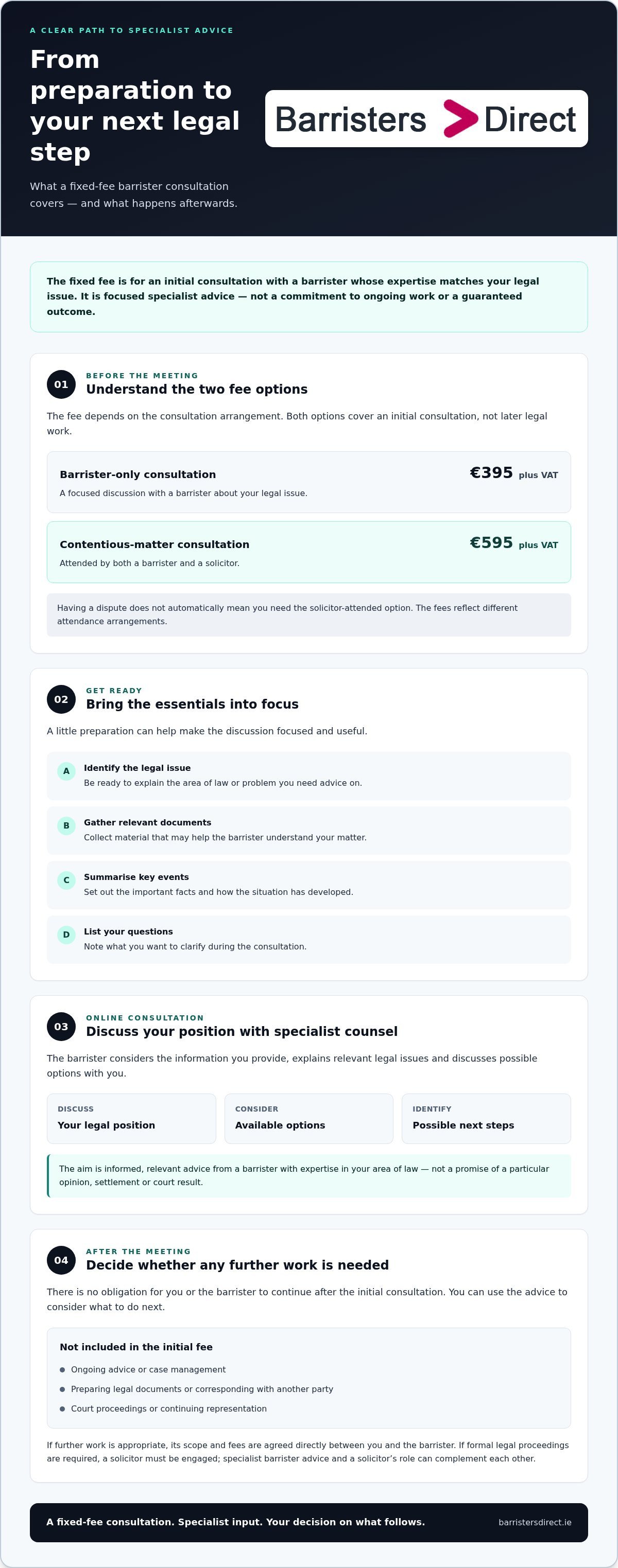
It’s understandable to want clarity on the fee and what the meeting can cover before you book. A barrister-only consultation costs €395 plus VAT. For a contentious matter, a consultation attended by both a barrister and a solicitor costs €595 plus VAT.
The consultation gives you an opportunity to discuss your legal position, consider available options and identify what may need to happen next. It’s focused advice, not ongoing work or representation. Any further work and fees are agreed directly between you and the barrister.
You can arrange a consultation through Barristers Direct without treating it as a replacement for a solicitor’s role. This article explains the two fee options, what to expect from the meeting and how specialist advice may help you decide on your next step.
Key Takeaways
- Assess the barrister consultation fee by the specialist input you need, rather than expecting a particular legal outcome.
- Prepare by identifying the legal issue, gathering relevant documents, summarising key events and listing your questions.
- Direct access can offer early barrister input, while a solicitor remains important for broader legal work.
- Share the area of law you need advice on to arrange a consultation with a barrister who has relevant expertise.
- Consultations take place online.
Table of Contents
- What is the barrister consultation fee in Ireland?
- What does a barrister consultation fee provide?
- Is direct access to a barrister worth the consultation fee?
- How should you prepare for a paid barrister consultation?
- How do you arrange a Barristers Direct consultation?
What is the barrister consultation fee in Ireland?
The barrister consultation fee is a fixed charge for an initial consultation with a barrister. It covers a focused meeting to discuss your legal issue with a specialist, rather than an open-ended commitment to legal work. The barrister can consider the information you provide, give advice relevant to the matter and help you think through possible next steps.
At Barristers Direct, the barrister-only consultation costs €395 plus VAT. For a consultation about a contentious matter attended by both a barrister and a solicitor, the fee is €595 plus VAT. The €395 plus VAT option is for a barrister-only consultation; the €595 plus VAT option is for a contentious-matter consultation attended by a barrister and solicitor.
These fees cover the initial consultation, not court proceedings, ongoing advice or other legal work. The distinction matters: a fixed fee makes the cost of the consultation clear, but it doesn’t set the cost or scope of any work that may follow. Barristers Direct arranges access to a barrister with expertise in the relevant area of law. Its overview of Barristers Direct explains the service’s role in arranging that access.
Which fixed-fee consultation option applies?
If you want to discuss your issue directly with a barrister, the barrister-only consultation costs €395 plus VAT. If the consultation concerns a contentious matter and includes a solicitor as well as the barrister, the fee is €595 plus VAT. Having a dispute doesn’t automatically mean you need the solicitor-attended option. The appropriate arrangement depends on the consultation you’re arranging and the input needed.
The solicitor-attended option brings both legal professionals into the consultation. Solicitors have an important role in broader legal work, and their attendance may be relevant when a matter is contentious. The two fees describe different attendance arrangements, not a choice between good and lesser-quality advice.
Does the consultation fee cover later work?
No. The fee covers the relevant initial consultation only. It doesn’t include additional advice, preparing legal documents, proceedings or continuing representation. This sets a clear boundary around what the initial payment covers, so you can have a focused discussion without treating it as a quote for a complete legal matter.
If further work is appropriate after the meeting, you and the barrister agree its scope and fees directly. Neither you nor the barrister is obliged to continue after the initial consultation. You can use the advice to understand your position and consider what to do next, whether that means seeking further work from the barrister or taking another course. The consultation provides specialist input, not a promised legal result.
What does a barrister consultation fee provide?
A consultation arranged through Barristers Direct gives you an opportunity to discuss your legal issue with a barrister who has expertise in the relevant area. The barrister can consider the information you provide, explain relevant legal issues and discuss possible options. The aim is to give you specialist input and a clearer sense of what may be worth doing next, so you can consider your options with more information.
A barrister consultation is a paid initial meeting for specialist advice, not a guaranteed outcome. Its value lies in having a focused discussion with a barrister whose expertise relates to your matter. Your barrister consultation fee covers the consultation itself; it doesn’t promise a particular opinion, settlement or court result.
How does specialist advice help clarify a legal issue?
Legal problems can involve several questions at once: which facts matter, which legal principles may apply and what options are open to you. A specialist barrister can help unpack these points and discuss how they may affect your position. That discussion can make it easier to identify the next questions to address, even if you need time to consider your options afterwards.
For example, in a commercial dispute, a barrister may discuss the issues arising from the disagreement and possible routes to consider. That focused input is distinct from managing the dispute from start to finish. The commercial dispute advice service relates to this area of legal advice.
What is outside the scope of the initial fee?
The initial consultation is not ongoing case management. It does not, by itself, include further advice, preparing documents, corresponding with another party or representing you in court. If you and the barrister decide that additional work would be useful, you agree its scope and fees directly with the barrister. Neither party is obliged to continue after the meeting.
Nor does payment secure a particular result. A barrister can advise on the issues and possible next steps, but the outcome of a dispute or legal process isn’t guaranteed. If formal legal proceedings are required, a solicitor must be engaged. Specialist barrister advice and a solicitor’s role can complement each other.
For broader guidance on understanding legal bills, the Legal Services Regulatory Authority’s consumer information explains legal bills and complaints about excessive fees. If you’re ready to outline your legal area and arrange access to a matched barrister, you can do so through Barristers Direct.
Is direct access to a barrister worth the consultation fee?
It depends on what you need from the meeting. The value of a direct consultation is access to relevant specialist input at an early stage, not a promise that a dispute will settle or that a legal process will end in a particular way. For an individual or business facing an unfamiliar legal issue, a barrister’s focused perspective may help clarify the questions to consider before deciding what to do next.
Direct access to barristers became permissible under the Legal Services Regulation Act, giving members of the public and businesses another route to seek early advice. It sits alongside the established role of solicitors in supporting clients with broader legal work. The benefit of instructing a barrister directly is the opportunity to discuss an issue with a relevant specialist without first committing to ongoing work.
When can a direct consultation be a useful first step?
If you’re unsure how to understand a legal issue or what options may be available, an initial consultation gives you a structured opportunity to discuss it with a barrister who has expertise in the relevant area. A business might seek early specialist input on a developing commercial disagreement; an individual might want to understand their position before deciding whether further legal support is needed. The purpose is clarity, not a guarantee that litigation can be avoided.
Any possible saving in time or cost is secondary to the quality and relevance of the advice. Consider whether the barrister’s expertise fits the issue you want to discuss. A consultation can inform your decision while leaving you free to consider the advice and decide whether to take another step.
How do barristers and solicitors work together?
Barristers provide specialist legal advice, while solicitors can support broader client and legal work. These roles can complement each other. A solicitor may be involved in a matter from the outset, or a client may seek early barrister input before deciding what further support is appropriate. Direct access adds a route to specialist advice; it doesn’t make a solicitor’s role unnecessary.
If formal legal proceedings require representation, a solicitor must be engaged. The initial consultation and any later work are separate stages, so the discussion can help you understand what support may be relevant without assuming that one professional will handle every part of the matter.
| Stage | What to expect | | Initial advice | A focused discussion with a barrister matched to the relevant area of law. | | Solicitor involvement | Solicitors remain important for broader legal work and are required where formal proceedings need representation. | | Further work | Any additional work and fees are agreed directly between you and the barrister. |
Use the consultation to identify the advice you need and the choices you want to understand. If you’re considering direct access, Barristers Direct arranges consultations with barristers matched to the relevant area of law.
How should you prepare for a paid barrister consultation?
A clear account of the issue helps you make effective use of the meeting. Beforehand, organise the key facts and decide what you most need the barrister to clarify. The barrister consultation fee covers the initial consultation, so arriving with a concise chronology and focused questions can help keep the discussion centred on your concerns.
Use this sequence to prepare:
- Identify the issue. Write down the main legal concern in a sentence or two, including what you need advice about.
- Gather relevant documents. Collect material that helps explain the matter, such as correspondence, agreements or notices. Keep it organised and focused on the issue.
- Summarise what happened. Note the key dates, the people or organisations involved and how the matter reached its current position.
- List your questions. Put the points you most want answered first, including questions about options and possible next steps.
What information can help explain your position?
Start with a short chronology. Record the main events in date order, identify who was involved and describe what remains unresolved. If there are several strands to the issue, separate them rather than presenting them as one long account.
Then state what you want to understand. You might be seeking clarity on your position, the options available or what a particular document means. Relevant documents can provide context, but no single document or fact guarantees a particular legal assessment. The barrister will consider the information discussed in the consultation.
What questions should you take to the meeting?
Questions help turn a broad concern into a focused discussion. Choose those that will help you understand the legal issue and make an informed decision about what to do next. For example, ask:
- What are the central legal issues in my situation?
- What options could I consider, and what factors might affect them?
- What steps may be appropriate after this discussion?
- Would any further work be needed, and how would its scope and fees be agreed?
If you’re unsure what to prioritise, write down every concern first, then mark the questions that matter most to your immediate decision. You don’t need to predict every issue the barrister might raise. A concise summary, organised documents and an honest account of what you know can give the discussion a useful starting point.
Once you’ve set out the legal area and prepared your notes, you can arrange a consultation through Barristers Direct with a barrister matched to the issue.
How do you arrange a Barristers Direct consultation?
Arranging a consultation starts with identifying the area of law you need advice on. Barristers Direct uses that information to arrange access to a barrister with relevant expertise. You can then pay the applicable fee and take part in an online consultation to discuss your matter directly with the barrister. A concise outline of the concern and the questions you want answered can help give the meeting a clear focus.
The consultation is online. The barrister consultation fee covers the initial meeting; Barristers Direct arranges access, while the advice is provided by the barrister.
What happens after the initial meeting?
After the consultation, you and the barrister can each decide whether to continue. Neither party is obliged to do further work. If you agree that additional advice or other legal work is appropriate, you and the barrister agree its scope and fees directly. This keeps the initial meeting distinct from any later engagement, so you can consider the advice before deciding on a next step.
If formal proceedings require representation, a solicitor must be engaged. The barrister’s specialist advice can help clarify the issues, while a solicitor can support the broader work needed for proceedings. The consultation is an opportunity to understand your position, not a commitment to a particular course or outcome.
Who can use the consultation service?
Individuals and businesses across Ireland can seek early specialist input through the service. The legal issue might concern employment, a family matter, a commercial dispute, debt recovery, personal injury or another specialist area. Barristers Direct arranges consultations nationwide across Ireland, matching the barrister to the area of law rather than to a particular locality. Its information about Barristers Direct explains the organisation’s role in arranging access to barristers.
Before arranging a consultation, it may help to have a short description of the issue ready and to identify the main point you want clarified. You don’t need to have decided whether you will seek further legal work. The initial discussion can help you understand what questions remain and consider whether another step is right for you.
If you’re ready to outline your legal area and arrange a consultation with a matched barrister, start with Barristers Direct.
Take the next step with a clear question
Legal uncertainty can make it difficult to know where to begin. A useful first move is to identify the decision in front of you: what do you need to understand before you can choose how to proceed? Keeping that question in view can help you make purposeful use of a conversation with a specialist.
The barrister consultation fee is best considered in light of the advice you need and the clarity you hope to gain, not as a promise of a particular outcome. If you’ve prepared a brief account of your situation and the points you want addressed, you’ll have a practical starting point for discussing your issue with a barrister whose expertise matches its area of law.
If you’re ready to take that step, arrange a fixed-fee consultation with a specialist barrister. A focused conversation can help you move forward with a clearer understanding of your options.
Frequently Asked Questions
Is Barristers Direct's consultation free?
No. It’s a paid consultation arranged once the applicable fee is paid. A barrister-only meeting costs €395 plus VAT; a contentious-matter consultation attended by a barrister and solicitor costs €595 plus VAT. The fee depends on the attendance arrangement. This is payment for an initial consultation with a barrister, not free legal advice or an inclusive fee for further legal work.
Can businesses arrange a barrister consultation?
Yes. Businesses in Ireland can arrange an initial consultation to discuss a legal issue with a barrister who has expertise in the relevant area. For example, a company considering how to respond to a contractual disagreement could use the meeting to seek specialist input on the issues it should understand. The consultation doesn’t promise a particular outcome. If further work is needed, the business and barrister agree its scope and fees directly.
Can the consultation take place online?
Yes. The consultation takes place online. This allows members of the public and businesses to speak with a barrister who has expertise in the relevant area. The format doesn’t alter what the consultation covers, and any additional legal work is agreed separately with the barrister.
Is a consultation confidential?
The consultation materials are provided to you and the specific barrister, not to another party. This describes who receives those materials; it isn’t a promise from Barristers Direct of confidentiality beyond the relationship between you and the barrister. If you have concerns about discussing sensitive information, raise them with the barrister as part of your consultation so the boundaries are clear.
Does paying a barrister consultation fee guarantee a settlement or legal result?
No. Paying the barrister consultation fee gives you access to a specialist discussion and advice about the matter you present, not a guaranteed settlement or legal result. A barrister may explain possible options and help you consider a way forward, but the outcome depends on the circumstances and any later steps taken. Treat the consultation as an opportunity to gain an informed perspective, not a promise that a dispute will be resolved.
What happens if more legal work is needed after the consultation?
You and the barrister can each decide not to continue after the initial meeting. If you both agree to proceed, you discuss and agree the additional work and its fees directly with one another. The consultation payment doesn’t automatically cover that work. If formal legal proceedings require representation, a solicitor must be engaged. You can consider the advice first, then decide whether to discuss a further engagement with the barrister.
Disclaimer
_This article does not constitute legal advice. Barristers Direct does not provide legal advice. To obtain legal advice, you should contact a legal practitioner._